


Coconut Oil pH Guide for Vaginal Health and Safety
“Coconut oil is natural, so it can't affect vaginal pH.” That advice sounds reassuring, but it skips the most important question: what does pH mean for an oil, and where are you using it? A person might apply coconut oil for dryness, feel comfortable at first, then notice burning, unusual discharge, or recurring irritation. The oil's natural origin doesn't tell you whether it suits the vulvar skin, the vagina, a lubricant, or a condom.
The practical answer is more nuanced than “acidic” or “alkaline.” Coconut oil doesn't have one fixed pH, measured values vary with extraction and testing, and a finished product can behave differently from raw oil. The vagina also maintains its own acidic environment, so internal use deserves more caution than external application. This guide explains the science in plain language, connects coconut oil pH with microbiome balance, and gives you a safer framework for choosing intimate care formulas.
Table of Contents
- Understanding pH Measurement in Oils
- Normal Vaginal pH and Microbiome Balance
- Impact of Coconut Oil on Vaginal pH
- Safety Considerations for Vulvovaginal Use
- Alternatives for pH Conscious Formulations
- Conclusion
Understanding pH Measurement in Oils
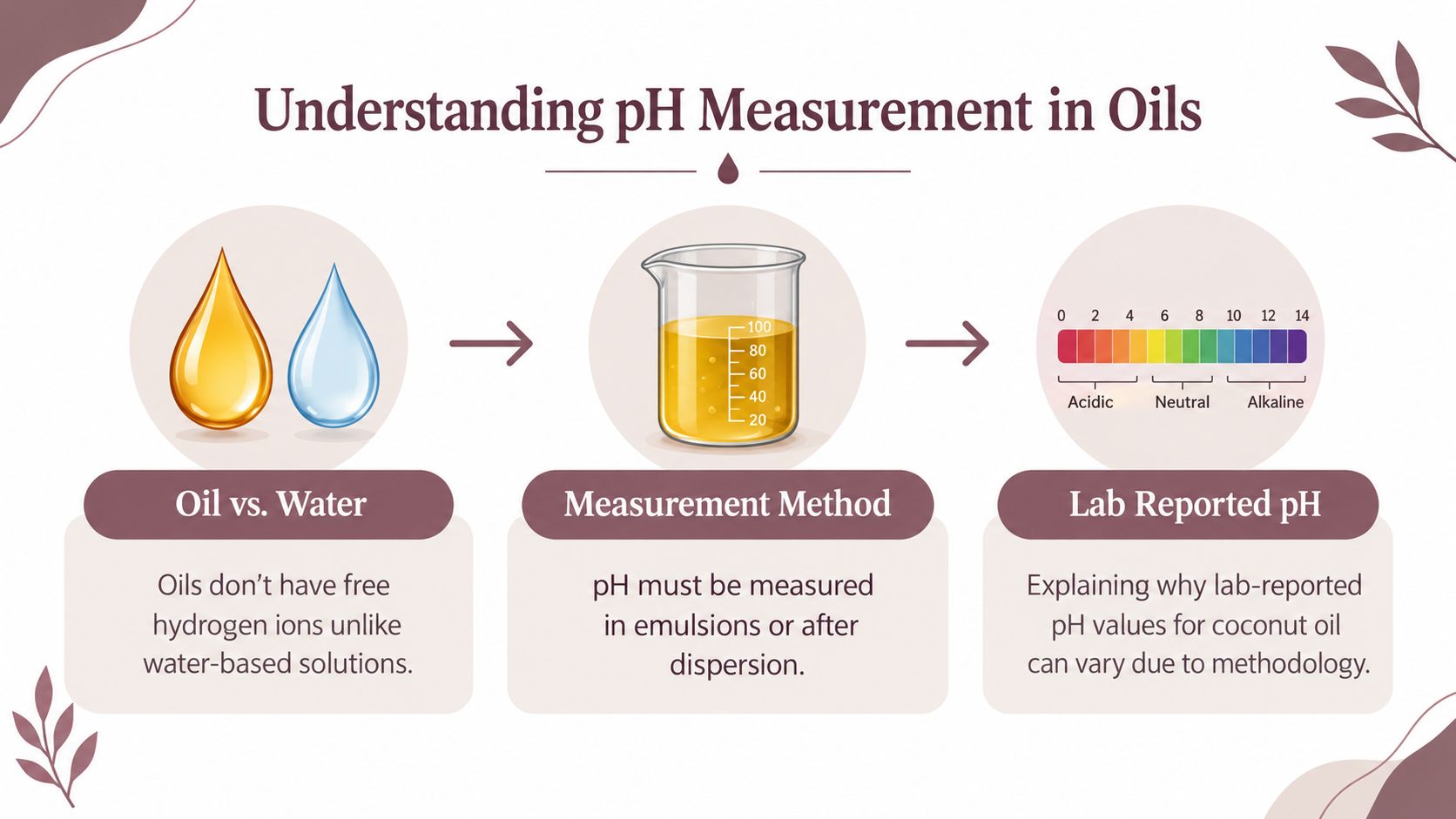
pH is designed for water-based environments. It describes hydrogen-ion activity in an aqueous solution, which is why pH strips and meters work naturally with water, gels, and liquid formulations. Pure coconut oil is different. It's a non-aqueous substance, so it isn't typically defined by one standardized pH in the same way as water.
A useful analogy is tea. You can discuss the acidity of tea after leaves steep in water because the water carries dissolved ions. If you pour oil over the same leaves, you've created a different testing environment. A laboratory may disperse the oil in water, create an emulsion, or test a processed sample, and each approach can produce a different reading.
Why laboratory values vary
Published analyses illustrate the problem. One 2024 physicochemical study measured coconut oil at pH 4.7 after aqueous heating extraction and pH 5.1 after extraction with n-hexane, showing that the method and sample handling influence the result. The same research reported values across samples that extended from 4.7 to 5.62, rather than revealing one universal coconut oil pH. (Read the laboratory analysis of coconut oil measurements)
Other characterization work has reported coconut oil values from mildly acidic to near-neutral, including measurements of 5.12 to 5.62 for biodiesel-related samples and 5.43 to 6.51 for oil derived from fresh and waste coconut pulp. Those results don't mean every jar on a store shelf will have the same reading. They show why a product label that says “pH-balanced coconut oil” needs context about the testing system.
What to check instead
For raw oil, acid value and peroxide value often provide more useful information about quality and stability than consumer-style pH. Acid value helps indicate the presence of free fatty acids, while peroxide value helps assess oxidation.
That distinction matters if you're comparing a kitchen oil with a finished balm or intimate formula. A product such as Soothe & Restore Salve combines coconut and jojoba oils in an organic balm intended for external vulvovaginal dryness, itching, and irritation. That kind of product should be judged by its ingredients, intended application, and formulation testing, not by assigning the raw oil a single pH label.
If irritation or unusual symptoms are present, don't use a pH number to diagnose yourself. A guide to testing for a yeast infection at home can help you understand what home testing can and can't tell you, but persistent symptoms still warrant professional evaluation.
Normal Vaginal pH and Microbiome Balance
The vagina isn't meant to be pH-neutral. Medical guidance places normal vaginal acidity at approximately pH 3.8 to 4.5, an environment associated with beneficial microbiota and mucosal protection. (Review the medical guidance on vaginal pH and microbiota)
Think of the vaginal environment as a garden. The soil's chemistry helps determine which plants thrive. In the vagina, naturally occurring bacteria, including lactobacilli, contribute to an acidic setting. When that setting shifts, the balance of organisms can change too.
Why acidity matters
A pH result isn't a complete health report, but it can be a useful clue. Changes may occur alongside bacterial vaginosis, irritation, hormonal shifts, sexual activity, menstruation, antibiotic use, or exposure to fragranced cleansers. A person can also have significant discomfort without pH being the only cause, especially when a skin condition, allergy, or hormonal dryness is involved.
That's why “natural” and “acidic” aren't interchangeable ideas. A substance can feel soothing on external skin while being poorly suited to the vaginal canal. The location, amount, contact time, other ingredients, and a person's individual susceptibility all influence the outcome.
Practical rule: Treat vaginal pH as part of an ecosystem, not as a score that one ingredient can guarantee.
People researching probiotics may also benefit from Informed decisions on women's supplements, especially when they're trying to separate general wellness information from products intended to address diagnosed symptoms. For a broader explanation of the subject, see this guide to demystifying vaginal pH.
A product like the Complete Infection Defense Kit combines external and internal support products for concerns including BV, yeast infections, and pH imbalance. It shouldn't replace diagnosis or prescribed treatment, but its intended uses demonstrate an important principle: intimate care often requires separate approaches for external comfort, internal support, and urinary wellness.
Impact of Coconut Oil on Vaginal pH
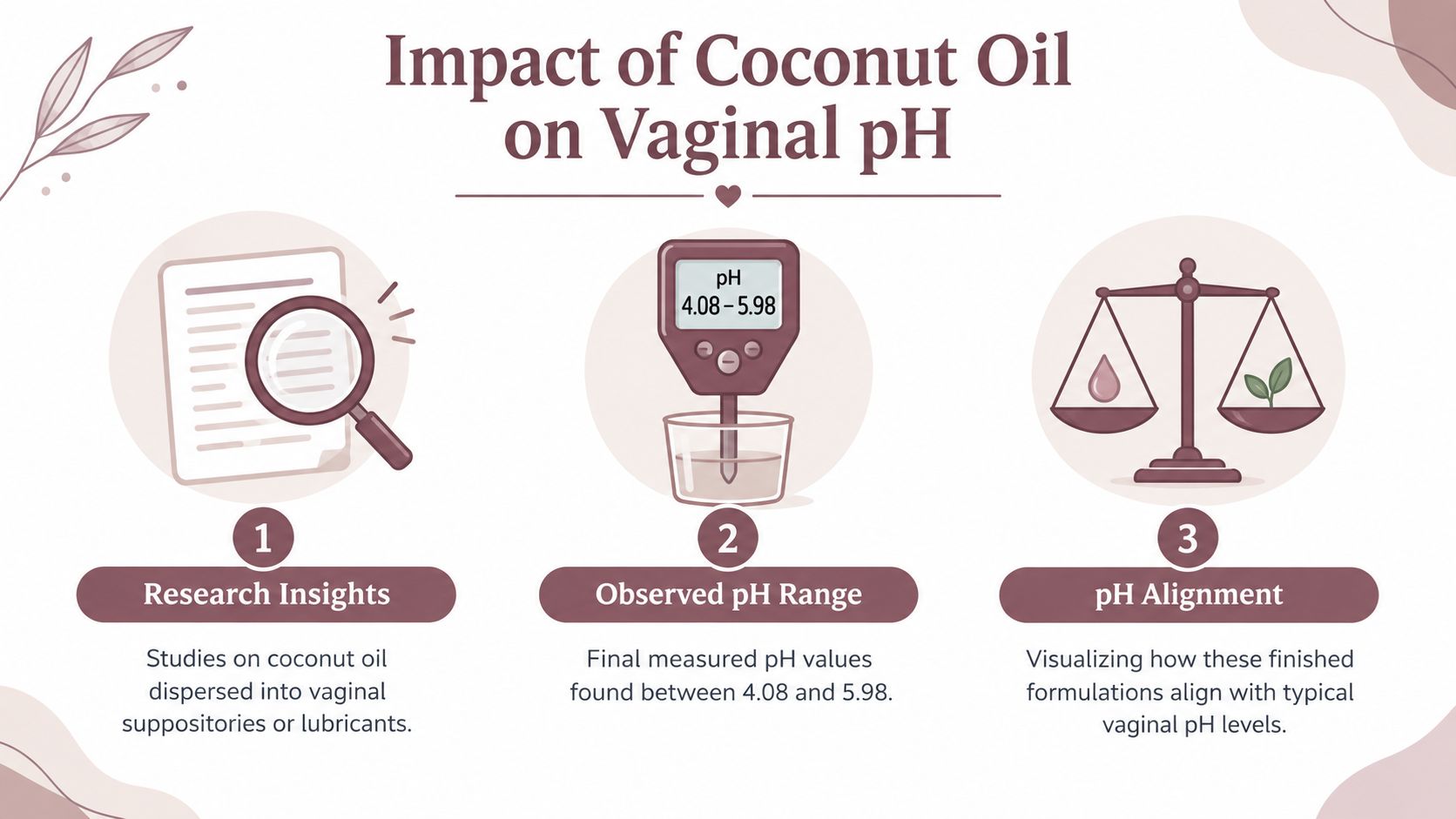
Raw coconut oil tells you only part of the story. The more relevant question is what happens after coconut oil becomes a suppository, lubricant, balm, or emulsion, because water, stabilizers, preservatives, and other ingredients can change the finished product's measurable pH.
One study formulated coconut-oil suppositories with final pH values between 4.08 and 5.98. The reported formulations maintained an acidic environment and overlapped with the commonly cited vaginal range, but the upper end extended beyond that range. (Review the study of coconut-oil physicochemical properties and suppositories)
Why a controlled formulation differs from DIY use
A measured suppository is not the same as scooping oil from a jar and applying it internally. Researchers can control the preparation, disperse ingredients, and test the finished system. Home use usually lacks that control, so the starting oil's extraction history, storage conditions, purity, and contact with vaginal fluid all become variable.
This also explains why personal experiences conflict. One person may report temporary relief from external dryness, while another experiences more residue, irritation, or recurrent symptoms after internal use. Those experiences don't establish that coconut oil reliably treats dryness, BV, or yeast infections. Available reviews describe the in-vivo evidence about coconut oil's effects on genital and urogenital microbiota as limited, and oil-based products may be harder to clean.
External and internal use aren't equivalent
External vulvar skin and internal vaginal tissue have different conditions and needs. An oil applied sparingly to intact external skin may function as a temporary moisture barrier, while internal application introduces a substance into an ecosystem that normally maintains a narrower acidic balance.
Use this decision framework:
- For external dryness: Consider whether the product is designed for vulvar skin and avoid fragranced or irritating additions.
- For internal dryness: Choose a vaginal moisturizer or lubricant formulated and tested for internal use.
- For recurring symptoms: Seek evaluation rather than repeatedly changing oils or home remedies.
- For sex with condoms: Check barrier compatibility before applying any oil-based product.
A pH reading can support product evaluation, but it can't predict your personal response. Stop using a formula if burning, itching, odor, discharge changes, or worsening discomfort appears.
Safety Considerations for Vulvovaginal Use
Coconut oil's most immediate sexual-health warning concerns latex condoms. Coconut oil should not be used with latex condoms because oil can degrade latex and contribute to condom failure. That affects protection against both pregnancy and sexually transmitted infections. (Review guidance on coconut oil, condoms, and microbiota)
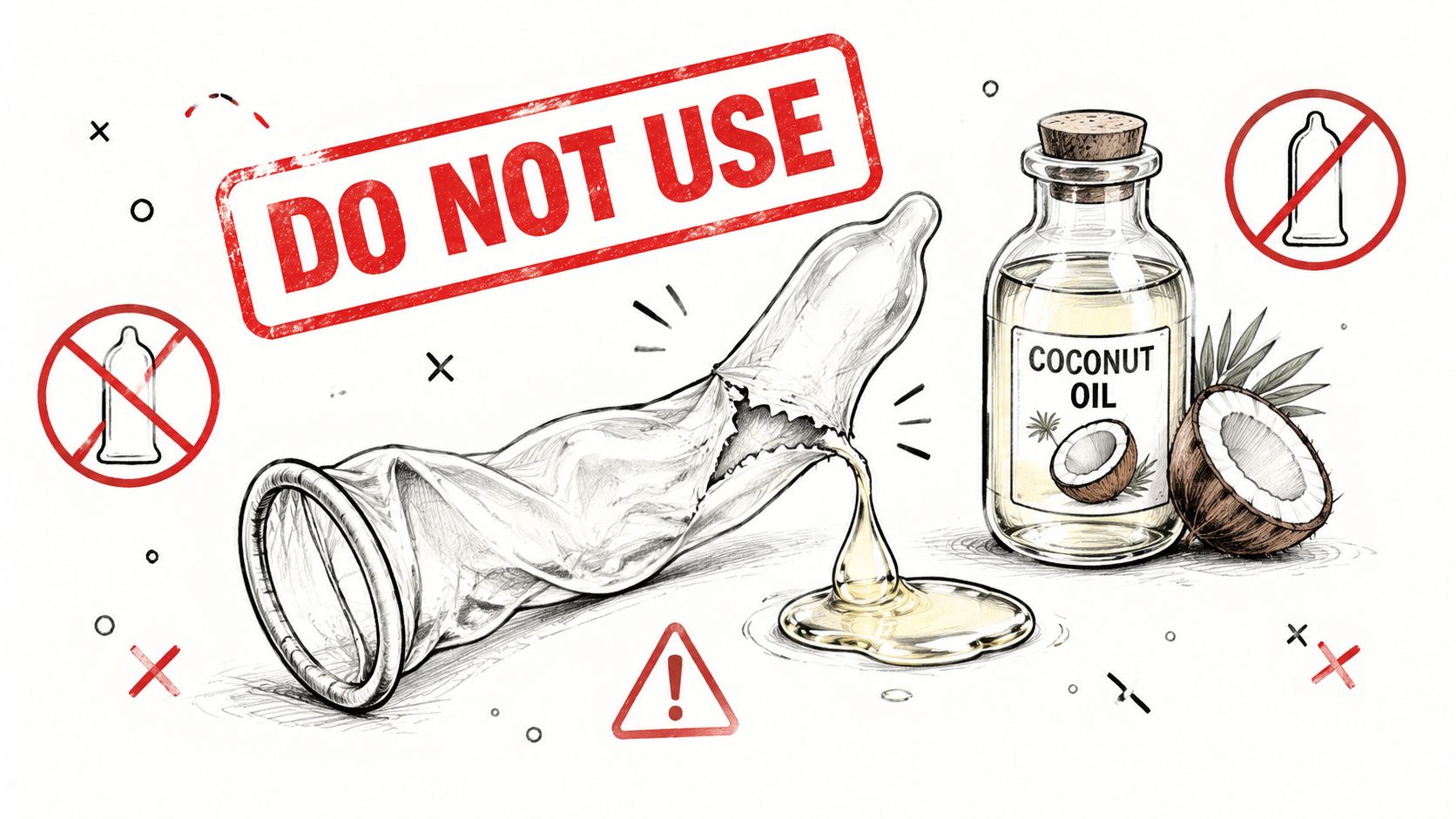
Use a lubricant specifically marked compatible with your barrier method. If you're unsure which material your condom contains, check the manufacturer's instructions instead of assuming that every non-latex option behaves the same way.
What microbiome evidence can and can't tell you
Research on coconut oil and genital microbiota remains limited and mixed. That uncertainty doesn't prove that coconut oil causes an infection in every user, but it does make broad safety claims inappropriate, especially for people prone to BV, yeast recurrence, or irritation.
Oil-based products can also leave a film that's more difficult to rinse away than a water-based gel. Residue, friction, trapped moisture, and an individual's sensitivity may matter more than the oil's label description. Internal use deserves more caution because it places the product directly in the vaginal environment.
A product's quality controls matter too. Manufacturers may monitor acid value, peroxide value, and finished-product pH after emulsification or suspension. Those checks provide more meaningful information than a single pH value copied from an unrelated coconut oil sample.
This resource on pH-balanced vaginal care products can help you think through formulation claims and intended use.
The following video offers additional context for evaluating coconut oil as an intimate product:
A practical safety checklist
Before using coconut oil around the vulva or vagina, ask:
- Where will it go? External vulvar use and internal vaginal use carry different considerations.
- What barrier method is involved? Never pair coconut oil with latex condoms.
- What symptoms already exist? Burning, odor, unusual discharge, sores, or persistent itching need assessment.
- What does the label specify? Look for clear directions, intended body site, and formulation information.
- How does your skin respond? Stop if discomfort increases, even if the product is marketed as gentle or natural.
Alternatives for pH Conscious Formulations
Coconut oil became popular in personal care partly because of its fatty-acid composition. Specifications for virgin organic coconut oil commonly identify lauric acid as a major component, with listed ranges of 40.0% to 52.0% in one pharmaceutical specification, while another characterization reported 60.04%. (Review the virgin organic coconut oil specification)
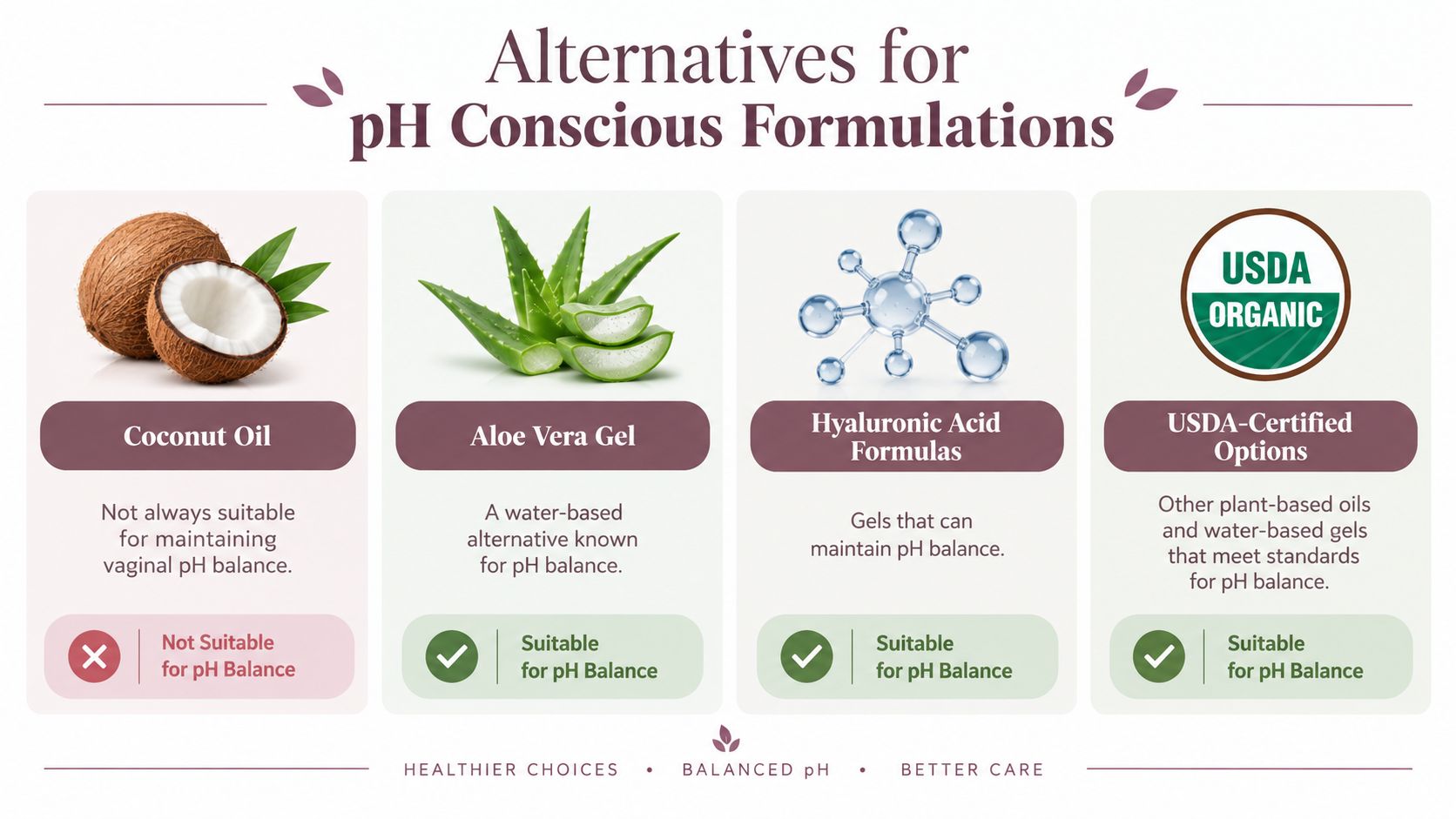
That chemistry helps explain its texture and longstanding use in soaps and personal-care products. It doesn't automatically make coconut oil a pH-conscious vaginal lubricant. Alternatives can be easier to evaluate when they're created as water-based gels, moisturizers, or finished intimate formulas.
Compare the formulation, not just the ingredient
| Option | What to look for | Main consideration |
|---|---|---|
| Coconut oil | Clear external-use directions and simple ingredients | Not automatically suitable for internal pH balance, and not compatible with latex condoms |
| Aloe vera gel | A water-based formula made for intimate use | Check for fragrance, alcohol, and other potential irritants |
| Hyaluronic acid formula | Vaginal moisturizer or lubricant with stated use instructions | Useful when the goal is hydration rather than an oil barrier |
| Water-based lubricant | pH-conscious labeling and barrier compatibility | Often easier to clean and suitable for sexual use when properly formulated |
The phrase “plant-based” doesn't answer questions about pH, osmolality, preservatives, or condom compatibility. Read the full ingredient list and confirm whether the product is intended for external skin, internal vaginal use, or both.
For additional guidance on choosing lubricants for pelvic health, consider how friction, tissue sensitivity, barrier methods, and recurring symptoms affect your choice. Someone seeking occasional lubrication may need a different formula from someone managing persistent dryness.
A balanced formulation should make its intended use clear. If a product doesn't state whether it's internal, external, or condom-compatible, that missing information is itself a reason to choose more carefully.
Conclusion
The phrase coconut oil pH sounds like it should have one simple answer, but coconut oil isn't an aqueous product with one fixed intrinsic pH. Published measurements vary by extraction and testing method, while finished coconut-oil formulations can show different values after dispersion. For intimate health, the formulation and use case matter more than a label claiming that the raw oil is acidic or natural.
Use extra caution with internal application, recurring BV or yeast symptoms, and any sex involving latex condoms. Look for products with clear body-site instructions, finished-product testing, and barrier compatibility. If dryness or irritation keeps returning, ask a healthcare professional to investigate the cause rather than relying on repeated home experiments.
Momotaro Apotheca offers plant-based vulvovaginal care, including externally focused products such as the Soothe & Restore Salve made with coconut and jojoba oils. Explore Momotaro Apotheca to review ingredient information and choose care based on your symptoms, intended use, and pH-conscious needs.


