


Glycerin Free Water Based Lube: What to Know Before You Buy
The most popular advice about glycerin-free water-based lube is incomplete. Removing glycerin can be a reasonable choice if your vulvovaginal tissue reacts to certain formulas, but the label alone doesn't tell you whether a lubricant is comfortable, pH-conscious, or gentle on mucosa. Osmolality, pH, the complete ingredient list, and your own symptoms matter more than a single “free from” claim.
That distinction is practical, not academic. A lubricant can skip glycerin and still contain other highly concentrated humectants or irritating additives. If you've experienced burning, dryness after sex, recurrent irritation, or discomfort with condoms, learning how to read beyond the front label gives you a much better starting point.
Table of Contents
- What a Glycerin Free Water Based Lube Actually Is
- Why Glycerin Shows Up in Lubes and Why People Avoid It
- Osmolality the Number That Matters More Than the Label
- Water Based vs Silicone vs Oil Based Lubricants
- Ingredients to Look For and Ingredients to Skip
- Compatibility With Condoms Toys and Sensitive Conditions
- Choosing and Using Glycerin Free Lube Safely
What a Glycerin Free Water Based Lube Actually Is
A water-based lubricant uses water as its primary carrier. Manufacturers then add ingredients that change the texture, slow evaporation, preserve the product, and help it spread across skin and mucosal tissue. Those supporting ingredients may include humectants, cellulose-based thickeners, pH buffers, preservatives, botanical extracts, or flavoring agents.
“Glycerin-free” means the formula doesn't contain glycerin, also called glycerol. Glycerin is a common humectant, which means it attracts and holds water. It can also add a smooth, slightly sweet quality to a product. Removing it doesn't turn the lubricant into plain water, and it doesn't guarantee that every other ingredient will suit your body.
The basic vocabulary
A few label terms make lubricant shopping less confusing:
- pH describes acidity or alkalinity. A vaginal lubricant should be formulated with vaginal use in mind, especially if your tissue is sensitive.
- Osmolality describes the concentration of dissolved particles in a solution. It helps indicate whether a product may draw water out of epithelial cells.
- Paraben-free refers to a preservative choice. It isn't the same claim as glycerin-free, and neither label tells you the product's osmolality.
- Water-based describes the carrier and texture category. It doesn't describe the full safety profile.
A glycerin-free formula may still contain sorbitol, propylene glycol, polyethylene glycol, or other glycols. These substances can affect the product's concentration and feel, so the complete formula matters. A short ingredient list can make it easier to identify a trigger, but “natural” or “organic” language isn't a substitute for formulation details.
Practical rule: Treat glycerin-free as a useful screening criterion, not a final safety verdict.
For readers comparing everyday moisture support with sexual lubricant, a water based vaginal moisturizer may serve a different purpose than a product designed mainly to reduce friction during intimacy. You can also explore this guide to an organic water-based lubricant for more label-reading context. The practical takeaway is simple: glycerin-free water-based lube is one category inside a much larger group of products, and the missing ingredient tells you very little by itself.
Why Glycerin Shows Up in Lubes and Why People Avoid It
Glycerin appears in many lubricant formulas because it is inexpensive, slightly sweet, and attracts water. That water-attracting quality can make a product feel slippery, although the texture may change as the lubricant absorbs or shifts on the body. Some people like the sensation. Others notice stickiness, dryness, or irritation afterward.
Vaginal epithelial tissue works like a layer of tiny, water-containing sponges. A highly concentrated lubricant can pull water outward from those cells instead of leaving the surrounding tissue comfortable. The review of lubricant safety and osmolality explains that hyperosmolal products may draw water from epithelial cells and weaken barrier function, while formulations with lower irritation potential are closer to iso-osmolar conditions.
Why experiences vary
People often start avoiding glycerin after noticing a recurring pattern:
- Burning or stinging during application
- Dryness or increased friction after sex
- Irritation in already sensitive vulvar skin
- Discomfort during perimenopause or menopause
- Concern about repeated yeast or bacterial symptoms
Those experiences deserve attention, but glycerin is not automatically the cause. Concentration, the full ingredient list, osmolality, pH, tissue condition, and an underlying infection can all affect comfort. Some people tolerate glycerin without difficulty, while others feel better after removing it.
The phrase “glycerin feeds yeast” is too broad to guide every purchase. A more defensible concern is the product's total osmotic load, especially when several additives may be difficult for sensitive tissue to tolerate. Glycerin-free can remove one possible trigger, but it does not confirm that a lubricant has a suitable osmolality, pH, or overall formula.
The label works more like a screening tool than a verdict. Check glycerin alongside the complete ingredient list and the product's available formulation information.
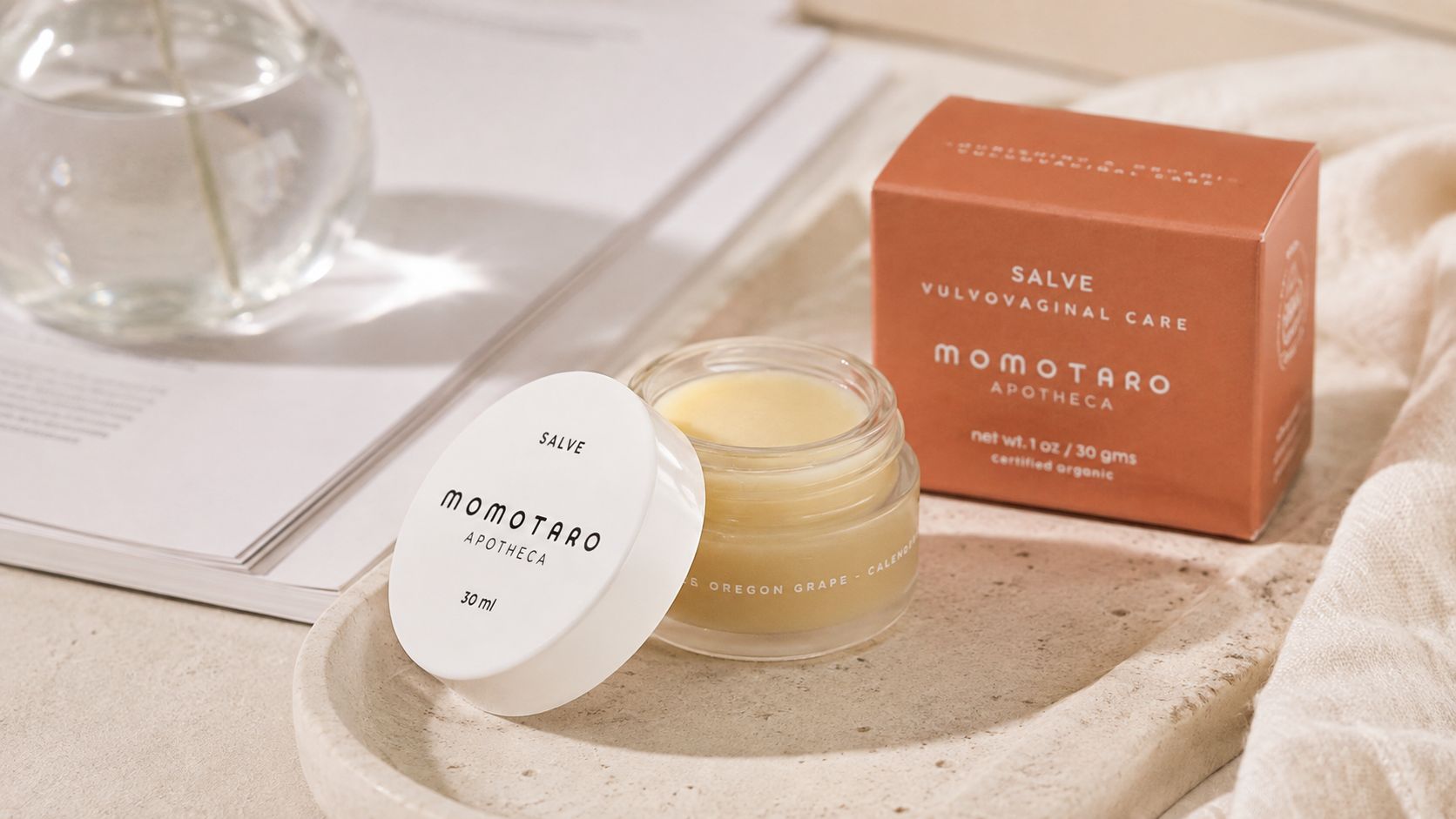
For external dryness or friction, Soothe & Restore Salve is an organic balm described for vulvovaginal dryness, itching, and irritation. It contains coconut and jojoba oils and is intended for external comfort. It should not replace a water-based lubricant or a clinician's evaluation of symptoms that persist.
Osmolality the Number That Matters More Than the Label
Glycerin-free does not automatically mean tissue-friendly. The more useful safety questions concern osmolality, pH, and the complete ingredient list. Glycerin is only one dissolved ingredient, so removing it does not reveal how concentrated the finished lubricant is.
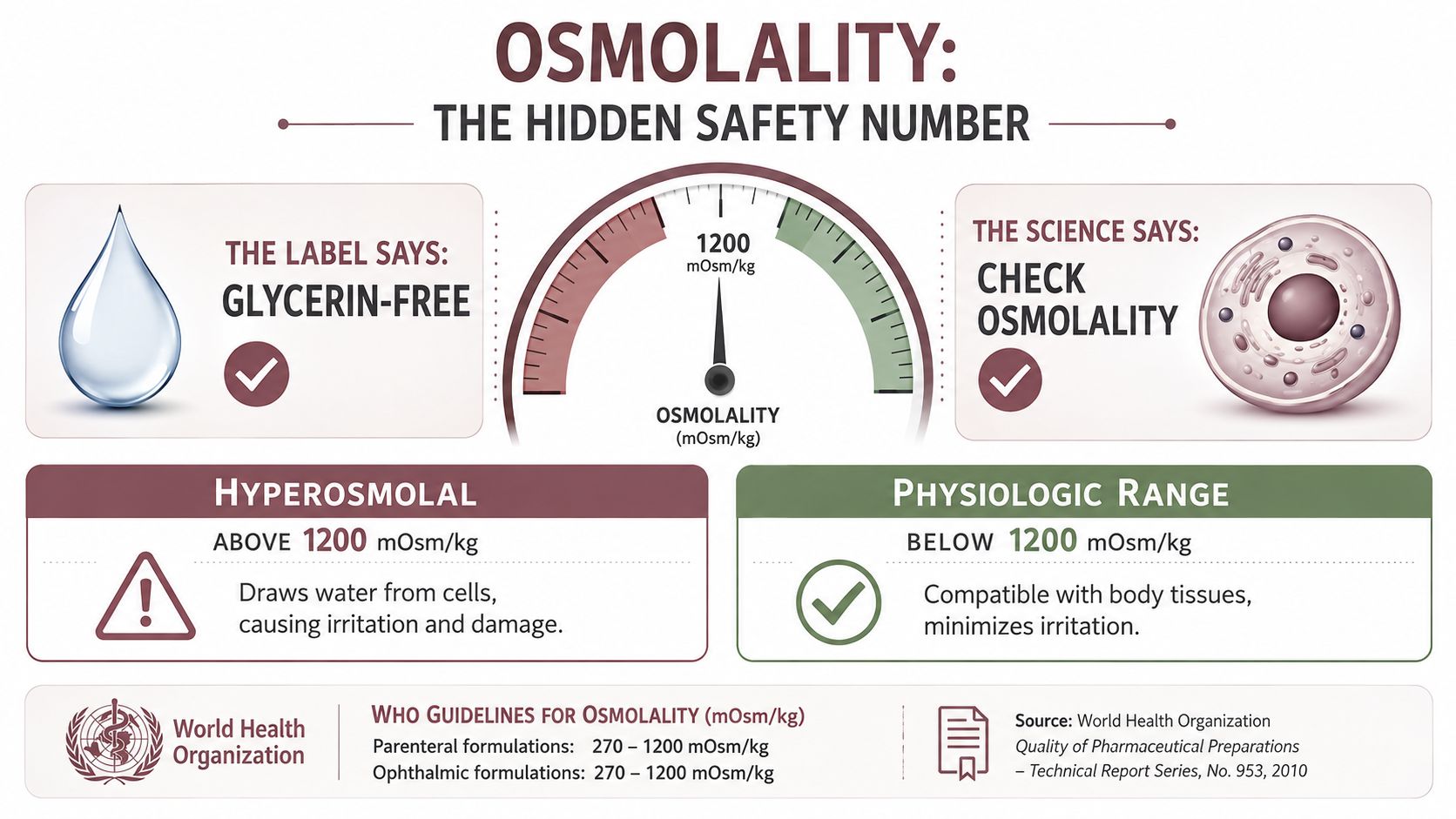
Osmolality measures the concentration of dissolved particles, expressed in mOsm/kg. In everyday terms, it indicates how strongly a lubricant may draw water toward itself. Vaginal fluid is roughly 260 to 320 mOsm/kg, according to a clinical review of lubricant osmolality.
A commonly used practical target for vaginal lubricants is at or below 380 mOsm/kg. WHO-aligned guidance has permitted an upper safety ceiling of 1,200 mOsm/kg (WHO-aligned lubricant safety guidance). Those figures describe different reference points. A product can fall below the WHO ceiling while remaining much more concentrated than vaginal fluid. For sensitive tissue, a formula closer to the body's range may therefore be a more sensible choice.
What high osmolality can do
A strongly hyperosmolal lubricant can draw water out of epithelial cells. The cells shrink, tissue may feel drier or more irritated, and the protective barrier may work less effectively. That can explain a familiar pattern: the product feels slick at first, then burning or extra friction appears later.
The difference between formulas can be substantial. Specialty guidance describes products around 314 mOsm/kg as non-irritating, while formulas ranging from 1,491 to 5,848 mOsm/kg are associated with irritation and adverse effects on mucosal function (specialty lubricant guidance). The same guidance reports that many common water-based lubricants fall within the 2,000 to 6,000 mOsm/kg range. A glycerin-free label cannot show where a product sits.
A randomized trial of lubricants formulated around WHO pH and osmolality guidance reported a good safety profile (randomized trial of WHO-guided lubricants). If a brand does not publish osmolality, ask customer support: “What is the measured osmolality in mOsm/kg, and was it tested for vaginal use?”
The Complete Infection Defense Kit is presented as a broader vulvovaginal wellness collection with topical, bath, probiotic, urinary-support, and suppository products. It is not a lubricant and should not replace diagnosis or treatment for a suspected infection. That distinction keeps a wellness routine separate from choosing a product designed to reduce friction.
Water Based vs Silicone vs Oil Based Lubricants
The right base depends on what you're doing, what you're wearing, and how your tissue responds. A glycerin-free label does not decide the winner by itself. For water-based products, also check osmolality, pH, and the full ingredient list. The base answers a different question: how the lubricant behaves during use.
| Feature | Water-Based (Glycerin-Free) | Silicone-Based | Oil-Based |
|---|---|---|---|
| Feel | Lightweight and often more natural, but may absorb or dry sooner | Very slick and longer lasting | Rich, coating, and persistent |
| Cleanup | Usually washes away easily with water | Often needs soap to remove fully | Can linger and stain fabrics |
| Water use | Can rinse away quickly in the shower or bath | Usually remains slippery in water | Varies, but cleanup can be difficult |
| Latex condoms | Generally compatible when the product label permits use | Generally compatible with latex, but check the product label | Most oils can weaken latex |
| Toy compatibility | Usually the simplest option for silicone toys | May damage some silicone toys over time | Material compatibility varies |
| Main formulation question | Check osmolality, pH, and additives | Check toy and condom compatibility | Check condom material and tissue tolerance |
Match the base to the setting
For everyday partnered sex, water-based lubricant is often the easiest starting point. It works with many condom and toy situations, rinses from skin without a complicated cleanup routine, and offers a lighter texture. If it becomes tacky, adding a little water can sometimes refresh the slip. Burning that returns with repeated use is a reason to stop using that formula, even if it is labeled glycerin-free.
Silicone is useful for shower or bath play and for people who dislike frequent reapplication. It can feel too slick for some users, and silicone toys need closer attention because certain silicone formulas may affect their surface over time. A patch or compatibility check from the manufacturer can prevent an expensive toy mistake.
Oil-based products can feel comfortable on external skin and tend to remain present longer. They are not a safe default with latex condoms, because most oils can weaken latex. Their effect on vaginal tissue and the microbiome also deserves caution, particularly for anyone who already notices irritation or recurrent symptoms.
Water-based lubricants remain widely used. About 52% of global personal lubricant demand is attributed to water-based products, compared with 31% for silicone and 17% for oil, according to modern market reporting summarized alongside clinical evidence (clinical trial and formulation-category context). The same publication describes a randomized trial of five water-based lubricants in which four weeks of use improved Female Sexual Function Index scores by at least four points in more than half of participants in each treatment group. That supports water-based lubricant as a useful category, not every formula within it. A product still needs to meet your body's needs for pH, osmolality, ingredients, and material compatibility.
Ingredients to Look For and Ingredients to Skip
Start with the back label, not the color, flavor, or “sensitive” badge on the front. A glycerin-free water-based lube should ideally provide enough information for you to assess the carrier, thickener, buffering system, preservatives, and sensory additives.
More reassuring label features
Look for:
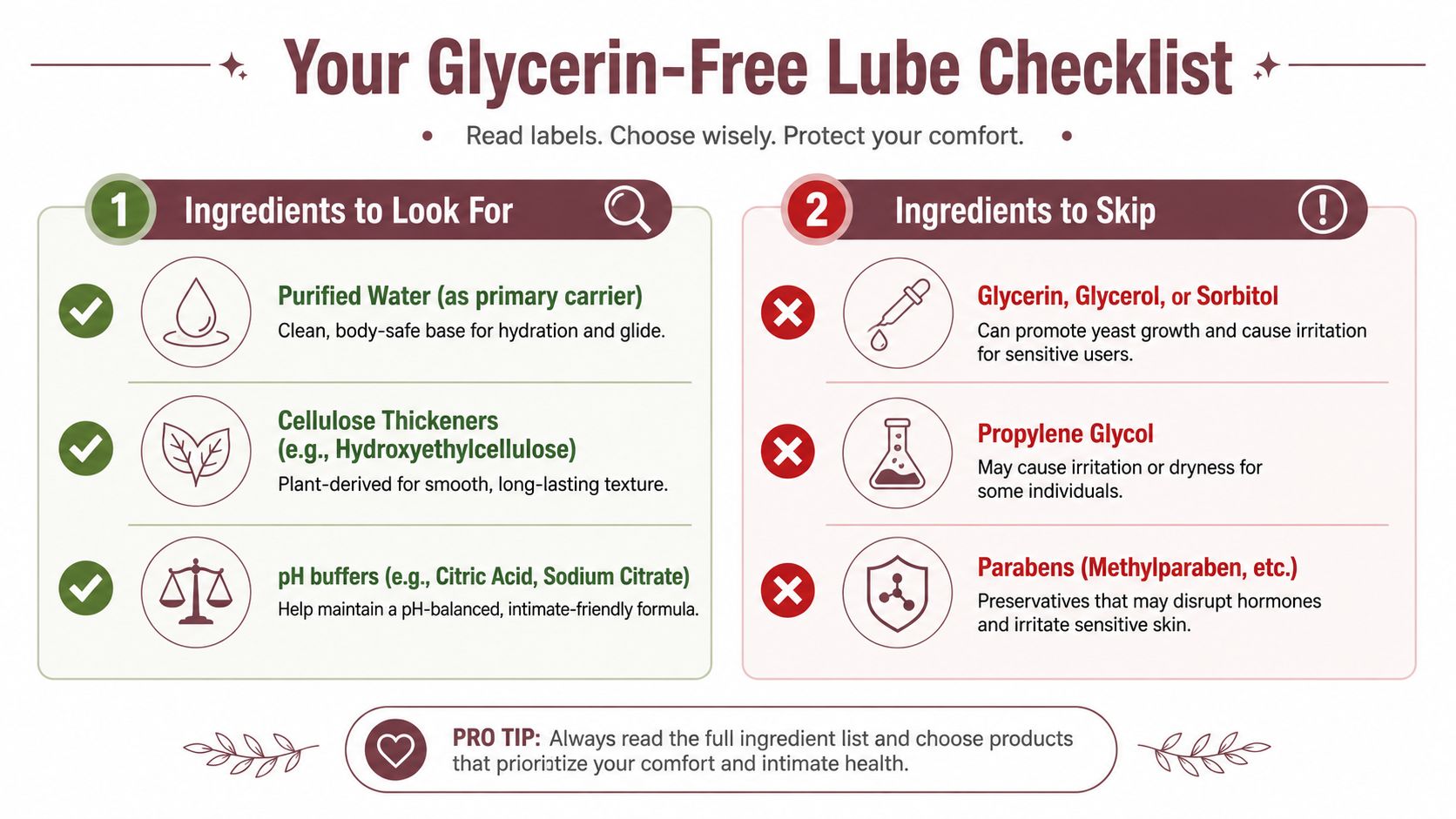
- Purified water near the beginning: This confirms the product is built around a water-based carrier.
- Cellulose thickeners: Hydroxyethylcellulose and hydroxypropyl cellulose can create slip without relying entirely on concentrated glycols.
- pH buffers: Citric acid and sodium citrate can help a formula maintain its intended acidity.
- A short ingredient list: Fewer ingredients can make it easier to identify what your tissue dislikes.
- Minimal fragrance or flavoring: Scent and flavor are optional features, not comfort requirements.
The formulation guidance on water-based lubricants identifies glycols as major contributors to osmolality and describes cellulose polymers plus pH buffers as practical tools for creating glide without adding as much osmotic stress (formulation guidance on lubricant osmolality).
Ingredients that deserve caution
If you're prone to irritation, consider avoiding:
- Glycerin, glycerol, or sorbitol: These may increase the formula's humectant and osmotic load.
- Propylene glycol and polyethylene glycol: These are glycols that can contribute to concentration and may bother reactive skin.
- Strong fragrance, flavor, warming, or tingling ingredients: Menthol, capsaicin, and similar additives can create sensations that feel like burning.
- Chlorhexidine and nonoxynol-9: These can be harsh for mucosal tissue and shouldn't be treated as routine lubricant ingredients.
- Parabens: Some people prefer to avoid them because of contact sensitivity concerns, though paraben-free doesn't automatically mean low-osmolality.
- Petroleum derivatives: These can be difficult to wash away and are not a good default with latex condoms.
The evidence base for over-the-counter vaginal lubricants remains limited, and reviews have raised preclinical concerns about several excipients while emphasizing that definitive human data are still lacking (review of vaginal lubricant safety). That uncertainty makes transparent testing, conservative ingredient choices, and attention to symptoms more useful than marketing language. You can also compare approaches in this guide to the best lubricant for sensitive skin.
Compatibility With Condoms Toys and Sensitive Conditions
Read the condom package and lubricant label together. Water-based lubricants are generally the most flexible choice with condoms, while pure silicone lubricants are commonly compatible with latex when the product instructions allow it. Oil-based products can weaken latex, so avoid treating coconut, jojoba, mineral, or other oils as condom-safe without clear material-specific guidance.
Polyisoprene and polyurethane condoms follow different compatibility rules from latex. If you use one of these materials, check the manufacturer's instructions rather than assuming that every lubricant base behaves the same way. The lubricant itself may be compatible while an added ingredient creates a separate irritation concern.
Toys need their own check
Silicone-based lubricant can interact with silicone toys and may degrade the toy's surface over time. Use a glycerin-free water-based lubricant with silicone toys, or place a condom over the toy if you need a barrier. For other toy materials, follow the toy manufacturer's care instructions, especially if the surface is porous or has a soft coating.
Silicone can be a strong practical option for water play because it stays slick when water would quickly rinse away a water-based formula. A hybrid product may offer a different balance, but hybrid formulas still require ingredient and material-compatibility checks.
Sensitive tissue needs a slower approach
Perimenopause and menopause can make friction more noticeable, so longer-lasting glide may matter more than a lightweight feel. Recurrent yeast or bacterial symptoms call for a pH-conscious, low-osmolality formula, but lubricant changes don't diagnose or treat an infection. Vulvar dermatitis, pelvic pain, and post-surgical healing deserve individualized advice from a qualified clinician.
Start with a small amount and stop if it burns. Water-based formulas often need replenishing during a longer session, but don't follow a rigid reapplication schedule if your body is signaling irritation. Afterward, rinse gently with water if you want to remove residue. Douching isn't necessary and can add another source of disruption.
Choosing and Using Glycerin Free Lube Safely
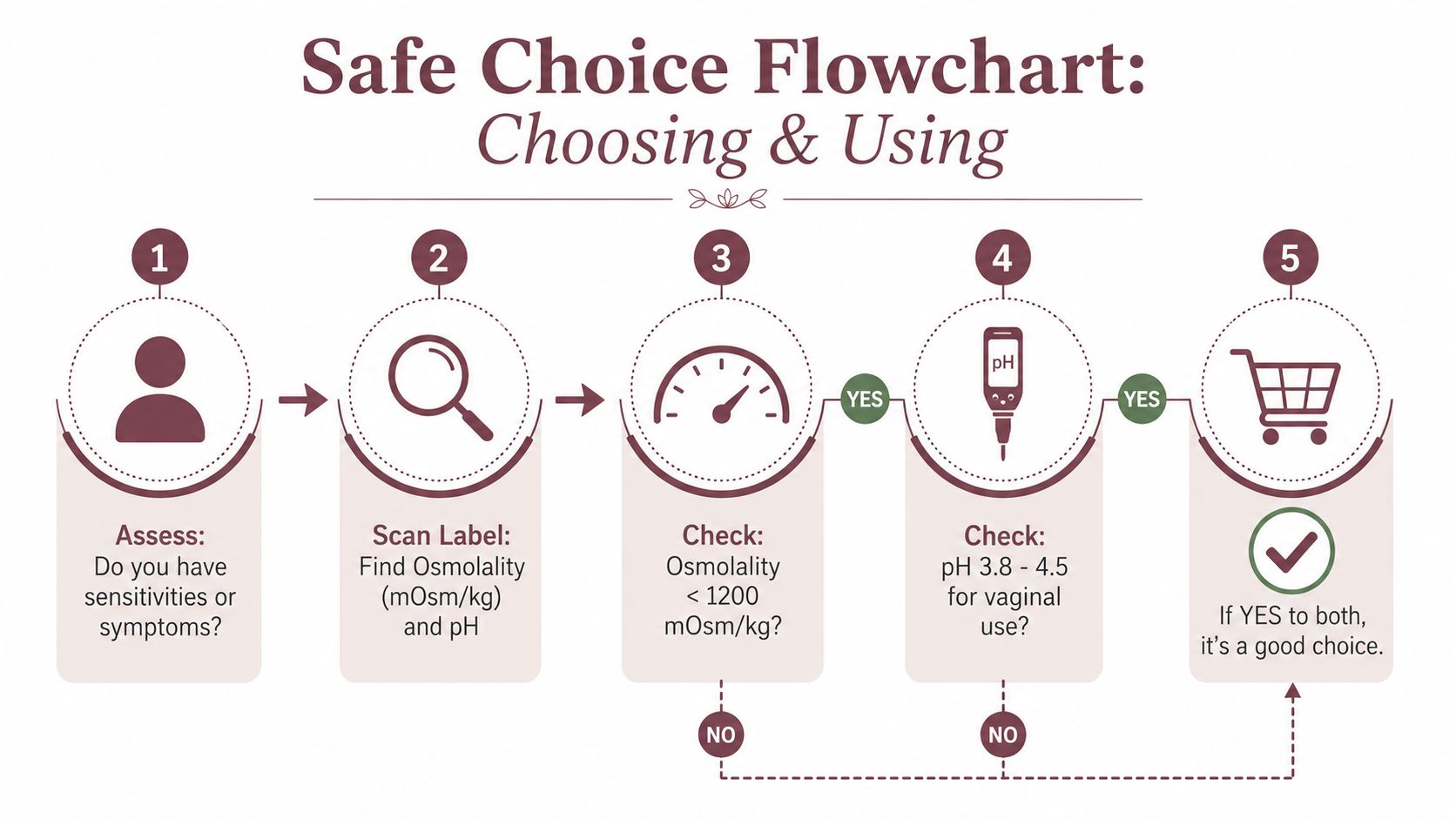
A glycerin-free label can narrow your search, but it cannot tell you whether a lubricant will suit your body. Start by identifying the intended use, such as routine friction reduction, external dryness, shower use, or toy play. Then check osmolality, pH, the complete ingredient list, and condom or toy compatibility.
For vaginal use, guidance commonly favors osmolality at or below 380 mOsm/kg, while WHO materials allow up to 1,200 mOsm/kg as an upper safety ceiling, as noted earlier. Vaginal pH is generally described as roughly 3.8 to 4.5. These figures help you ask better questions, not guarantee that a formula will feel comfortable for you.
A cautious first-use plan
Choose the smallest available container when possible. Test a little on intact skin on your inner forearm first. If that goes well, you can try a tiny amount on the external vulva. This cannot predict internal tolerance, but it reduces the risk of buying a large bottle that immediately irritates you.
During sex or play, add lubricant gradually. If a water-based formula becomes tacky, a little water may restore its slip. Burning is a signal to stop, not a reason to keep layering product. Close the bottle securely, store it away from heat, and follow its expiration and storage instructions.
Stop using it and seek clinical advice for persistent burning, unusual discharge, repeated yeast or bacterial symptoms, bleeding after intercourse, or pain that doesn't resolve with more lubrication. These symptoms may reflect irritation or another condition that needs assessment. For practical application ideas, read this guide on how to use lube.
Use this shopping checklist:
- Glycerin-free is only the beginning.
- Ask for measured osmolality.
- Look for vaginal-use pH information.
- Choose the shortest tolerable ingredient list.
Momotaro Apotheca offers plant-based vulvovaginal wellness products for concerns such as external dryness, irritation, daily care, after-sex care, and perimenopause. Visit Momotaro Apotheca for its products and educational resources, then choose lubricant separately according to osmolality, pH, compatibility, and your symptoms.


