


How to Soothe Vaginal Irritation: A Real-World Care Guide
It's 9 p.m. You've changed your underwear twice, the itching won't quit, and you've searched “how to soothe vaginal irritation” so many times that every cream now looks like a possible mistake. The instinct is understandable: find one product, apply it generously, and hope the problem disappears overnight.
That approach often misses the underlying issue. Soothing means calming irritated external tissue so the itching, burning, heat, or swelling becomes tolerable. Treating means addressing the cause, which might be friction, contact dermatitis, an infection, hormone-related tissue changes, or another condition. You need both when the problem persists. A balm may protect raw skin, but it won't diagnose an infection. An appropriate treatment may resolve the cause, but inflamed skin still needs gentle care while it heals.
Vulvovaginal irritation is common across life stages. One review found that, one year after menopause, vaginal dryness affected 62% to 67% of women, while itching affected 40%, burning 48%, and dysuria 15%; several years after menopause, dryness reached 85% and dysuria 30% (clinical review). The good news is that a consistent routine usually makes the next flare easier to understand and manage.
Table of Contents
- When Irritation Flares and What You Actually Want Tonight
- Immediate Soothing Steps You Can Do Right Now
- Applying Topical Relief Without Making It Worse
- Ingredient Categories That Help Versus Harsh Ones to Skip
- A Daily Prevention Routine That Stops the Next Flare
- When It Is Not Just Yeast or Simple Irritation
- Your Quick Soothe-and-Prevent Checklist
When Irritation Flares and What You Actually Want Tonight
At 9 p.m., the best first move isn't guessing whether you have yeast, BV, or an allergy. It's stopping the immediate aggravators and calming the tissue enough to think clearly. Remove tight clothing, stop using every scented product in the bathroom, and resist the urge to keep checking the area with your fingers or a washcloth.
A useful distinction is simple:
- Soothing: Cooling the vulva, reducing friction, protecting the skin barrier, and easing discomfort.
- Treating: Using the right medical treatment for an infection, dermatitis, GSM, or another diagnosed condition.
Confusing those jobs creates two common problems. If you soothe without treating an underlying cause, symptoms can drag on. If you treat without protecting irritated tissue, the skin may remain sore and reactive, especially if you keep adding products.
Practical rule: Start with the least irritating routine possible, then decide whether the pattern needs medical evaluation.
Look closely at recent changes. Did you use a new soap, wipe, detergent, lubricant, condom, pad, or razor? Did symptoms begin after sex, exercise, sweating, antibiotics, or a shift in your menstrual cycle? If soap seems involved, this guide on vulvar irritation from soap can help you identify the exposure and remove it.
This guide focuses on the complete process: relief tonight, safer topical application, ingredient choices, daily prevention, and the point where self-care needs to end. Recurrent irritation isn't a personal failure. Once you stop repeating the trigger and identify the underlying cause, it's usually far more manageable.
Immediate Soothing Steps You Can Do Right Now
Follow these steps in order. Don't improvise with a cabinet full of creams.
- Cool the area. Wet a clean, soft washcloth with cool tap water, wring it out, and hold it gently against the vulva for 10 to 15 minutes. Cooling can reduce the sensation of heat and help settle swelling without adding another ingredient.
- Remove trapped moisture and friction. Change into loose cotton underwear, or sleep without underwear if that feels more comfortable. Tight leggings, synthetic fabric, and damp clothing keep rubbing against already sensitive skin.
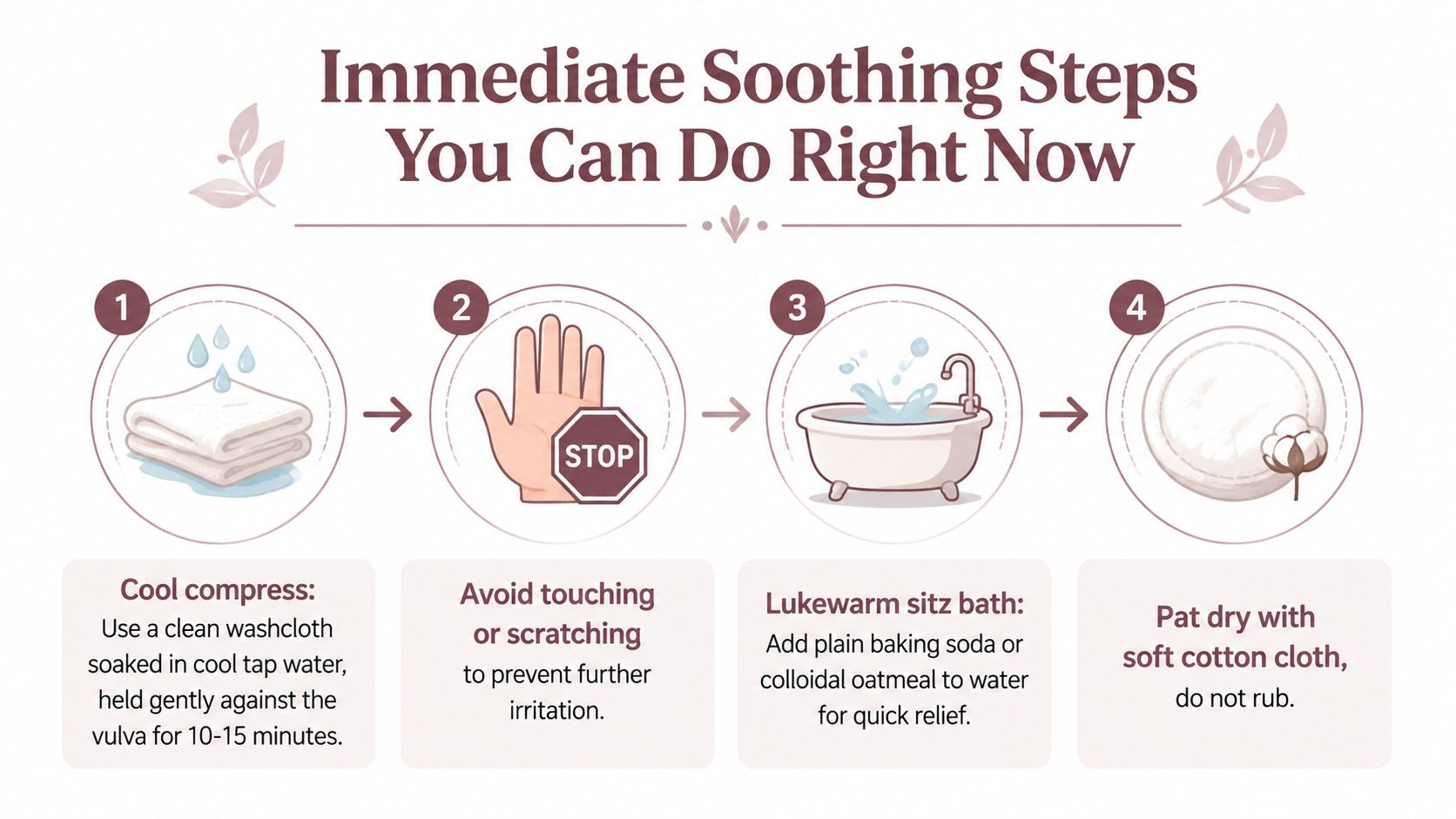
- Keep your hands off. Scratching creates tiny injuries and extends the irritation cycle. After urinating, pat gently rather than wiping aggressively. If the area is extremely tender, a brief rinse can be more comfortable than repeated toilet paper friction.
- Rinse with plain lukewarm water. Let water run over the vulva, but don't scrub, douche, use a washcloth, or apply soap. Cleveland Clinic guidance recommends cleaning the vulva once daily with plain water, avoiding irritants, patting dry, and using a bland emollient when appropriate (vaginitis care guidance).
- Add a simple barrier if skin feels raw. A very thin layer of plain petrolatum or another bland emollient can reduce rubbing. If you prefer a plant-based balm, Soothe & Restore Salve is an organic balm made with coconut and jojoba oil for vulvovaginal dryness, itching, and irritation.
If the flare followed hair removal, avoid shaving again until the skin settles and follow a focused Brazilian laser hair removal aftercare guide for reducing friction and product exposure after treatment. You can also review how to calm razor burn fast. These measures soothe symptoms, but they don't replace diagnosis when discharge, sores, urinary pain, or recurring flares appear.
Applying Topical Relief Without Making It Worse
The application technique matters as much as the product. Wash your hands, use a pea-size amount, and apply it with a clean fingertip. More product won't heal irritated skin faster. It can trap moisture, increase residue, and make it harder to tell whether your symptoms are improving.
Apply soothing products to the external vulva, including the labia and surrounding skin, unless the product is specifically an intravaginal suppository or a cream prescribed for internal use. Don't place a general-purpose balm inside the vagina. Pat it onto the skin instead of rubbing, then wait briefly before dressing so the product doesn't immediately transfer to underwear.
Avoid the small habits that contaminate or overwhelm sensitive tissue:
- Don't double-dip. Use a clean fingertip each time you reach into a jar.
- Don't layer several new products. If you react, you won't know which ingredient caused it.
- Don't share products. Personal topical products should remain personal.
- Don't cover cracked or open skin casually. Broken skin needs clinician guidance, particularly when pain or bleeding is present.
For a smaller introduction to a topical balm, the Salve Sampler Packet is a sample-size version of the salve. Whichever product you choose, check the full ingredient list first. Plain emollients, carefully formulated humectants, and pH-conscious products are generally more sensible starting points than heavily scented or complex formulas.
Postpartum tissue needs extra patience, especially when there are stitches, tears, or tenderness. A practical healing after birth guide can help you distinguish ordinary recovery care from symptoms that need your maternity clinician.
Ingredient Categories That Help Versus Harsh Ones to Skip
Vulvar tissue doesn't need a long ingredient list to feel cared for. It needs a low-irritant formula that reduces friction and supports the barrier without introducing fragrance, aggressive cleansing agents, or essential oils.
| Ingredient Category | Effect | Examples |
|---|---|---|
| Barrier emollients | Reduce rubbing and protect dry, irritated skin | Petrolatum, dimethicone |
| Humectants | Help attract and hold moisture when properly formulated | Glycerin, hyaluronic acid |
| Barrier-support ingredients | Can provide a gentler cushioning effect | Colloidal oat, allantoin |
| pH-conscious formulas | Better suited to the acidic vaginal environment when designed for that use | Products labeled pH-balanced |
| Fragrance and parfum | May intensify contact irritation and obscure the true cause of a reaction | Fragrance, parfum, masking fragrance |
| Essential oils | “Natural” doesn't mean non-irritating on vulvar tissue | Tea tree, peppermint, citrus oils |
| Harsh cleansing agents | Can strip protective oils and increase dryness | Strong surfactants such as SLS |
| Drying alcohols | May sting and worsen already compromised skin | High-alcohol gels, alcohol-heavy witch hazel |
The practical baseline is fragrance-free, water-based when relevant, and formulated for sensitive external tissue. Don't assume a product is safe because it says “clean,” “botanical,” or “natural.” Essential oils and concentrated plant extracts can still provoke burning.
A pH label helps, but it doesn't rescue an irritating formula. For more context on choosing pH-balanced vaginal care products, focus on the whole formula and where it's meant to be used. Keep the routine boring until your skin is calm.
A Daily Prevention Routine That Stops the Next Flare
Prevention works through repetition, not perfection. The goal is to remove the small, recurring insults that keep the area reactive.
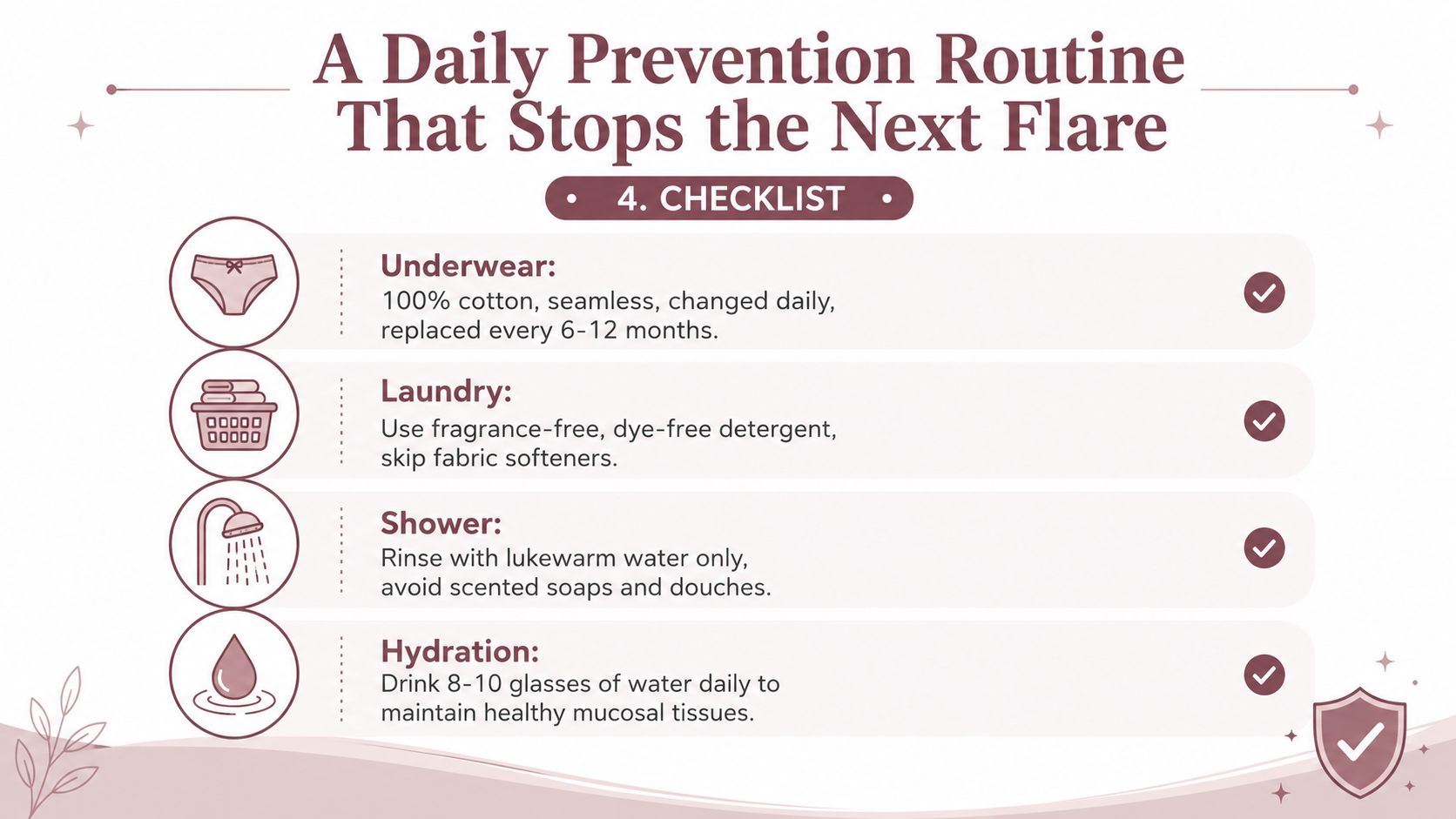
Morning: Put on breathable, 100% cotton underwear with minimal seams, and change it daily. Replace worn underwear regularly rather than continuing to use pairs that have become rough, stretched, or difficult to rinse clean. Loose clothing gives the area more airflow than tight jeans or leggings.
Laundry: Use fragrance-free detergent for underwear and skip fabric softener and dryer sheets. An extra rinse can help remove residue, especially if symptoms started after changing laundry products. Don't wash intimate garments with heavily scented products and assume the rinse cycle will fix everything.
After sweating: Change out of damp workout clothing promptly. Rinse the vulva with lukewarm water if sweat or residue is bothering you, then pat dry. Rubbing with a towel defeats the purpose of a gentle routine.
During and after sex: Use enough water-based, fragrance-free lubricant to reduce friction. If condoms, lubricant, or spermicide repeatedly precede irritation, change one variable at a time and consider a clinician discussion about contact sensitivity. A gentle rinse afterward may remove residue, and urinating after sex is a reasonable habit for people who are prone to urinary discomfort.
At night: Choose loose cotton sleepwear or skip underwear if that's comfortable. Keep hydration steady throughout the day, and include probiotic-rich foods if they already suit your diet. Don't turn prevention into a rigid project. A routine you repeat calmly beats an elaborate routine you abandon after a few days.
When It Is Not Just Yeast or Simple Irritation
Itching is not a diagnosis. Repeatedly treating every flare as yeast can delay the care you need, especially when symptoms keep returning or the visible signs don't match the assumption.
A large review found that postmenopausal vaginal irritation appears alongside broader genitourinary symptoms, including dryness, burning, itching, pain, and urinary discomfort (menopause-related evidence). Another review reported that vaginal dryness affected 27% to 55% of women across reviewed populations, with urinary symptoms reaching 36% (epidemiologic review). Those findings matter because genitourinary syndrome of menopause, or GSM, often looks like infection when the deeper problem is estrogen-related tissue change.
Four causes that deserve a closer look
- GSM: Dryness, burning, irritation, pain with insertion, discomfort during sex, or stinging when wiping can point toward hormone-related tissue changes. Persistent itching after 45 deserves a GSM discussion, not an endless cycle of over-the-counter creams. A clinician may discuss regular vaginal moisturizers or low-dose local estrogen when symptoms are significant, as reflected in updated menopause guidance (GSM treatment guidance).
- Vulvodynia: Burning or pain may continue even when the skin looks relatively normal. The pain can involve nerve sensitivity, pelvic floor tension, or several overlapping factors, so repeated antifungal treatment may not help.
- Contact dermatitis: A rash or irritation pattern that matches a pad, liner, detergent residue, condom, lubricant, wipe, or hair-removal product points toward contact exposure. Stop the suspected trigger and seek evaluation if the rash persists or the skin cracks.
- Microbiome instability: Vaginal discomfort can involve changes in microbial balance without a straightforward Candida infection. Recent literature has examined microbiota instability, the differing roles of lactobacilli, personalized approaches, and the lack of standardized care for vulvodynia (microbiome and vulvovaginal conditions review).
Stop self-care and get checked when
- Fever with pelvic pain: Seek prompt medical care rather than waiting for home care to work.
- Unusual discharge: Thick cottage-cheese-like discharge, green-gray discharge, or strong odor needs an examination and appropriate testing.
- Open sores or splitting skin: Don't cover damaged tissue with multiple products.
- Unexpected bleeding: Bleeding unrelated to your period needs clinical evaluation.
- Severe or disruptive pain: Pain that interrupts sleep or sex should not be managed indefinitely at home.
- Urinary burning persists: Burning with urination lasting more than 24 hours warrants evaluation.
- Symptoms recur within a month: Repeated flares need a diagnosis, not automatic repeat treatment.
- Gentle care fails: No improvement after 3 days of removing irritants and using a simple routine is a reason to call.
- STI exposure is possible: Arrange testing, especially with a new partner or unusual symptoms.
- Postpartum or postmenopausal changes appear: Healing tissue and estrogen-sensitive tissue need specific care.
Scheduling early is usually faster and less expensive than allowing a manageable problem to become severe. Bring the products you've used, note when symptoms began, and describe whether the discomfort is external, internal, urinary, or related to sex.
Your Quick Soothe-and-Prevent Checklist
Save this as your flare-day plan. The sequence matters because it removes aggravation before adding anything topical.
Flare-day actions
- Cool compress: Hold a clean, cool washcloth against the vulva for 10 to 15 minutes.
- Hands off: Don't scratch, scrub, or repeatedly inspect the skin.
- Cotton first: Change into loose, breathable underwear or sleep without it.
- Water only: Rinse with lukewarm water and pat dry.
- Use a thin barrier: Apply a pea-size amount of a bland external emollient if the skin feels raw.
- Pause new products: Stop scented soap, wipes, deodorants, essential oils, and recently introduced formulas.
- Recheck tomorrow: If the irritation isn't easing, or if a red flag appears, contact a clinician.
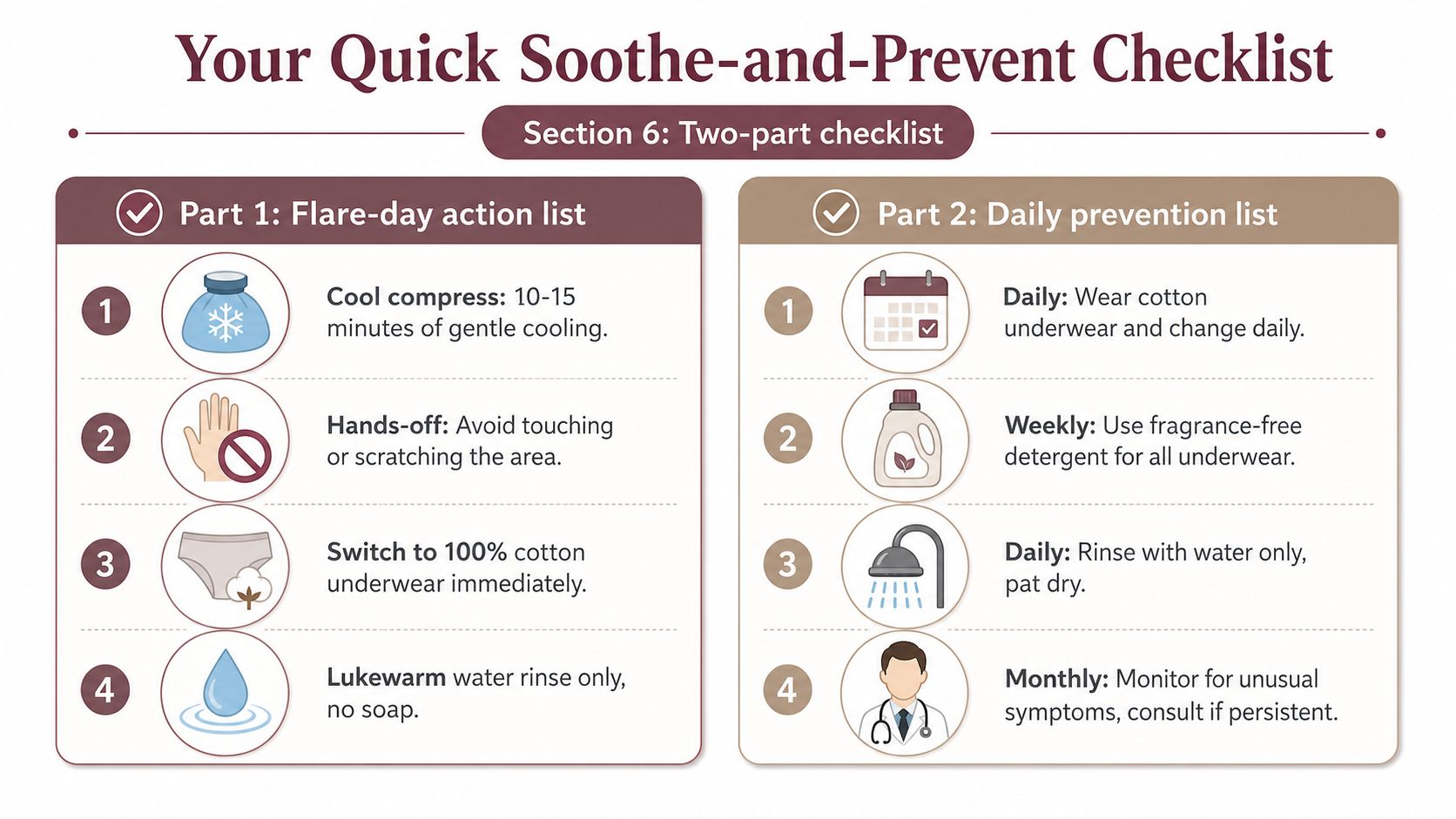
Daily prevention
- Wear breathable underwear: Choose cotton and change it daily.
- Wash thoughtfully: Use fragrance-free detergent and skip fabric softener for intimate garments.
- Rinse after sweat: Change damp clothing and pat the area dry.
- Reduce sexual friction: Use a water-based, fragrance-free lubricant.
- Support your overall routine: Drink fluids regularly and include probiotic-rich foods if they work for you.
- Track patterns: Make a brief monthly note of itching, discharge, urinary symptoms, sex, products, periods, and flare timing.
- Trust the pattern: Persistent or recurring symptoms deserve an appointment.
You don't need to memorize every possible cause. Start with cooling, less friction, fewer ingredients, and a clear limit for self-care. If your symptoms keep returning, become painful, or match any warning sign above, trust your instincts and book the visit.
Momotaro Apotheca offers plant-based vulvovaginal care, including an organic salve for external dryness, itching, and irritation related to everyday friction and other vulvovaginal concerns. Visit Momotaro Apotheca to explore gentle, pH-conscious options and choose a routine that fits your symptoms.


