


How to Treat Chronic Yeast Infections
Buying a stronger over-the-counter antifungal is usually not the answer to chronic yeast symptoms. When itching, burning, discharge, or irritation keeps returning, the first question isn't “Which product should I try next?” It's whether Candida is causing the symptoms at all. Effective care starts with confirmation, then moves to a structured medical plan, with gentle external support and careful trigger tracking alongside it.
Recurrent vulvovaginal candidiasis, often shortened to RVVC, is defined by the CDC as three or more symptomatic episodes within 12 months. That pattern deserves more than repeated guesswork. The practical path is diagnostic-first: identify the condition and species, treat the confirmed infection thoroughly, and use supportive habits that reduce irritation without pretending to replace medical care.
Table of Contents
- Why Your Symptoms Might Not Be Yeast
- The Two-Phase Medical Strategy for Recurrence
- When Standard Antifungals Stop Working
- Supportive Care and Microbiome Restoration
- Identifying and Removing Environmental Triggers
- Tracking Symptoms and Building a Long-Term Plan
Why Your Symptoms Might Not Be Yeast
Itching alone cannot identify a yeast infection. Thick discharge, redness, burning, swelling, and pain during sex can also occur with bacterial vaginosis, trichomoniasis, sexually transmitted infections, dermatitis, lichen sclerosus, and other vulvovaginal conditions. Repeated antifungal use for the wrong condition may delay diagnosis and irritate sensitive tissue further.
Candida may be present without causing disease. The CDC explains that vaginal Candida colonization can occur without symptoms, so a positive finding does not prove that Candida caused every symptom. Diagnosis depends on the examination, symptom pattern, and test results together.
When self-treatment stops making sense
A familiar, occasional episode that was previously diagnosed may be reasonable to discuss with a clinician or pharmacist. Recurring symptoms require a different approach. If an over-the-counter course fails, symptoms return soon after treatment, or the pattern changes, stop treating based on appearance alone and arrange an evaluation.
Assessment may include examination of the vulva and vagina, discharge evaluation, microscopy, and fungal culture. Microscopy commonly examines discharge with saline or 10% potassium hydroxide under approximately 400× magnification, as described in the CDC recurrent vulvovaginal candidiasis guidance. Culture can identify Candida and help distinguish species that may respond differently to standard medication.
Practical rule: Recurrent symptoms call for repeated diagnostic review, not an endless cycle of identical treatments.
Symptoms overlap enough to make self-diagnosis difficult. A practical comparison of yeast infection and BV symptoms can help organize questions for an appointment, but it cannot confirm an infection. Seek prompt care for severe pain, fever, sores, pregnancy-related symptoms, unusual bleeding, a strong new odor, or possible STI exposure.
The same principle applies to other health concerns, including what happens if you drink moldy water: exposure or colonization is not the same as disease, and symptoms need the right context before self-treatment.
The Two-Phase Medical Strategy for Recurrence
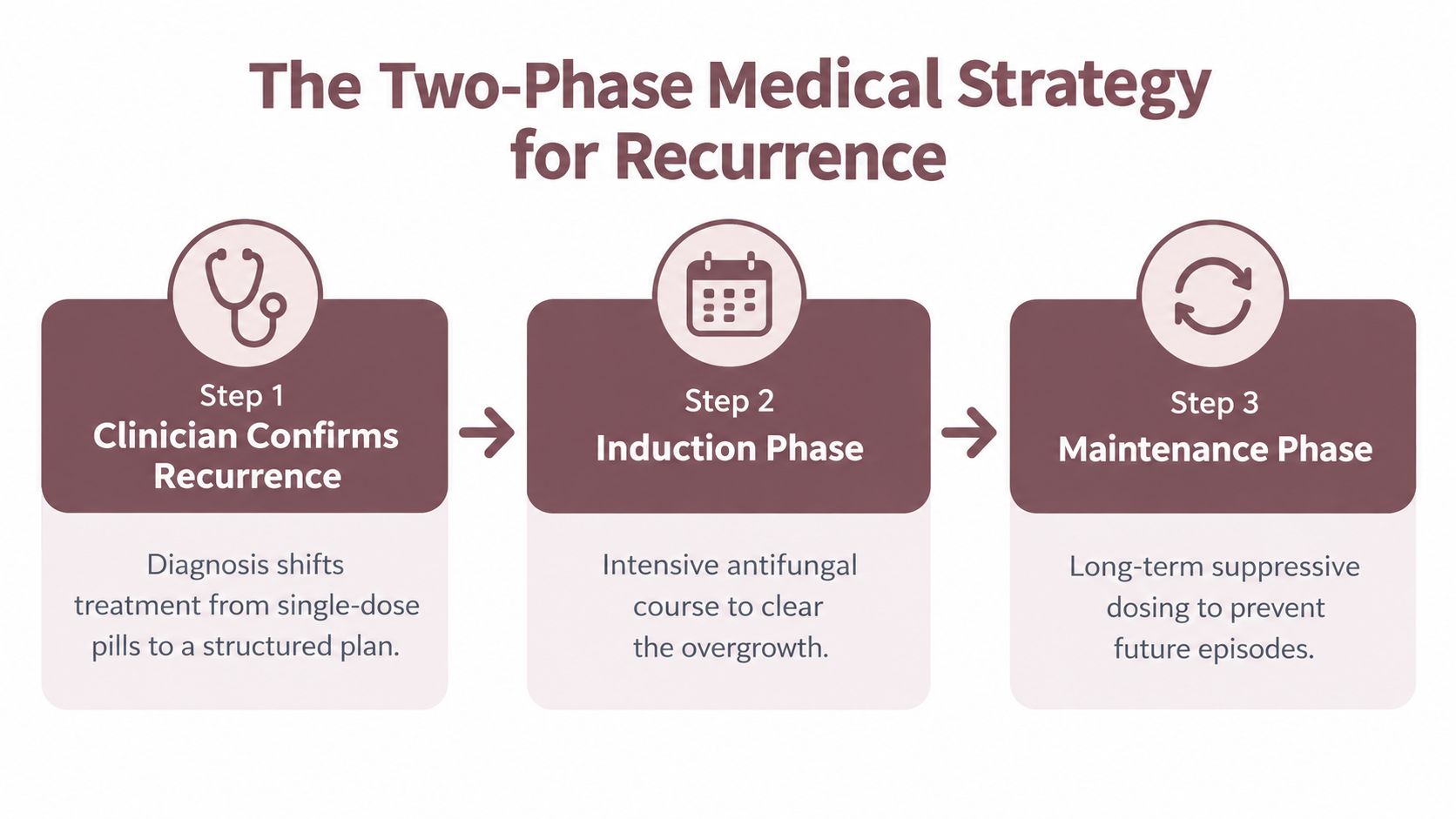
A recurring yeast infection usually needs more than a stronger over-the-counter product. Once a clinician confirms recurrent Candida, treatment generally follows a two-phase strategy: induction to control the active infection, followed by maintenance to reduce symptomatic return. This approach addresses the immediate infection while recognizing that recurrence may reflect an ongoing tendency.
Phase one is induction
For confirmed recurrent infection caused by Candida albicans, the CDC candidiasis treatment guidance describes a longer induction course rather than a single dose. Depending on the clinical situation, treatment may include 7 to 14 days of topical azole therapy or fluconazole on days 1, 4, and 7.
Induction aims to control both symptoms and the infection before suppression begins. A clinician should choose the medication, route, and duration, particularly during pregnancy, with interacting medicines, liver disease, or concern about a non-albicans species.
Topical and oral treatments involve different trade-offs. Topical medication may irritate local tissue and is often preferred during pregnancy. Oral therapy can cause systemic interactions and is not suitable for everyone. The CDC guidance for sexually transmitted infections recommends seven days of intravaginal azole treatment during pregnancy and advises against relying on oral fluconazole in that setting.
Phase two is maintenance
After clinical control, suppressive fluconazole may be prescribed at 100, 150, or 200 mg once weekly for six months, according to the CDC candidiasis guidelines. The IDSA candidiasis guideline identifies fluconazole 150 mg once weekly as a preferred maintenance option after initial control and recommends an azole regimen for at least six months.
Maintenance lowers the chance of symptomatic recurrence during treatment, but it is suppression rather than a guaranteed permanent cure. If symptoms return, repeat treatment should follow reassessment of the diagnosis, species, medication tolerance, and susceptibility rather than automatic repetition.
Prepare for an appointment by recording previous treatments, recurrence dates, pregnancy status, current medicines, and adverse reactions. This guide to preparing for an OB-GYN appointment and questions to ask can help organize that history.
Supportive products such as the Complete Infection Defense Kit can sit alongside prescribed treatment as comfort-focused care, but they do not replace induction, culture, or maintenance. pH-conscious, non-irritating care may improve comfort while the medical plan addresses recurrence.
When Standard Antifungals Stop Working
Treatment failure doesn't always mean you need a stronger version of the same medication. It can mean the organism is different, the organism is resistant, the original diagnosis was incomplete, or the remaining discomfort is coming from irritated tissue rather than active Candida.
Non-albicans Candida, including Candida glabrata, may respond differently to standard azole therapy. The CDC recommends culture or other testing for complicated or persistent cases, while the IDSA advises culture and susceptibility evaluation when symptoms persist and azole-resistant Candida albicans is a concern.
Ask for more than a basic swab
A useful evaluation should answer several questions:
- Is Candida present? A positive result needs to be interpreted alongside symptoms and examination.
- Which species is present? Species identification can reveal non-albicans Candida that may require a different approach.
- Is the organism susceptible to the proposed medication? Susceptibility testing can help when symptoms continue despite appropriate treatment.
- Could another condition be responsible? Bacterial vaginosis, dermatitis, sexually transmitted infections, lichen sclerosus, and pelvic floor pain can mimic or follow an infection.
Microscopy can miss infection, particularly when the organism doesn't produce the forms clinicians typically look for. That makes a negative microscopy result useful but not always definitive when symptoms persist. Ask whether culture with species identification, and susceptibility testing when appropriate, would clarify the next step.
For recurrence after appropriate treatment, the CDC lists clinician-directed vaginal boric acid as one option for some non-albicans cases. The IDSA also discusses boric acid among alternatives for difficult infections. Boric acid must never be swallowed, and it isn't appropriate during pregnancy without direct medical guidance. Don't improvise a dose, insert household products, or use it as a replacement for testing.
A failed treatment is information. It should narrow the questions, not push you into more unstructured self-treatment.
Persistent burning can also continue after the infection has cleared, particularly when the vulvar skin, vaginal opening, or pelvic floor remains reactive. If testing no longer supports active infection, ask your clinician whether irritation, contact dermatitis, nerve sensitivity, or pelvic floor tension could be contributing. Resources on pelvic floor therapy for women can help explain why pain may need a different treatment pathway after an infection.
Here is a short visual explanation of why recurrence needs reassessment rather than automatic retreatment:
Supportive Care and Microbiome Restoration
A stronger antifungal is not always the missing piece. Confirmed infection needs appropriate medical treatment, while irritated external skin often needs separate care. Supportive measures can reduce friction, protect the vulvar barrier, and prevent new products from worsening discomfort. They cannot establish whether Candida remains present.
Soothe the outside without treating the inside
Rinse the external vulva with lukewarm water and pat dry rather than scrubbing. If the skin is dry or chafed, a small amount of a fragrance-free, external-only balm may improve comfort. Keep oils, balms, essential oils, and salves out of the vagina unless a product is specifically designed and labeled for intravaginal use.
“Plant-based” does not guarantee gentleness. Tea tree, botanical extracts, and essential oils may irritate inflamed or broken skin. Test an external product on a less sensitive area first, stop if burning or a rash appears, and seek medical advice before use during pregnancy, breastfeeding, or alongside medication.
A pH-conscious routine excludes douches and perfumed washes. The vagina maintains its internal environment, while the vulva benefits from mild, non-irritating care. Choose comfort measures that support the treatment plan without adding inflammation.
Treat probiotics as support, not a cure
Lactobacillus species are associated with a healthy vaginal environment, and targeted probiotics may support gut and vaginal ecosystem health. They should not delay an examination or prescribed therapy when symptoms recur. The guide to probiotics for vaginal health explains how to assess strain selection and practical use without treating a supplement as diagnostic care.
Labels identify strains and dose, but they cannot promise that a supplement will prevent an individual's recurrences. Keep the routine simple during treatment:
- Clean gently: Wash the external area with water or a mild, fragrance-free cleanser.
- Reduce friction: Choose breathable clothing and pause activities that increase burning while the tissue settles.
- Protect the barrier: Use only an external product whose ingredients you tolerate.
- Review supplements: Discuss probiotics and botanical products with a clinician if you are pregnant, immunocompromised, or taking medication. Log whether a product reduces irritation, but do not treat symptom relief as proof that Candida has cleared.
Supportive care can make treatment easier to tolerate, while testing and medical follow-up determine whether infection requires further treatment.
Identifying and Removing Environmental Triggers
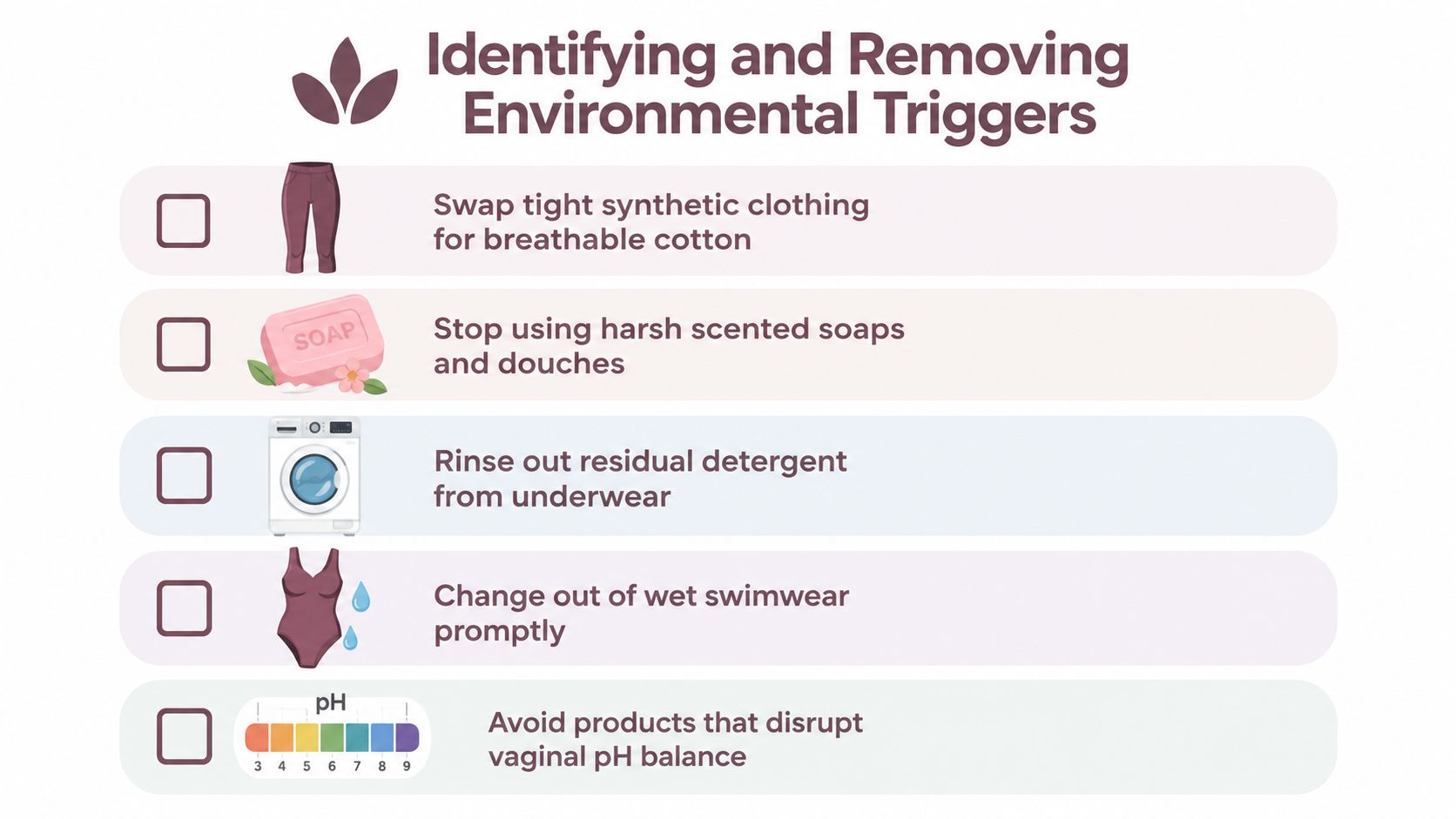
The most useful environmental changes are usually boring, specific, and easy to test. A new scented wash, detergent residue, tight clothing, or prolonged dampness can irritate vulvar skin without causing a yeast infection. Removing those exposures won't cure confirmed Candida, but it can prevent ongoing contact irritation from being mistaken for treatment failure.
Compare the routine, not just the product
| Common exposure | Gentler alternative | Why the swap helps |
|---|---|---|
| Scented wash, bubble bath, or douche | Water or a fragrance-free external cleanser | Removes avoidable fragrance and chemical exposure |
| Tight synthetic underwear or leggings | Looser, breathable clothing | Reduces heat, moisture, and friction |
| Strong detergent or fabric softener | Fragrance-free detergent with thorough rinsing | Limits residue against sensitive skin |
| Sitting in a wet swimsuit | Change into dry clothing promptly | Reduces prolonged dampness and rubbing |
| Deodorizing sprays or scented pads | Unscented menstrual products | Avoids unnecessary fragrance near the vulva |
The vagina shouldn't be deodorized. A change in odor, especially when paired with discharge or irritation, is a reason to seek evaluation rather than cover it with fragrance. Douching can also disturb the local environment and make it harder to interpret symptoms accurately.
Audit contact points
Look beyond the bathroom. Lubricants, condoms, spermicide, shaving products, laundry products, menstrual products, and sexual activity can all create a pattern of external irritation for some people. That doesn't mean any one exposure caused Candida, and it doesn't justify eliminating everything at once. Change one plausible irritant at a time when possible, then record what happens.
Sex doesn't require aggressive cleanup. Urinating afterward may be sensible for urinary comfort, but washing inside the vagina isn't necessary. Use adequate lubrication to reduce friction, stop if burning starts, and rinse the external area gently if semen, lubricant, or another product seems irritating.
A useful audit: If a product smells strongly, tingles, cools, heats, exfoliates, or promises to “detox” the vagina, treat it as a possible irritant until proven otherwise.
Avoid attributing every recurrence to clothing, food, stress, or sex. Track exposures as clues, not verdicts. Medical evaluation remains central because lifestyle changes can reduce irritation while leaving an untreated infection or another condition unaddressed.
Tracking Symptoms and Building a Long-Term Plan
A symptom diary can turn “I keep getting infections” into a timeline your clinician can use. Record the first day of itching, burning, discharge, odor, pain, or swelling, along with the date treatment began and whether testing confirmed Candida. Add menstrual timing, recent antibiotics, pregnancy possibility, sexual activity, lubricant or condom changes, new laundry products, and any product that caused immediate stinging.
Don't use the diary to prove causation. If symptoms appear after sex several times, that pattern is worth discussing, but it doesn't prove sex caused Candida. If symptoms occur around menstruation, record the timing without assuming hormones are the explanation. A careful log helps your clinician decide what needs testing and what may just coincide.
Bring a focused record to the appointment
A clear appointment summary can include:
- Confirmed results: Test type, Candida species, and susceptibility results when available.
- Treatment history: Medication name, route, duration, response, and side effects.
- Recurrence pattern: Dates of symptoms and whether each episode was clinically evaluated.
- Health context: Pregnancy, diabetes, immune conditions, liver disease, and current medications.
- Competing symptoms: Odor, sores, bleeding, urinary pain, pelvic pain, or symptoms that remain after antifungal treatment.
Ask direct questions: “Was Candida confirmed?” “Which species was identified?” “Do I need culture or susceptibility testing?” “Could dermatitis or pelvic floor pain be contributing?” “What should I do if symptoms return during maintenance?” These questions move the conversation from product selection to a plan with checkpoints.
Chronic symptoms can affect intimacy, sleep, confidence, and willingness to seek care. You deserve a clinician who takes the discomfort seriously without assuming every flare is yeast. A sustainable plan combines accurate testing, the appropriate induction and maintenance strategy, sensible review of medications and health conditions, and external care that keeps irritated tissue comfortable.
Momotaro Apotheca offers plant-based, pH-conscious options for external vulvovaginal comfort and probiotic support, intended to complement rather than replace diagnosis and medical treatment. Explore the brand's Momotaro Apotheca resources and products, then bring any routine you're considering to your healthcare professional if symptoms are recurrent, severe, atypical, or persistent.


