


Intimate Wellness Products: How to Choose
Perfumed washes, “detox” pearls, and daily deodorizing sprays are often presented as basic hygiene. They aren't. A healthy vagina cleans itself, and a natural vulvovaginal scent isn't evidence that something needs masking. The more useful question is not, “How do I make this area smell different?” but, “What does my body need right now, and will this product support it without disturbing sensitive tissue?”
That shift matters because intimate wellness products range from external moisturizers and lubricants to ingestible supplements and condition-specific routines. Some can reduce friction or support the vulvar skin barrier. Others may be unnecessary, irritating, or unsuitable for an active infection. Choosing well starts with body literacy, not with the loudest “freshness” claim on a package.
Table of Contents
- Redefining Intimate Care Beyond Basic Hygiene
- Understanding the Core Product Categories
- Decoding Labels for Safety and pH Balance
- Matching Products to Symptoms and Life Stages
- Evaluating Ingestibles and Internal Support
- Navigating Regulation and Knowing When to Seek Care
- Building a Sustainable and Body-Safe Routine
Redefining Intimate Care Beyond Basic Hygiene
The vulva and vagina aren't interchangeable. The vulva is the external anatomy, including the labia and surrounding skin. The vagina is the internal canal, which has its own microbial and chemical environment. That distinction helps explain why an external, fragrance-free balm may be appropriate for dry vulvar skin while a scented wash or internal “cleansing” product can create problems.
The vagina is self-cleaning. Internal douching, perfuming, and aggressive scrubbing can remove protective secretions and disturb the environment the body works to maintain. The external vulvar skin does need gentle care, but gentle usually means warm water, careful drying, breathable clothing, and avoiding products that sting or leave a strong fragrance behind.
Practical rule: A product shouldn't have to create a new scent to prove that it works.
Natural variation is normal. Scent, moisture, discharge, and sensitivity can change with the menstrual cycle, sexual activity, sweating, pregnancy, and hormonal transitions. A familiar baseline matters more than an idealized “fresh” standard created by advertising. If your usual scent changes suddenly, or you notice unusual discharge, pain, persistent burning, or intense itching, masking the symptom isn't the answer. Those changes deserve clinical evaluation.
Comfort is different from treatment
Intimate wellness products can support comfort, moisture, and friction management. They may be useful for external dryness, irritation caused by clothing, or sexual activity that feels uncomfortable. They aren't automatically treatments for yeast infections, bacterial vaginosis, sexually transmitted infections, skin disorders, or urinary infections.
That boundary protects you from a common mistake: using a soothing product to cover a condition that needs diagnosis. A balm might make irritated skin feel calmer while the underlying problem continues. The relief can be real, but it shouldn't be confused with resolving the cause.
A better definition of intimate wellness
Think of intimate care as maintenance of a sensitive ecosystem, not household cleaning. The goal is to protect the vulvar skin, reduce unnecessary friction, preserve a suitable vaginal environment, and respond to changes with the least disruptive option.
This mindset also removes shame from ordinary support. Using lubricant doesn't mean your body is failing. Applying an external moisturizer doesn't mean you're unclean. Seeking care for recurring irritation isn't an overreaction. These are practical ways to listen to tissue that deserves the same attention as any other part of the body.
Understanding the Core Product Categories
A simple skincare analogy can make the product aisle less confusing. A cleanser removes surface residue, a balm supports the outer barrier, an oil reduces friction, and an ingestible is intended to work through the digestive or urinary system. Each format has a different job, so buying a “complete” routine before identifying the concern can lead to unnecessary layering.
Cleansers
For many people, a cleanser has a narrow role. Use it on the external body if you choose one, and look for a short, fragrance-free formula that doesn't leave stinging, tightness, or a coated feeling. Don't use an external wash inside the vagina, and don't assume that foaming or a strong scent indicates better hygiene.
If the vulva feels dry or reactive, plain lukewarm water may be more comfortable than a specialized wash. Pat the area dry rather than rubbing it, especially after bathing or exercise.
Balms and salves
A balm works like a protective ointment for external skin. It can sit on the vulva, reduce friction from underwear or clothing, and help slow moisture loss. This format makes the most sense when the concern is external dryness, chafing, or irritation, not unexplained internal discharge.
The Soothe & Restore Salve is described as an organic balm made with coconut and jojoba oil for vulvovaginal dryness, itching, and irritation. Its stated use is external comfort and moisture-barrier support, so it shouldn't be treated as a substitute for diagnosis or prescribed treatment.
Oils and lubricants
Oils can provide a longer-lasting cushion for external massage or intimacy, but compatibility matters. Oil-based products may not be suitable with some barrier contraceptives, so check the product instructions and the material of any condom you're using. A water-based lubricant is often easier to rinse away and may be a practical choice when you want glide without an oily residue.
For a clearer explanation of how a water-based lubricant fits into intimate care, see this guide to an organic water-based lubricant. Choose based on the activity, the tissue involved, and your sensitivity rather than the word “natural” alone.
Ingestibles and curated kits
Ingestibles include supplements such as cranberry products, probiotics, and D-mannose. Their intended target may be urinary comfort or microbial support, but they aren't interchangeable with topical products. A supplement also shouldn't be judged solely by packaging language such as “detox,” “balance,” or “defense.”
Curated kits can be useful when they group products for a defined routine, such as external comfort plus urinary support. They can also encourage overuse if every symptom leads to multiple new products at once. Start with the simplest format that matches your concern, then add only what has a clear purpose.
Decoding Labels for Safety and pH Balance
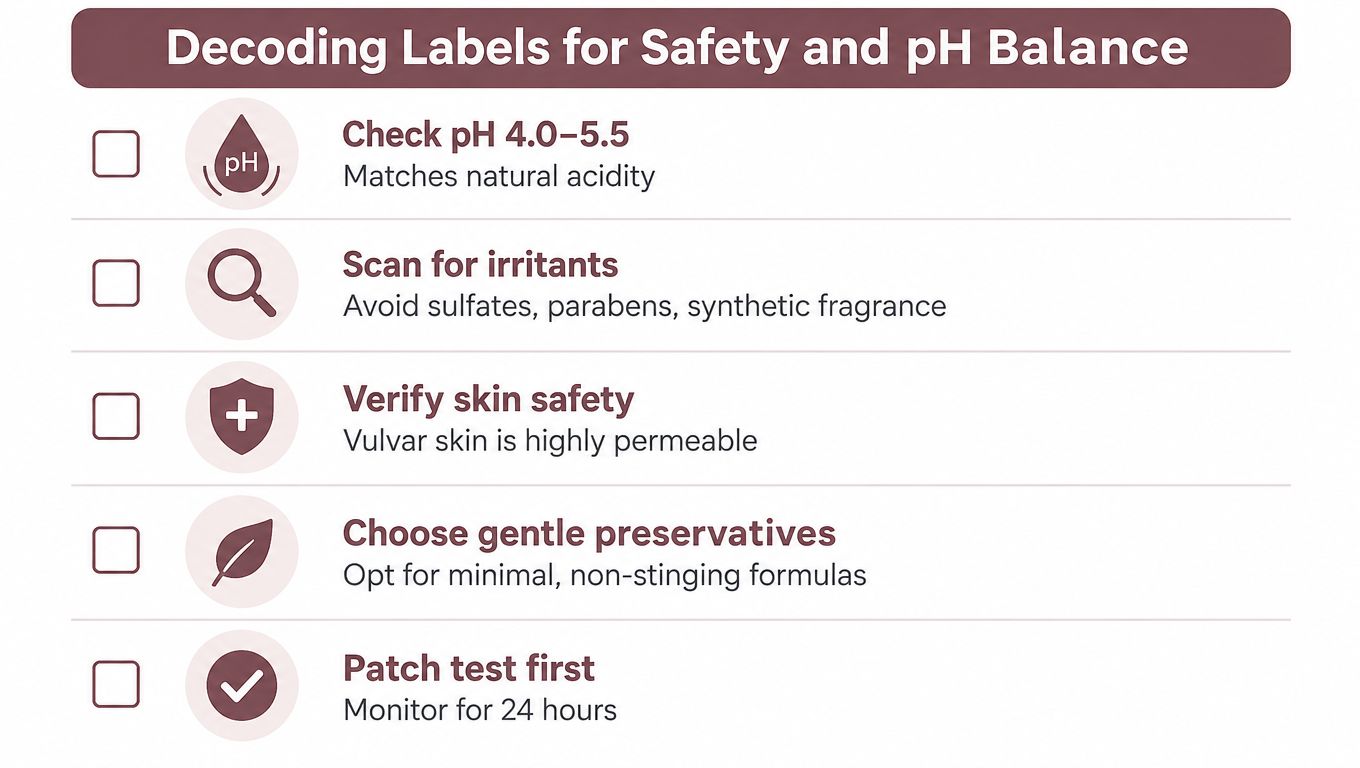
“Natural” and “clean” describe marketing choices, not a complete safety assessment. A plant-derived ingredient can still sting sensitive tissue, while a formula with appealing botanicals may include fragrance or preservatives that do not suit you. Read the full ingredient panel, the intended location of use, and the warnings before choosing anything for the body.
Vulvar tissue is sensitive and relatively permeable, so exposure matters. Fragrance, harsh sulfates, drying alcohols, and ingredients that create heat or tingling can worsen already-irritated skin. Parabens are only one possible label concern. A shorter ingredient list may be easier to assess, but fewer ingredients do not guarantee comfort.
Use pH as a suitability check
The normal vaginal environment is acidic, typically around pH 3.5 to 4.5. In lower-estrogen states such as perimenopause and menopause, vaginal pH can rise into the 5.0 to 7.5 range, making the environment more vulnerable to unwanted colonization. These ranges, along with the role of acidic formulations, are discussed in this evidence review on vulvovaginal moisturizers and vaginal health.
For internal vaginal use, look for a stated pH or a clear explanation of the formulation. Be cautious when a brand says “pH balanced” without explaining the target or location of use. This guide to pH-balanced vaginal care products explains how to evaluate formulation claims by where a product is used. External vulvar skin should not be managed as though it were identical to the vagina.
Osmolality matters for internal moisturizers
pH is one part of suitability. Osmolality describes how strongly a solution draws water toward itself. Evidence reviews prefer vaginal moisturizers with acidic pH and osmolality below the WHO ideal recommendation of 380 mOsm/kg, because highly osmotic products may pull water away from cells instead of providing lasting hydration. The same review explains why maintaining or restoring an acidic environment supports tissue comfort and a lactobacilli-dominant flora.
Make the first application cautious
Patch-test a small amount on an external area first, unless the instructions say otherwise. Introduce only one new product at a time, so a reaction can be linked to a specific formula.
Stop using a product if it causes burning, swelling, worsening itch, or a new rash. “Made for sensitive skin” does not guarantee that a formula suits your body. Your response is useful information, not a failure to use the product correctly.
Matching Products to Symptoms and Life Stages
The same product can feel helpful at one stage and inadequate at another. Hormonal changes can affect moisture, tissue resilience, sensation, and comfort, while postpartum recovery may involve tenderness, healing tissue, pelvic floor changes, or sensitivity to ingredients that previously caused no trouble. A routine should follow the symptom and the anatomy involved, not a generic age label.
During perimenopause and menopause, dryness may involve both the vulvar skin and internal vaginal tissue. An external balm may reduce friction on the vulva, while persistent internal dryness deserves discussion with a qualified clinician. The evidence review linked above notes that lower-estrogen states can also shift vaginal pH, so adding moisture without considering formulation suitability isn't enough.
Postpartum care needs restraint. Healing tissue may tolerate only water and clinician-approved products at first. If pain, pressure, leakage, scar sensitivity, or sexual discomfort continues, a pelvic health assessment can be more useful than adding another topical product.
| Life Stage or Symptom | Primary Concern | Recommended Product Format |
|---|---|---|
| Daily external dryness | Moisture loss or friction on vulvar skin | Fragrance-free external balm |
| Intimacy-related friction | Reduced glide or tenderness during sexual activity | Lubricant selected for tissue and condom compatibility |
| Perimenopause or menopause | Dryness, sensitivity, and possible pH changes | External moisturizer plus clinician guidance for persistent internal symptoms |
| Postpartum recovery | Healing tissue and changing pelvic comfort | Minimal, gentle external care and professional assessment when symptoms persist |
| Recurrent urinary discomfort | Symptoms after intimacy or repeated urinary concerns | Hydration and clinician-guided preventive plan, with supplements evaluated separately |
| Recurrent itch or unusual discharge | Possible infection, dermatitis, or another condition | Diagnosis first, then condition-specific treatment or comfort care |
Build a routine around the trigger
If clothing and sweat trigger external irritation, reduce friction and use a small amount of a suitable barrier product on intact external skin. If sex causes discomfort, address lubrication, pace, and arousal time rather than applying a scented product afterward. If symptoms recur, record when they appear, what you used, and whether the discomfort is external, internal, urinary, or pelvic.
Low desire can also involve pain, hormonal changes, stress, medication, relationship dynamics, or pelvic floor tension. For broader education on non-pharmaceutical approaches, this resource on how to improve low sex drive naturally may help you consider the issue beyond product selection.
Let the routine change with your body
A daily maintenance routine may be intentionally small. You might rinse externally, dry carefully, use a bland moisturizer only when needed, and choose lubricant for intimacy. A symptom-led routine might be different, but recurring symptoms should prompt diagnosis rather than endless experimentation.
The most useful question is, “What problem am I trying to solve?” If you can't answer that in one sentence, pause before buying a kit.
Evaluating Ingestibles and Internal Support
A capsule cannot serve as a reset button for both the urinary and vaginal microbiomes. These systems overlap anatomically, but they have different conditions and needs. Probiotics, cranberry, and D-mannose each have proposed uses, so evidence for urinary support should not automatically become a claim about vaginal comfort.
Probiotic labels should name the strains, explain serving instructions, and make the intended goal clear. “For vaginal health” provides too little information to judge whether a product addresses microbial support, general nutrition, or another purpose. A probiotic also cannot diagnose discharge, burning, pelvic pain, or a suspected infection.
Cranberry and D-mannose aren't equivalent
For recurrent urinary tract infection prevention, the American Urological Association says clinicians should offer cranberry prophylaxis as an option for women with recurrent UTIs. The same guideline advises clinicians to tell patients that D-mannose alone may not be effective. Review the AUA recurrent UTI guideline with a clinician before adding a supplement to a prevention plan.
NICE cites older evidence in which D-mannose at 200 mL of a 1% solution once daily for up to 6 months was associated with fewer recurrences than no treatment, 14.6% versus 60.8%, with an NNT of 3. More recent guidance discusses a high-quality randomized trial involving 598 participants and 2 g per day that found no difference from placebo. The clinical benefit therefore remains uncertain, despite a generally favorable safety profile. Conflicting evidence is a reason to question confident “miracle prevention” language.
Use supplements as one layer
A supplement may fit some prevention plans, but recurring symptoms still need evaluation. Ask a clinician or pharmacist about interactions, pregnancy or breastfeeding, kidney conditions, allergies, and your medical history. Check whether the formula is intended for urinary support, vaginal support, or general nutrition. Those purposes are not interchangeable.
A bladder-support product guide can clarify how one supplement category is positioned for urinary comfort versus vaginal support. Product education remains different from diagnosis. Repeated urinary symptoms call for appropriate testing and medical advice, rather than repeated product changes.
Navigating Regulation and Knowing When to Seek Care
Many feminine hygiene products in the United States are lightly regulated, and some categories are treated as cosmetics rather than medical devices. That means consumers may find limited standardized information about safety or efficacy, as discussed in this research on regulation and safety in feminine hygiene products.
This doesn't mean every non-prescription product is unsafe. It means marketing language can't do the work of ingredient transparency, appropriate labeling, or clinical diagnosis. A product can be useful for comfort while still having no authority to diagnose or treat the cause of a symptom.
Know when comfort care is reasonable
External comfort products may be appropriate for mild, familiar irritation when the skin is intact and you can identify a likely trigger, such as friction or dryness. Use the smallest amount needed, follow the directions, and stop if symptoms worsen.
Seek medical care instead of self-treating when you notice:
- Persistent burning or itching: Ongoing symptoms may reflect infection, dermatitis, hormonal tissue changes, or a skin condition.
- Unusual discharge or odor: A change from your normal baseline needs assessment, especially when accompanied by pain or irritation.
- Severe pelvic or vulvar pain: Significant pain isn't a routine hygiene issue.
- Bleeding, sores, or marked swelling: These signs deserve prompt professional evaluation.
- Recurring symptoms: Repeated episodes warrant clarification of the cause rather than repeated cycles of the same product.
- Urinary warning signs: Painful urination, urgency, fever, back pain, or worsening urinary symptoms need medical attention.
Postpartum and pelvic symptoms need context
After birth, dryness isn't the only possible source of discomfort. Pelvic floor muscle overactivity, scar tissue, pressure, leakage, and changes in sexual sensation can all affect recovery. A guide to pelvic floor therapy for new parents can help explain why specialized assessment may be more useful than layering topical products.
Don't insert a product into healing tissue unless your clinician has said it's appropriate. If you're pregnant, breastfeeding, taking medication, or managing a diagnosed condition, ask a healthcare professional before adding an ingestible or internal product.
Building a Sustainable and Body-Safe Routine
A sustainable routine is usually less crowded than the marketing suggests. Start by identifying your baseline, then separate external skin care from internal symptoms. Use a gentle external cleanser or water if needed, a bland balm for external dryness or friction, and a compatible lubricant when intimacy calls for more glide.
Keep an ingredient record when your skin is reactive. Write down the product, where you applied it, and what happened afterward. This turns trial and error into a clearer personal safety profile and helps a clinician spot patterns if symptoms persist.
The market is expanding beyond sex and menstruation toward dryness, irritation, menopause-related changes, and longer-term comfort needs. A market report on sexual wellness and intimate care trends reflects that broader direction. That shift is useful because people deserve condition-specific education instead of being told that every concern requires the same “feminine hygiene” solution.
For general principles around selecting gentle, transparent body products, you can also explore this guide to ALODERMA organic body care. The same discipline applies here: read the label, respect sensitive skin, and don't confuse organic positioning with proof that a formula suits internal use.
Body literacy grows through observation. Learn what feels normal for you, notice meaningful changes, choose the least disruptive product that addresses the actual concern, and involve a clinician when symptoms cross the line from occasional discomfort to a recurring or unexplained problem.
Momotaro Apotheca offers plant-based balms, oils, ingestibles, and curated routines organized around concerns such as dryness, irritation, urinary discomfort, and life-stage changes. Visit Momotaro Apotheca to review transparent product information and choose an intimate wellness routine that matches your symptoms rather than generic hygiene marketing.


