


Lactic Acid Gels: What They Are and How They Work
Can a product that makes the vagina more acidic support balance without treating the problem causing symptoms? That question matters because lactic acid gels are often marketed as natural cures, while the evidence supports a narrower, more useful description: they're pH-support products that may help with comfort or recurrence-focused routines, but they aren't interchangeable with diagnosis and treatment for bacterial vaginosis.
The distinction is simple but easy to lose. Maintenance or symptom support asks whether lowering vaginal pH may help create conditions associated with a healthier vaginal environment. Stand-alone treatment asks whether the gel can clear an active infection on its own. Those are different claims, and current research doesn't justify treating them as the same.
Table of Contents
- What Lactic Acid Gels Actually Are
- How Vaginal pH and Lactobacilli Set the Stage
- How to Use a Lactic Acid Gel Safely
- What the Evidence Says About Recurrent BV
- Lactic Acid Gels Versus Other pH-Support Products
- Where They Fit in Perimenopause and Postpartum Routines
- Common Misconceptions and Safety Boundaries
- Your Decision Checklist and Next Steps
What Lactic Acid Gels Actually Are
Could changing the vaginal environment help with comfort or recurrence without treating an active infection? A lactic acid gel is a topical vaginal formulation designed to support an acidic environment. It usually combines lactic acid or lactate with a gel that spreads across vaginal tissue and stays in contact with it. In a randomized-trial protocol for recurrent bacterial vaginosis, the formulation was set at pH 4.5, within the lower-pH conditions associated with lactobacillus-dominated vaginal microbiota. The formulation details appear in the randomized-trial protocol on lactic acid gel.
The gel copies one feature of the vaginal environment rather than rebuilding the whole ecosystem. Lactobacillus bacteria produce lactic acid, and a gel can make the surrounding conditions more acidic. It does not add living bacteria, replace a microbiome, or work as an antibiotic.
Support is not the same as treatment
Someone might use a lactic acid gel in a maintenance routine, such as after menstruation, sex, or treatment for a diagnosed episode. The aim is to support a lower-pH environment during periods when discomfort or imbalance tends to return. That is a symptom-support or recurrence-focused use, not proof that the gel can prevent every episode.
Stand-alone treatment requires a broader result: reliably clearing the organisms behind an active condition, resolving symptoms, and reducing related complications. Lactic acid gels have not established that role. Evidence remains mixed, and a review found limited evidence that lactic-acid products cure bacterial vaginosis or reliably reshape the vaginal microbiota, as discussed in this review of lactic acid products for bacterial vaginosis.
How they differ from familiar alternatives
Probiotics provide microorganisms, usually to support the gut or vaginal microbiome. A lactic acid gel supplies an acidic chemical setting instead. Boric acid suppositories also acidify the vagina, but boric acid is a different compound with different safety considerations, so the products are not interchangeable.
Prescription antibiotics target a diagnosed bacterial infection through an antimicrobial mechanism. Lactic acid gels make no equivalent claim. The useful shortcut is simple: the gel changes the setting, while an antibiotic targets the infection. That distinction keeps a supportive product from being mistaken for a complete treatment plan.
How Vaginal pH and Lactobacilli Set the Stage
Could vaginal acidity be the whole story? No. Vaginal pH is one condition within a larger ecosystem, not a health score in which the lowest number is always best. In a lactobacillus-dominated microbiota, an acidic range can make the environment less favorable for some anaerobic bacteria. Clinical literature places that range around pH 3.45 to 4.12, while one recurrent-BV gel protocol was set at pH 4.5. A guide to vaginal pH and a balanced environment explains why pH is useful context rather than a diagnosis.

The ecosystem works like a neighborhood
Lactobacilli are part of the neighborhood's regular population. They use available nutrients and produce lactic acid, helping keep pH low. Some strains also produce substances such as hydrogen peroxide, which may make the surroundings less welcoming to competing organisms.
Estrogen supports the vaginal lining and contributes to glycogen availability in vaginal cells. Lactobacilli can use glycogen-related nutrients to support their activity. The process can be summarized this way:
- Estrogen supports the vaginal epithelium.
- The epithelium provides glycogen-related nutrients.
- Lactobacilli use those resources and produce lactic acid.
- Lactic acid helps maintain an acidic pH.
- The acidic environment can discourage the overgrowth of some anaerobic bacteria.
A lactic acid gel works on one part of this chain. It can add acidity, which may support a more favorable setting during maintenance or symptom-support use. It does not supply the full community of bacteria, repair every change in the vaginal lining, or clear an active infection by itself.
Hormonal shifts, antibiotics, bleeding, and sexual activity can alter the wider ecosystem. An active infection can do so as well. A product such as Daily Probiotic takes a different approach by providing a daily probiotic formulated around gut, immune, and vaginal microbiome support.
Practical rule: Lowering pH may create more favorable conditions, but it does not guarantee that the right bacteria will repopulate or that an infection will disappear.
Sex, menstrual blood, and antibiotics can move the environment away from its usual state, though every shift does not cause BV. Restoring acidity is a precondition for some forms of microbial balance, not proof that balance has already returned.
How to Use a Lactic Acid Gel Safely
Could a gel support comfort without treating the cause of an infection? That distinction should guide every application. Start with the product label or your clinician's instructions. Wash your hands, lie down comfortably, and use the supplied applicator. Fill it only to the labeled dose. A clinician-directed course and a maintenance routine are different plans, so do not copy one into the other.
The recurrent-BV study used 5 mL once daily for 7 days. Because that protocol came from a specific study product, it should not be treated as a universal instruction for every commercial gel. Follow the label or ask a pharmacist or clinician to confirm the amount and schedule.
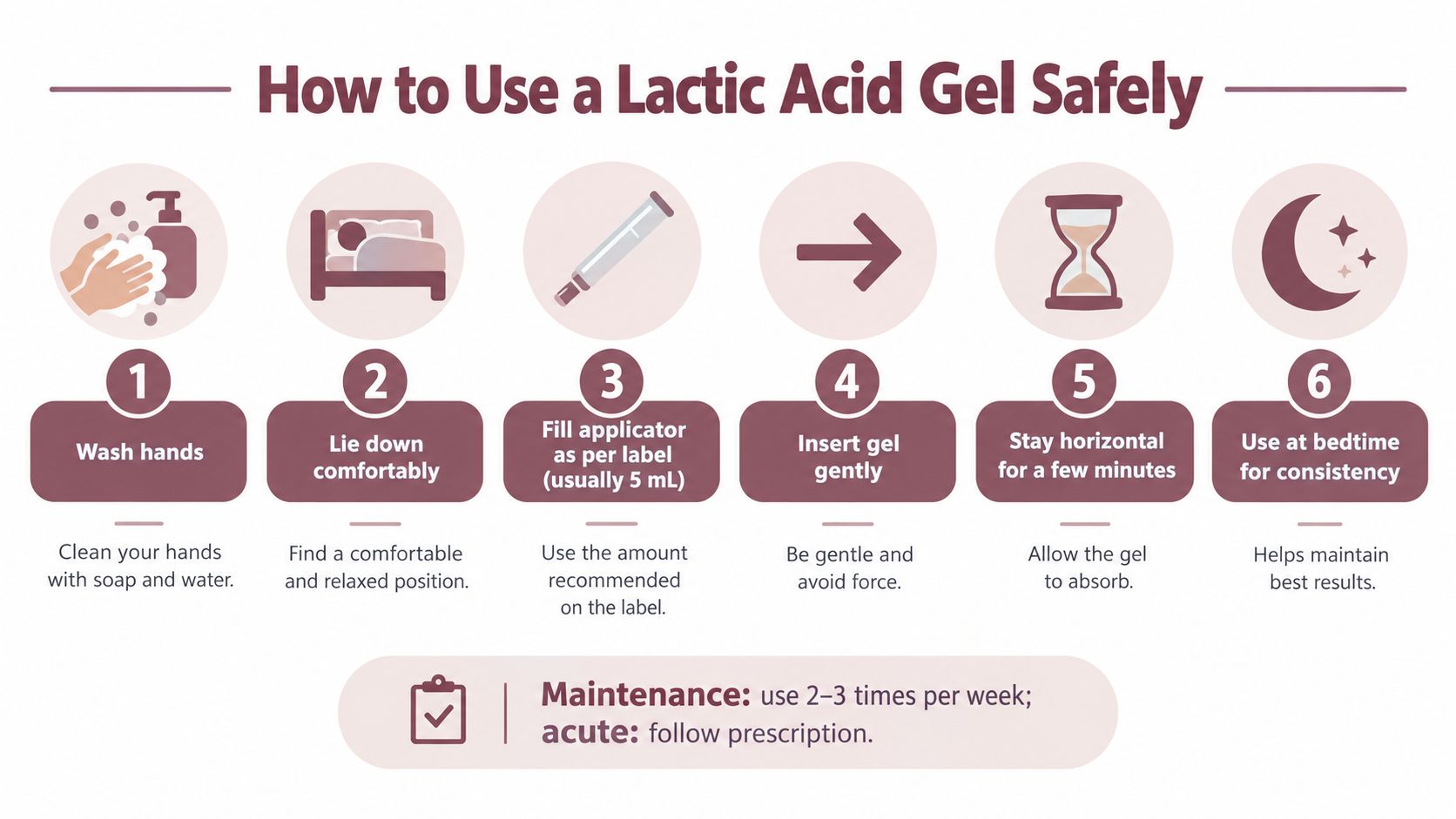
A simple application routine
- Wash your hands: Clean hands reduce the chance of adding irritants or bacteria.
- Lie down comfortably: Bedtime may make application easier and reduce immediate leakage.
- Follow the label: Use the supplied applicator and stated dose. A mild sensation is not a reason to add more.
- Insert gently: Stop if you feel sharp pain or significant resistance.
- Remain horizontal briefly: This can make the routine less messy, though some leakage may still happen.
- Keep the schedule consistent: A clinician-directed treatment course is not the same as occasional maintenance use.
Check the product instructions before using the gel shortly before intercourse. Ask a pharmacist or clinician how it fits with condoms and other vaginal products. During menstrual bleeding, follow the label or medical advice. Blood can change the local environment, and application may feel less comfortable.
Do not combine lactic acid gel with boric acid on the same night unless a clinician specifically directs you to. Do not apply it to broken tissue. Unexplained odor, itching, pain, or discharge deserves evaluation rather than self-treatment with a pH product. A gel may support symptoms or maintenance, but it is not a stand-alone answer to every possible cause.
Some people choose a broader routine, such as the Complete Infection Defense Kit, which includes external care, a probiotic, urinary support, and suppositories. These products have different ingredients and intended uses. Read each label and plan the timing with a clinician or pharmacist instead of layering products because they all sound “flora-friendly.”
What the Evidence Says About Recurrent BV
Can a lactic acid gel support vaginal balance without treating recurrent BV on its own? The evidence points to a useful distinction. Lactic acid gel performed less well than oral metronidazole for short-term symptom resolution in a large randomized comparison. In the VITA trial, about 47% of lactic-acid users reported symptom resolution at two weeks, compared with about 70% of those taking metronidazole. The trial used 5 mL once daily for 7 days, with an adjusted risk difference of minus 23.2 percentage points and a 95% confidence interval from minus 32.3 to minus 14.0. These findings are reported in the PubMed record for the recurrent-BV randomized trial.
The gel was not without advantages. Participants using lactic acid reported fewer treatment-related problems, including nausea, taste changes, and diarrhoea. For someone who wants to avoid systemic antibiotic effects, local use and tolerability may carry weight, even when the immediate symptom response is weaker.
Recurrent BV trial outcomes at a glance
| Study / Design | Regimen | Short-Term Cure | 6–12 Month Recurrence |
|---|---|---|---|
| Early open-label study, 54 women with BV and 42 controls | 5 mL lactic acid gel at pH 3.5 daily for 7 days | Performed as well as oral metronidazole on that study's BV criteria | Long-term control wasn't established |
| VITA randomized comparison | 5 mL lactic acid gel daily for 7 days versus oral metronidazole | About 47% versus about 70% symptom resolution at 2 weeks | Recurrence remained common in both groups |
| Recurrent-BV cohort | Lactic-acid gel regimen | Benefit varied among users | 72.2% were relapse-free at follow-up in that cohort |
These studies are not interchangeable. They involved different designs, participants, outcomes, and formulations, which helps explain why the early study and later randomized trial reached different conclusions. A review spanning several decades of lactic-acid research also shows why one success figure cannot represent every product or recurrence pattern. The causes and triggers of recurrent BV are discussed in this guide to recurrent bacterial vaginosis causes.
The practical takeaway is narrow but important. Use lactic acid gel as a preference-based or maintenance adjunct, or for symptom support when appropriate, rather than treating it as a proven stand-alone cure. An active or recurrent infection still warrants clinical assessment, because pH support cannot identify or address every cause of odor, discharge, irritation, or recurrence.
Lactic Acid Gels Versus Other pH-Support Products
Which product makes sense depends on the job. Supporting a usual vaginal environment, easing symptoms after prescribed treatment, and treating diagnosed BV are different goals, so they require different evidence.
Lactic acid gels add lactic acid or lactate to the vaginal environment. They are generally formulated for an acidic range, not unlimited acidification. A formulation analysis found 11 over-the-counter products with pH values between 3.75 and 4.82. Several commercial lactic-acid gels contained about 5% total lactic acid and measured pH values around 3.75 to 4.16. Some had osmolality above 3,000 mOsmol/kg, a formulation feature that may affect tissue comfort. These chemistry findings appear in the review of vaginal and vulvar lactic-acid formulations.
Match the mechanism to the intention
| Product | Mechanism | Evidence Strength | Best Fit |
|---|---|---|---|
| Lactic acid gel | Acidifies the vaginal environment | Mixed, with weaker short-term results than metronidazole in randomized recurrent-BV data | Local pH support or preference-based maintenance |
| Boric acid suppository | Acidifies the vagina through a different compound | Used in some clinical approaches, but safety and suitability require professional guidance | Selected clinician-directed situations |
| Oral Lactobacillus probiotic | Supplies probiotic organisms through the digestive route | Strain-specific and inconsistent | A broader microbiome routine, not acute infection treatment |
| Vaginal probiotic suppository | Places microorganisms directly in the vagina | Variable by strain and product | Microbial support when a clinician considers it appropriate |
| Prescription antibiotic | Targets diagnosed bacterial infection | Stronger acute-treatment role for BV than lactic acid gel | Active or recurrent BV requiring medical treatment |
Boric acid is not a stronger form of lactic acid gel. Greater acidity does not automatically produce better outcomes, and boric acid can be unsafe if used incorrectly, especially if swallowed or used during pregnancy. Probiotics also need product-specific evaluation. Strain, dose, route, and measured outcome all shape the evidence.
A guide to pH-balanced vaginal care products can help compare these categories without treating “natural” as a synonym for effective. Lactic acid gels may suit maintenance or symptom support for some people, but that role differs from stand-alone BV treatment.
For suspected BV, prescription antibiotics have stronger short-term treatment evidence in the trial data. Persistent odor, discharge, irritation, or recurrence needs assessment rather than repeated pH adjustment alone.
Where They Fit in Perimenopause and Postpartum Routines
Could a lactic acid gel support comfort during perimenopause or postpartum recovery? Sometimes, but its role depends on the tissue, symptoms, and clinical context.
During perimenopause, lower estrogen can thin and dry vaginal tissue and alter the conditions that support lactobacilli. A lactic acid gel may serve as a routine add-on for pH support or mild symptom support. It cannot replace localized vaginal estrogen or a moisturizer when genitourinary symptoms of menopause are driving the problem.
A practical plan may use a labeled product at bedtime on selected maintenance days. Space it from other vaginal products according to clinician or pharmacist advice. The goal is comfort and environmental support, not making the vagina increasingly acidic. Formulation research describes products designed to remain within an acidic range. It also reported that an external genital gel at pH 4.2 caused no significant change in vulvar skin pH during a 28-day study while improving moisturization, as noted in the formulation and external genital gel study. Those findings address external moisturization and pH behavior, not stand-alone treatment for BV.
Postpartum use requires more caution. Lochia, hormonal withdrawal, breastfeeding, healing tissue, and changing discharge can make self-diagnosis unreliable. A person might discuss a short course after the 6-week postpartum check, but the gel should not mask bleeding, pelvic pain, wound problems, or suspected infection.
A maintenance product belongs in a stable-care plan. It does not replace evaluation of a new symptom.
Stop and seek medical guidance if odor, itching, pain, or bleeding persists. A gel may suit one person's maintenance routine and be inappropriate for another with similar-looking symptoms.
Common Misconceptions and Safety Boundaries
The word natural can make a product sound safer and more effective than the evidence allows. Lactic acid is familiar to the body, and lactobacilli produce it naturally, but that doesn't mean every lactic acid gel can cure BV or prevent every recurrence.
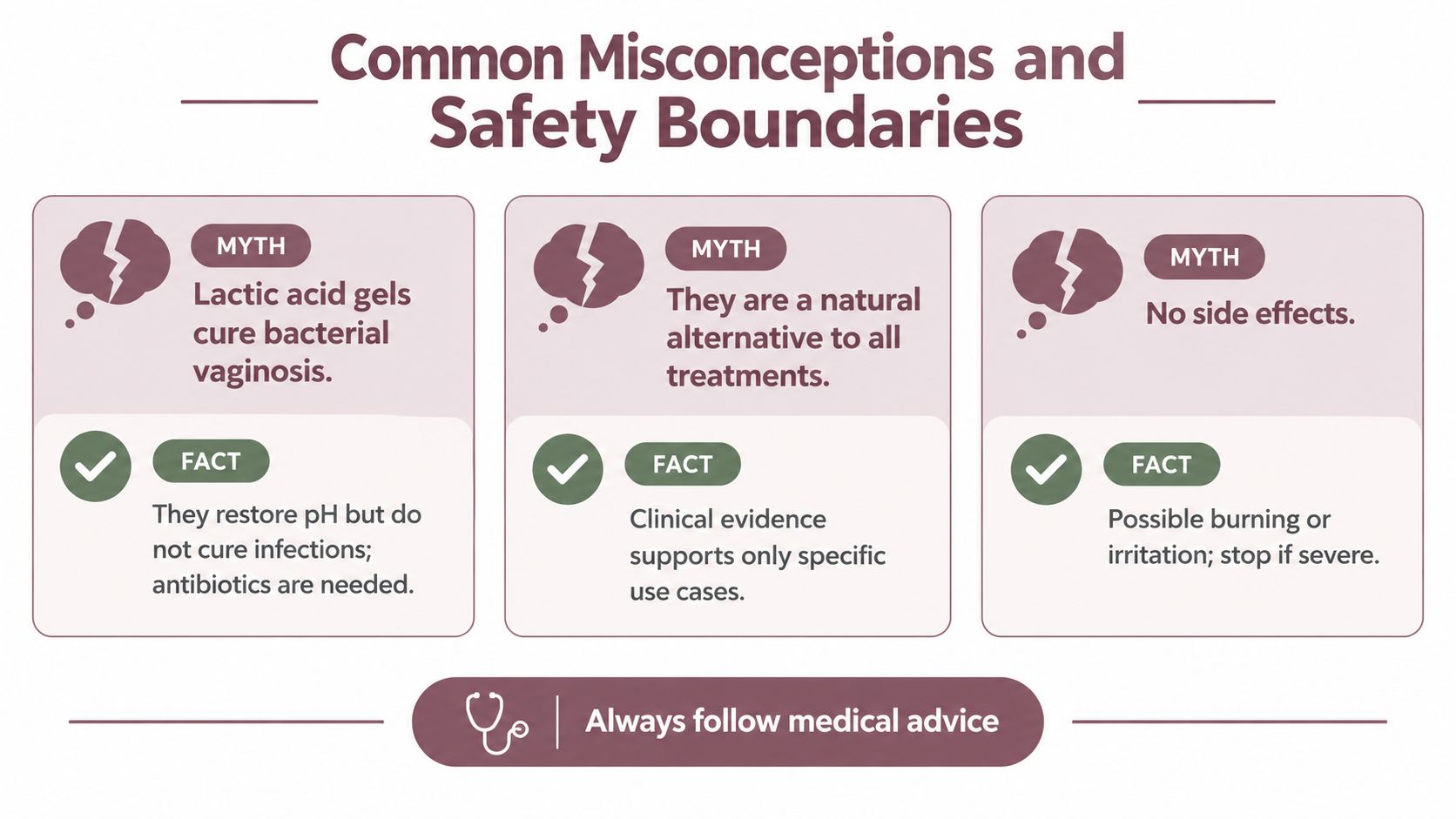
Three claims that need a reality check
- “Lactic acid gels cure bacterial vaginosis.” They may lower pH and support a local environment, but randomized evidence found weaker short-term symptom resolution than oral metronidazole. Don't substitute the gel for prescribed treatment.
- “They're a natural alternative to all treatments.” Their useful role is narrower. Evidence supports some pH-support and tolerability considerations, not a universal replacement for antibiotics, estrogen, moisturizers, or diagnosis.
- “They have no side effects.” Burning, stinging, or irritation can occur. Stop if symptoms are severe or worsening, and check the ingredients for known allergies.
Pregnant people shouldn't self-treat suspected BV with a lactic acid gel without medical advice. The same applies to anyone with an active or recurrent infection that hasn't been diagnosed, unexplained bleeding, significant pelvic pain, or damaged tissue. A product's pH, acid concentration, buffering agents, preservatives, and osmolality can vary, so one gel's tolerability doesn't predict another's.
Seek prompt clinical evaluation for fever, pelvic pain, malodorous discharge with itching, unexplained bleeding, or symptoms that continue beyond 7 days of appropriate use. These signs can point to a condition that needs testing or prescription treatment rather than more acidification.
Short-term studies provide useful safety information, but the effects of extended daily use aren't equally well established for every formulation. Read the expiry date, follow the labeled schedule, and don't assume that increasing frequency will improve the result.
Your Decision Checklist and Next Steps
Start with the symptom, not the product. If this is your first episode of unusual odor, discharge, itching, burning, or pain, a diagnosis is more useful than experimenting with pH. Similar symptoms can arise from BV, yeast, sexually transmitted infections, irritation, hormonal changes, or other conditions.
Ask yourself these questions:
- Is the problem new or recurrent? New symptoms deserve assessment, especially when they're intense or unusual for you.
- Has BV been confirmed? If not, don't assume that odor or discharge identifies the cause.
- Are you taking an antibiotic? Continue prescribed treatment unless your clinician tells you otherwise. Ask whether a gel fits afterward.
- Are hormones changing? Perimenopause, postpartum recovery, and breastfeeding can alter tissue comfort and vaginal ecology.
- What outcome do you want? Symptom support and maintenance are more realistic goals than instant clearance of an active infection.
A 2025 in vivo study in asymptomatic women found reductions in vaginal pH and Nugent scores after lactic-acid gel use, but it lacked a placebo control, so it couldn't prove clinical benefit. That distinction is especially important for people interested in prevention or long-term maintenance rather than acute treatment. The study and its limitations are described in the in vivo study of lactic-acid gels in asymptomatic women.
Decision outcomes by reader scenario
| Reader Scenario | Recommended Action | Realistic Expectation |
|---|---|---|
| New odor, discharge, itching, or pain | Arrange clinical evaluation before self-treating | Diagnosis comes before choosing pH support |
| Confirmed BV with prescribed antibiotics | Follow the treatment plan and ask about post-treatment maintenance | A gel may support a routine, but it isn't a substitute for antibiotics |
| Recurrent symptoms with prior diagnosis | Discuss recurrence-focused options with a clinician | Tolerability and symptom patterns may improve without guaranteeing cure |
| Perimenopause-related dryness | Address hormonal and moisturizing needs first | Lactic acid gel may be an add-on, not the primary therapy |
| Postpartum or breastfeeding changes | Obtain individualized postpartum guidance | Avoid using gel to cover bleeding, pain, or infection signs |
| No symptoms, interest in prevention | Review product safety and evidence limits | Lower pH doesn't prove prevention |
Track symptoms in a simple journal. Note timing around sex, periods, antibiotics, products, and hormonal changes, then bring that record to a clinician if symptoms recur. Used with realistic expectations, lactic acid gels can be one tool for pH support, not a universal solution.
Momotaro Apotheca offers plant-based vulvovaginal care products, including external soothing support, probiotics, urinary support, and curated routines for concerns such as irritation, BV, and life-stage changes. Visit Momotaro Apotheca to review the available options and choose a routine that complements, rather than replaces, appropriate medical care.


