


Natural Remedy for Yeast Infection: Safe Options That Work
You're probably here because the itch is back, the burning's familiar, and you're tired of guessing whether to grab another OTC box or try something more “natural” this time. I'm going to be blunt, natural doesn't automatically mean safe, and it definitely doesn't mean effective inside the vagina. The best approach is to separate what has evidence from what only sounds comforting.
If you want to browse a broader context for plant-based care, browse natural remedies at Hemp Well Ireland can be a useful starting point. But for yeast symptoms specifically, the smarter move is to sort options by evidence, soothing value, and risk.
Table of Contents
- When Itching Becomes a Search for Answers
- What a Yeast Infection Is
- The Two Natural Options With Real Evidence
- Yogurt, Tea Tree, Coconut Oil, Garlic, and ACV
- A Realistic Self-Care Routine During a Flare
- Why Natural Does Not Always Mean Safe
- Red Flags and When to See a Clinician
- A Gentle Routine for Ongoing Vulvovaginal Wellness
When Itching Becomes a Search for Answers
It usually starts the same way. You're on your third trip to the bathroom, the vulva feels raw, and you're doing that mental math everyone with repeat symptoms knows too well, another round of the same cream, or something more natural this time? That moment is exactly why this topic matters, because recurrent vulvovaginal candidiasis is common enough to keep sending people into the search bar, not because they're reckless, but because they're exhausted.
The World Health Organization says candidiasis affects millions of women worldwide. Independent clinical sources estimate about 75% of women will have at least one episode in their lifetime, nearly 45% will have two or more, and 5% to 8% will develop recurrent infection, usually defined as four or more outbreaks in one year. Those numbers explain the appeal of a natural remedy for yeast infection, but they don't magically turn every home treatment into a cure World Health Organization fact sheet).

A lot of advice online throws everything into one bucket, yogurt, garlic, tea tree oil, boric acid, probiotic capsules, coconut oil, vinegar. That's sloppy. The question is whether something is safe on the vulva, safe in the vagina, or not worth touching at all.
If you're already trying to figure out whether your symptoms fit, the internal guide on how to test for yeast infection at home is worth reading before you start putting anything new on irritated tissue.
What a Yeast Infection Is
A yeast infection is vulvovaginal candidiasis, which means too much Candida growth in and around the vagina. It usually follows a shift in moisture, flora, hormones, or recent antibiotic use, not poor hygiene. The common pattern is familiar, thick white discharge, itching, burning with urination, and external redness.
What it feels like versus what else it could be
The hard part is that several vaginal problems can feel similar at first. Bacterial vaginosis more often brings thin discharge and a fishy odor, while a UTI usually creates internal urinary urgency without the external vulvar itch that makes yeast so miserable. Self-diagnosis causes trouble here, because the symptom pattern matters.
Practical rule: if the main problem is external itching and irritation, yeast moves higher on the list. If the smell or discharge pattern is different, stop assuming it's yeast and adjust your plan.
Day-to-day triggers can nudge the balance in the wrong direction. Antibiotics can wipe out helpful bacteria, hormonal shifts can change the environment, and tight or synthetic clothing can trap moisture. Sexual activity and friction can add irritation too, which is why some people flare after otherwise ordinary days.
If you want a real-world example of a coordinated routine, the Organic Yeast Infection Treatment Bundle | Natural Relief & Prevention is built around external soothing, oral probiotic support, and a vaginal suppository for symptom-focused care. I'm mentioning it as a concrete example, not a cure-all, because the logic behind that kind of routine is simple, treat the outer irritation differently from the internal imbalance.
The Two Natural Options With Real Evidence
Most “natural” yeast remedies don't survive much scrutiny. Two options do keep showing up in the clinical conversation, boric acid and targeted probiotics. They're not interchangeable, and they don't do the same job.
Boric acid has the strongest at-home track record
Boric acid has been discussed in the medical literature for more than two decades as a nonstandard option for recurrent or treatment-resistant infections. A cited study in a naturopathic review reported a 98% cure rate in patients who weren't responding to conventional antifungals, and the same review describes a commonly used regimen of 600 mg vaginal suppositories twice daily for 3 to 7 days for acute infections, or 2 to 4 weeks for chronic patterns PubMed review on boric acid.
That doesn't make boric acid a casual DIY project. It's for vaginal use only, it should never be swallowed, and it needs to stay far from children. Pregnancy is a hard stop unless a clinician specifically tells you otherwise.
Probiotics make more sense as support than as a cure
Targeted vaginal-health probiotics are a different story. A formula built with Lactobacillus and Bifidobacterium strains can support the microbiome, which is the part of the equation many are trying to protect. That's the practical value, support and maintenance, not instant infection clearance.
For a useful breakdown of where probiotics fit and where they don't, the guide on vaginal probiotics for BV and yeast is a solid companion piece.
Bottom line: boric acid is the more evidence-backed at-home option for recurrent cases, and probiotics are better understood as a maintenance tool that may support a healthier vaginal environment.
Yogurt, Tea Tree, Coconut Oil, Garlic, and ACV
This is the group people grab first because it feels simple and familiar. Simple does not mean smart. Some of these options can soothe the outside a little, some are unproven, and a few can make irritated tissue worse fast.
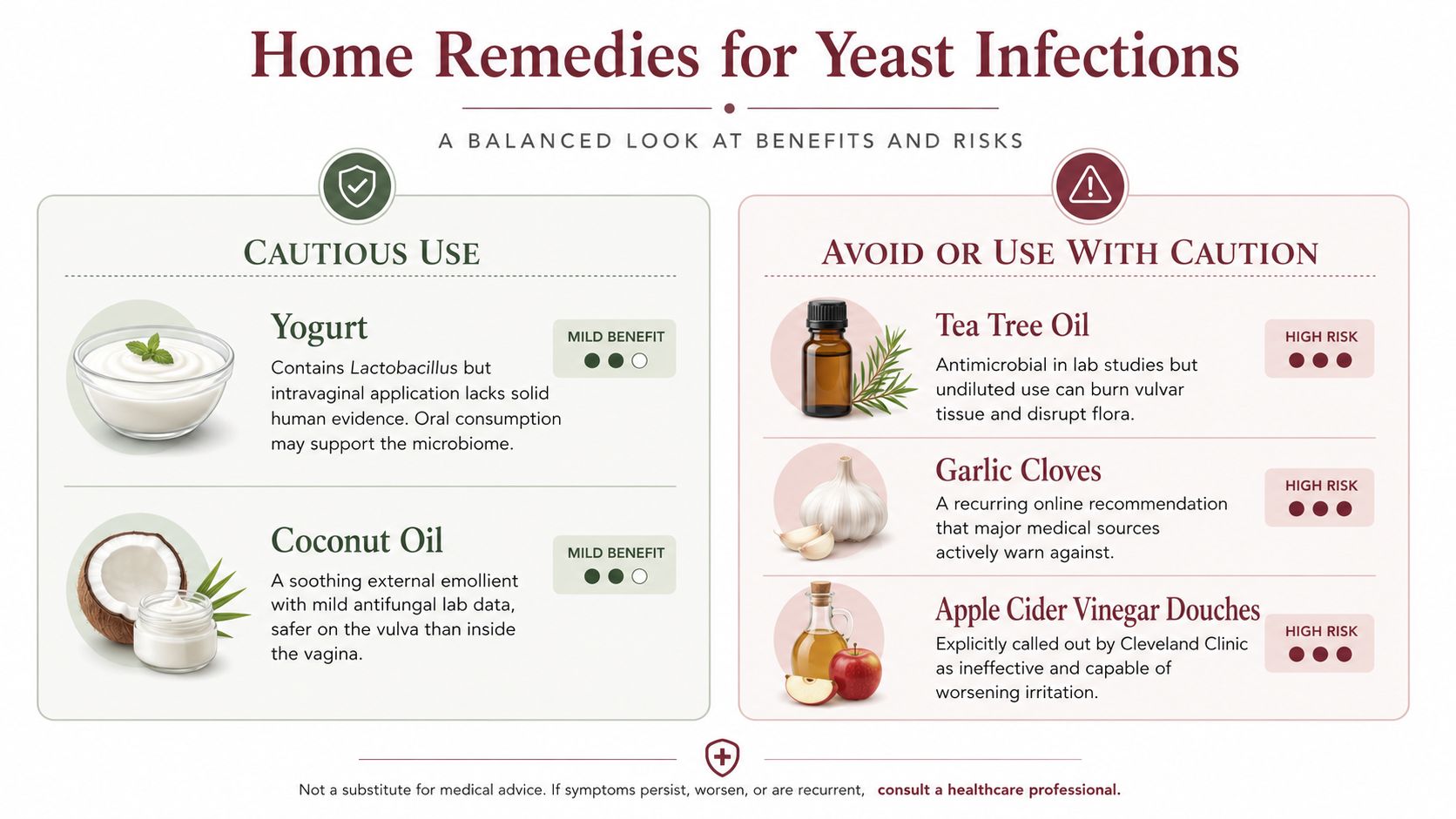
The cautious-use side
Yogurt contains Lactobacillus, which is why people keep reaching for it. The problem is that intravaginal use does not have solid human evidence behind it. Eating yogurt may support the microbiome in a broader way, but that is not the same as treating an active yeast flare.
Coconut oil makes more sense as an external emollient. It can feel soothing on the vulva, and lab data suggest mild antifungal activity, but that still does not prove it treats infection inside the vagina. Use it for comfort, not for cure.
The avoid-or-use-with-caution side
Tea tree oil gets recommended constantly because it sounds antimicrobial. Undiluted use can burn vulvar tissue and aggravate the irritation you are trying to calm, so putting it directly on sensitive tissue is a bad trade.
Garlic cloves are one of the internet's most stubborn myths. Major clinical sources warn against them, and there is no good reason to insert food into a vagina that is already inflamed.
Apple cider vinegar douches are a hard no. Cleveland Clinic calls home remedies ineffective and unsafe, and ACV can make irritation worse instead of better Cleveland Clinic on home remedies for yeast infections.
If you want a wash product meant for external use rather than kitchen experimentation, a tea tree-based cleanser like a tea tree-based antifungal wash product is at least framed as a topical wash, not an intravaginal treatment. That still does not make it a yeast cure. It just belongs in a more sensible category than douching or stuffing garlic inside your body.
A Realistic Self-Care Routine During a Flare
The right routine during a flare is boring on purpose. Keep the vulva cool, dry, and unbothered, and stop adding irritants. That means no douching, no scented soaps, no scrubbing, and no trying three new remedies in one afternoon.
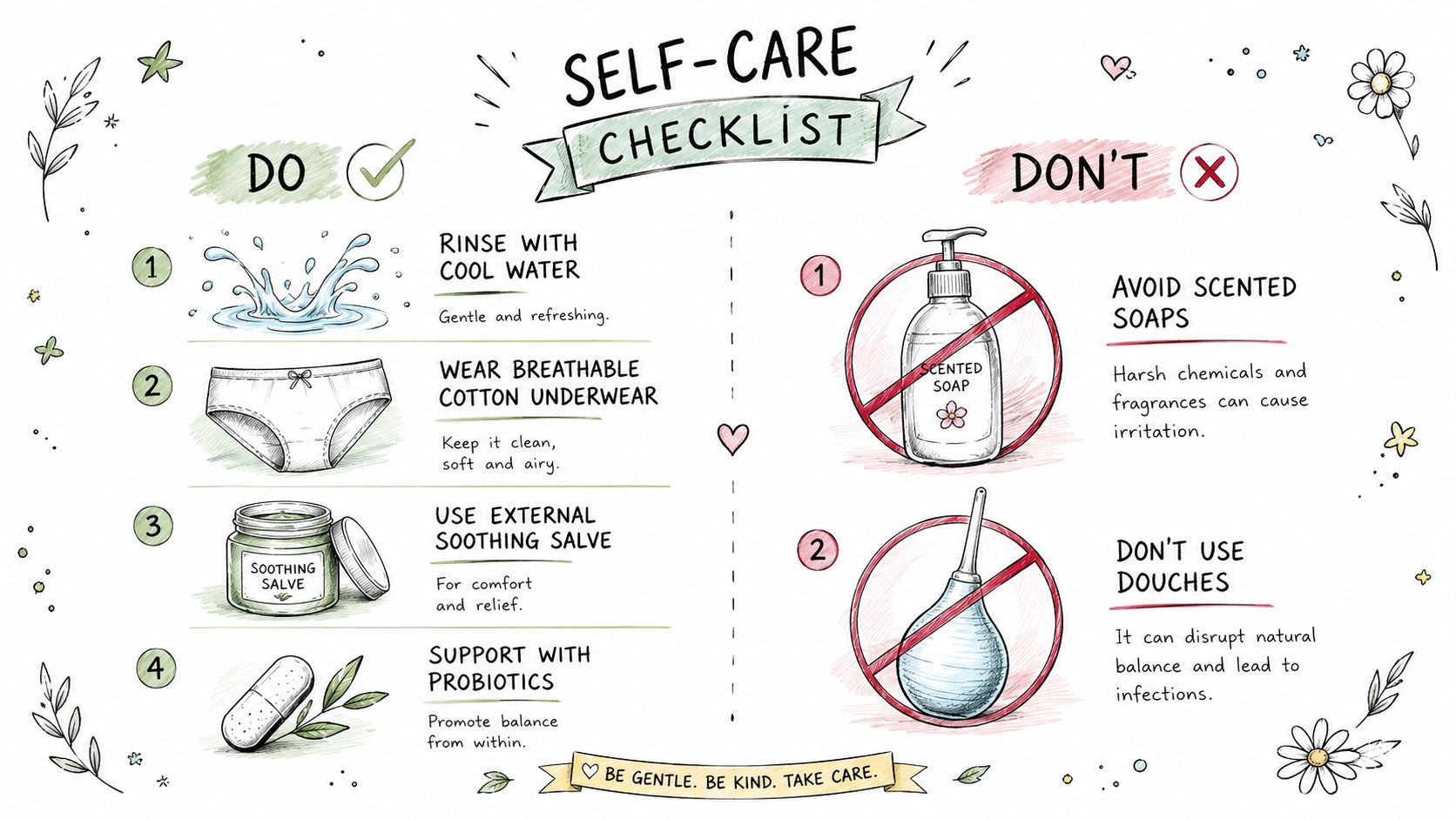
External care first
Rinse with cool or lukewarm water, pat dry, and switch to breathable cotton underwear. If the outer skin feels inflamed, a soothing salve meant for the vulva can reduce the friction from clothing and movement. The point is barrier support, not aggressive treatment.
Keep products off broken skin and mucous membranes unless the label specifically says they're intended for that use.
Internal support belongs in a separate lane
If you're using a targeted probiotic, take it consistently rather than sporadically. That makes sense for microbiome support, especially if you're someone who gets repeats after antibiotics, sex, or hormonal changes.
A plant-based suppository can also fit into the routine if it's specifically intended for vaginal use and the instructions are clear. The key difference is simple, external comfort products should stay external, and anything placed inside the vagina needs a much higher safety bar than a body oil or salve.
A short daily checklist
- Wash gently: Use water and avoid fragrance-heavy products.
- Dress for airflow: Choose cotton and loose fabrics when you can.
- Skip friction: Avoid harsh exercise gear and anything that rubs raw skin.
- Use only one new product at a time: If irritation worsens, you'll know what caused it.
- Track the pattern: Repeats after sex, antibiotics, or cycle changes matter.
Why Natural Does Not Always Mean Safe
A flare can make people reach for anything that sounds gentle. That impulse is understandable, but it leads to bad choices fast. The vagina and vulva are sensitive mucosal tissues, and they do not care whether a product came from a kitchen shelf or a wellness brand. If it burns, stings, or leaves the skin more irritated, it is not a safe choice.
Essential oils are the clearest warning sign. Tea tree and oregano are often promoted for antimicrobial activity, but high concentrations can irritate tissue and disturb the microbiome. Homemade suppositories create the same problem in a different form, because the dose is unpredictable, which makes the risk unpredictable too.
Formulation matters more than the ingredient's origin. A product designed for vulvovaginal use, with pH-conscious ingredients and clear directions, belongs in a different category from a DIY mix. That is the line readers should use, thoughtfully formulated versus improvised.
If a remedy would feel too strong on your lip or eyelid, do not assume it belongs in the vagina.
That is the standard I would use every time.
Red Flags and When to See a Clinician
Self-care has a limit. If this is your first infection, or you have fever, pelvic pain, blood-tinged discharge, or you might be pregnant, stop trying more home remedies and get checked. The same advice applies if symptoms last more than seven days, if you develop an allergic reaction, or if the flare keeps coming back.
Recurring symptoms deserve real evaluation, not another round of guesswork. If you keep getting the same pattern, self-treatment stops being a smart strategy and starts becoming a delay.
Tell the clinician exactly what you have already used. Include any boric acid, probiotics, oils, washes, suppositories, or douches, even if they seemed “just natural.” That detail changes the conversation fast, especially if a product is irritating the tissue or masking what is going on. If you want a structured next step after treatment, how to prevent recurring yeast infections lays out a practical maintenance approach.
A Gentle Routine for Ongoing Vulvovaginal Wellness
The best long-term approach is steady, not dramatic. A daily probiotic can be part of microbiome support, a pH-conscious external balm can help with everyday friction, and breathable clothing reduces the moisture and rubbing that keep things irritated. If sex tends to trigger flare-ups, post-sex care should be intentional, not an afterthought.
A coordinated routine usually works better than random products because it covers both layers of the problem, inside and out. You don't need a drawer full of fixes, you need a simple system you'll use. That's why curated regimens can make sense for people who keep cycling through the same symptoms.
If you like a calming ritual alongside functional care, even something as simple as aromatherapy shower steamers can fit the broader self-care picture without pretending to treat infection. The point is to support comfort without confusing comfort for cure.
For people who want a structured maintenance path, how to prevent recurring yeast infections is the next read. It lines up with the same practical rule I keep coming back to, soothe the vulva, respect the vagina, and don't waste time on remedies that only sound smart.
Natural care can sit alongside medical treatment just fine when it's used properly. If you want plant-based support without the guesswork, visit Momotaro Apotheca to explore vulvovaginal care options designed for soothing, maintenance, and recurrence-prone routines.


