


Pre and Postnatal Care for Vulvar Comfort
You're home with a newborn, a bathroom full of pads, and a body that doesn't feel familiar. Urine stings, stitches pull, and you're trying to decide whether a new smell means you need a shower or a clinician. If your next appointment feels far away, pre and postnatal care should give you more than instructions to wait. You need a contact plan, a gentle external routine, and clear reasons to seek help.
Table of Contents
- Why the Vulva Belongs in Pre and Postnatal Care
- Contacts to Book From Pregnancy to Week Six
- How to Wash and Soothe the Vulva Gently
- Symptoms That Should Leave Home Care
- What the First 14 Days Can Look Like
- Pelvic and Vulvar Healing After Six Weeks
- Confirm Your Contacts and Comfort Plan
Why the Vulva Belongs in Pre and Postnatal Care
The vulva does much of the visible work in a vaginal birth, yet it is often the last thing anyone asks about afterward. On the first night home, sitting down may take planning. The external genital area can feel swollen, bruised, stitched, or unfamiliar, and a new smell can leave you wondering whether you need a shower or a clinician.
Care has two layers. One is repeated contact with a skilled clinician who evaluates bleeding, blood pressure, wounds, and infection. The other is comfort care for sensitive external skin: gentle washing, soft fabrics, less friction from pads. The two work together, but they do different jobs, and confusing them is where trouble starts.
Pregnancy works like a long walk with planned stops. Birth is the steep step where risk concentrates: the first 24 hours after delivery are when danger is most tightly packed, so early clinical contact matters. The quieter gap comes right after. Many people leave the hospital with no scheduled check until week six, while swelling, stitches, discharge, and worry peak during the first 14 days at home.
Comfort is care, but it isn't diagnosis. Feeling cleaner or less itchy doesn't tell you whether a wound is healing safely.
Pregnancy can change the vulva's appearance and sensitivity long before birth, which adds its own worry. Reading about changes in the vulva during pregnancy can help you describe what is different without assuming every change means infection.
- Medical concerns: Heavy bleeding, fever, an opening wound, or symptoms of dangerous blood pressure need clinical assessment, not another layer of balm.
- Comfort concerns: Dryness, pad rubbing, and mild irritation deserve attention too, through an external routine that doesn't disguise worsening symptoms.
You don't have to choose between taking discomfort seriously and avoiding unnecessary treatment. The useful question is whether you need soothing, examination, or both.
Contacts to Book From Pregnancy to Week Six
Pre and postnatal contacts to book
| Contact | When | Main checks | Why it matters |
|---|---|---|---|
| Early pregnancy booking | As soon as pregnancy is known | History, blood pressure, weight, BMI, anaemia plan | Supports early action on complications |
| Every antenatal contact | At least eight times in pregnancy | Blood pressure, weight, and BMI | Builds a baseline for later change |
| Later pregnancy screening | From 20 weeks, each contact | Blood pressure plus urine protein | Helps detect pre-eclampsia |
| Dating and anatomy scan | Once, before 24 weeks | Ultrasound | Estimates dates and checks for anomalies or multiple pregnancy |
| Anaemia check | As the clinician schedules | Full blood count | Preferred method for diagnosing maternal anaemia |
| Immediate postpartum stay | At least 24 hours after birth | Bleeding, uterine tone, fundal height, temperature, pulse, blood pressure | Allows observation during early recovery |
| Home birth first check | As early as possible within 24 hours | Early maternal and newborn checks | Arrange outpatient care if a home visit isn't available |
| Early follow-up | 48 to 72 hours | Bleeding, wounds, feeding, blood pressure | Checks recovery after discharge |
| First two weeks | Days 7 to 14 | Healing, urinary function, mood, feeding | Covers the early gap in follow-up |
| Six-week review | Week 6 | Perineum or cesarean wound, contraception, mood | Reviews recovery and plans ongoing care |
The WHO antenatal-care recommendations support at least eight contacts, blood-pressure and urine-protein screening from 20 weeks, and an ultrasound before 24 weeks. Those appointments aren't interchangeable: an early assessment establishes information that a later appointment can't recreate.
Turn the calendar into appointments
At booking, ask who will arrange your tests and how you'll receive results. A blood test that was ordered but never completed needs follow-up, just as a missed appointment does. Keep your medication and supplement list together so you don't have to reconstruct it during a rushed conversation.
Nutrition questions belong here too. Pumpernickel Health Foods' guide to the recommended folate dose for pregnancy can help you prepare questions about supplements; your maternity clinician should confirm what's appropriate for your circumstances.
Before discharge, ask the birth team to write down:
- The next contact: Its date, location, and whether someone will visit you or you'll attend a clinic.
- The responsible service: Who assesses your recovery, who checks your baby, and whether those checks happen together.
- The backup route: A number for concerns outside office hours and an outpatient option if a home visit falls through.
Early home checks should be performed by skilled personnel or trained community health workers, not replaced by a relative's reassurance. Family members can help you notice changes, arrange transport, and explain symptoms, but they can't clear a suspected complication.
Know what a check actually includes
A proper postnatal assessment involves more than asking whether you're managing. Clinicians may assess bleeding, the firmness and size of the uterus, vital signs, feeding, and wounds. Uterine tone means how firmly the uterus is contracting; fundal height helps assess its size and position.
Use these questions to prepare for an OB-GYN appointment to make room for your concerns. Tell the clinician if transport, cost, language, or childcare makes attendance difficult.
A missed visit needs a new plan, not an assumption that recovery is complete. The later review should include healing, mood, feeding, and contraception, with further appointments when symptoms require them.
How to Wash and Soothe the Vulva Gently
The vulva is outside; the vagina is the internal canal. Washing the outside doesn't require cleaning inside, and neither pregnancy nor childbirth changes that distinction.
Keep the routine simple enough to use when you're exhausted.
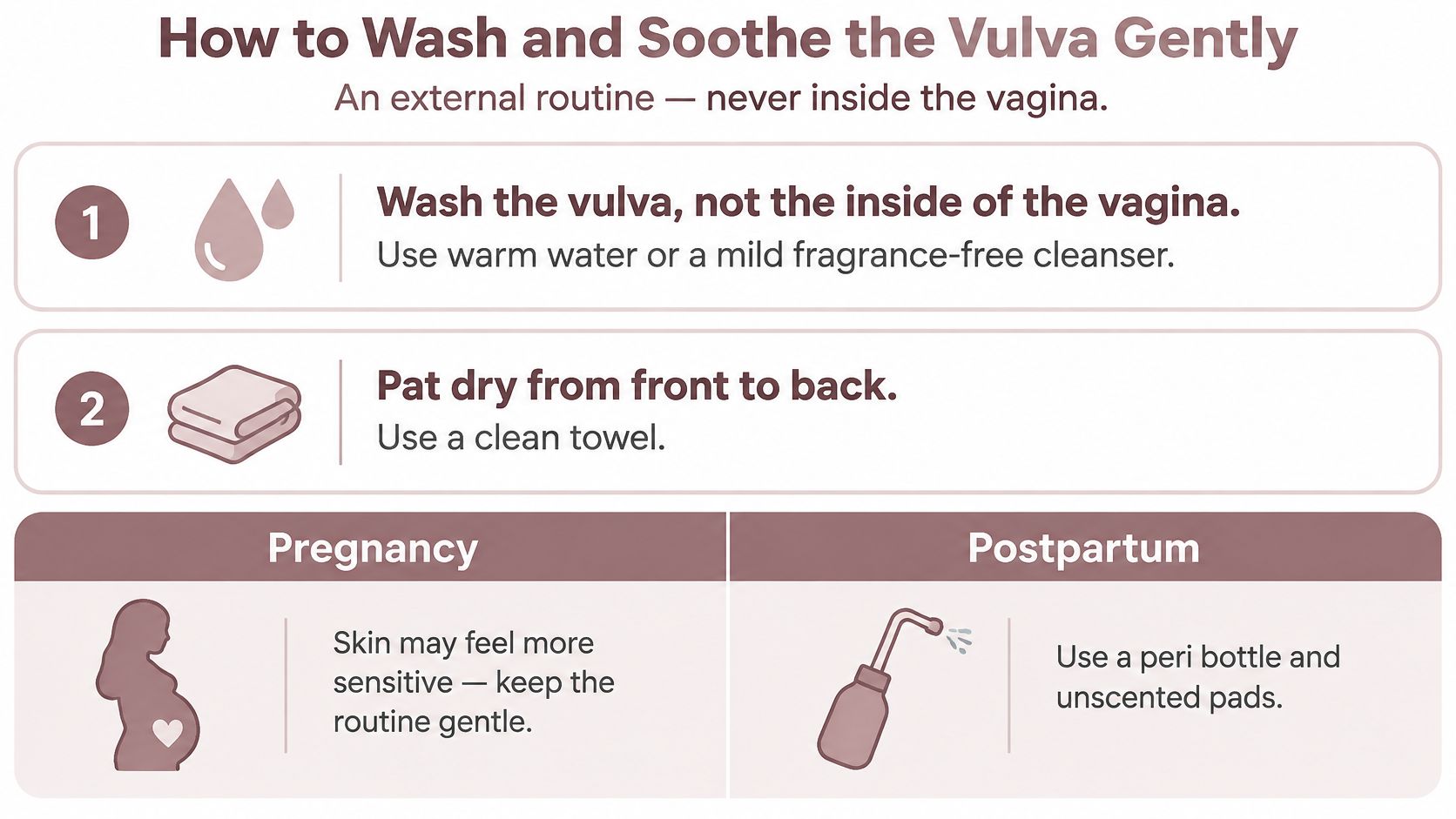
An external routine without scrubbing
- Start with warm water. Gently rinse the vulva. If you use a cleanser, choose a mild, fragrance-free one for external skin, and keep it away from the vaginal opening or wounds if it stings.
- Pat rather than rub. Use a clean, soft towel and work from front to back. Stitches need gentle handling, not scrubbing to remove every trace of discharge.
- Change unscented pads when damp or soiled. Moisture and friction can irritate skin without an infection being present. Skip deodorizing pads, powders, scented wipes, and sprays.
- Make urination less uncomfortable. If urine stings a fresh tear, pour warm water from a clean peri bottle over the external area while you pee. For soreness, a clean, cool compress may help; don't place ice directly against skin.
- Reduce rubbing. Choose breathable underwear and loosen tight layers if they press against swelling. You don't need to tolerate a seam digging into tender tissue.
- Leave the vaginal canal alone. Don't douche or steam it. Avoid essential oils on stitches or broken skin, and don't use fragrance to cover a smell you haven't assessed.
- Treat an abdominal incision separately. Follow the birth team's cesarean wound instructions. A vulvar wash routine isn't an incision-care plan.
- Check before adding products. If you're pregnant, breastfeeding, or under medical care, ask your clinician before using a balm, oil, toner, or ingestible. Stop anything that causes burning or irritation.
Notice changes without trying to erase them
Pregnancy discharge may increase without meaning you have an infection. After birth, lochia, the discharge of blood and tissue, generally changes from red toward pink and then yellow-white as it lessens. Colour alone can't diagnose yeast.
Think of the vagina as a self-cleaning oven, not something that needs perfume inside it. The comparison is imperfect, but the point is useful: adding fragrance doesn't make sensitive tissue safer.
Ingredient choices are specific to the body area. Mouthology's resource to compare natural mouthwash ingredients is for oral care, not a guide to vulvar products; never transfer mouthwash or oral essential-oil mixtures to genital skin.
Keep a brief note of your usual scent, discharge, and itch. Describe a new change plainly, such as increased discharge with itching, rather than trying to wash it away before asking for help.
Symptoms That Should Leave Home Care
Urine crossing a fresh tear can sting. That's different from burning accompanied by fever, flank pain, or feeling suddenly unwell. The first may improve with rinsing; the second needs assessment for a problem that hygiene won't treat.
Pattern and direction matter. Discomfort that's easing is different from pain that's spreading, intensifying, or returning after improvement.
Healing symptoms versus symptoms that need care
| What you notice | Often part of healing | Get professional care |
|---|---|---|
| Lochia | Red, then pink, then yellow-white, generally decreasing | Rapidly soaking pads, large clots, dizziness, or faintness |
| Perineal or vulvar soreness | Ache that eases and brief stinging relieved by rinsing | Worsening pain, wound opening, pus, or spreading redness |
| Urination | Brief sting when urine crosses a tear | Fever, flank pain, persistent frequency, or difficulty emptying the bladder |
| Discharge and scent | Your baseline, including pregnancy discharge without itching | Thick, clumpy discharge with intense itch, or thin, gray discharge with a fishy smell |
| Temperature and whole body | Tiredness that improves with support and rest | Fever, chills, or feeling suddenly much worse |
| Headache and swelling | Fatigue without concerning neurological symptoms | Sudden severe headache, vision changes, or marked new swelling |
| Mood | Tearfulness that is discussed, supported, and improving | Hopelessness, severe distress, or thoughts of harming yourself or your baby |
| Newborn | Feeding that is assessed and supported | Poor feeding, convulsions, fast or difficult breathing, unusual stillness, abnormal temperature, or early or extensive jaundice |
Discharge patterns can suggest a possible cause, but they don't establish one. During pregnancy and postpartum recovery, suspected yeast or bacterial vaginosis warrants clinician guidance rather than leftover medication or a product selected by smell alone.
A wound that opens needs examination even if it doesn't smell. Conversely, a new smell deserves attention even when you can't see the stitches clearly.
Don't wait for every warning sign to appear. One serious symptom is enough to seek help.
Choose the right level of help
Use emergency services for heavy bleeding with weakness or dizziness, breathing trouble, a seizure, or a sudden severe headache with visual changes. Possible postpartum hypertension is not something to sleep off. Don't drive yourself if you feel faint or unsafe.
Contact your maternity service promptly for new discharge, odor, urinary symptoms, fever, or wound changes. Explain that you're pregnant or recently gave birth, and describe whether symptoms are worsening.
For newborns, the WHO postnatal-care recommendations identify breathing faster than 60 breaths per minute, temperature above 37.5°C or below 35.5°C, poor feeding, convulsions, severe chest indrawing, absent spontaneous movement, and early or extensive jaundice as danger signs requiring prompt evaluation.
Chest indrawing means the chest pulls inward noticeably during breathing. If your baby looks unwell, seek help rather than delaying to perfect a measurement.
Hopelessness deserves urgent mental-health support. If you might act on thoughts of harm, or can't keep yourself or your baby safe, contact emergency services and ask a trusted person to stay with you. This is a health emergency, not a character flaw.
What the First 14 Days Can Look Like
Consider two possible recoveries. Neither is a test of toughness, and neither should depend on guessing whether a symptom is serious.
This timeline shows how external comfort and clinical follow-up can happen alongside each other.
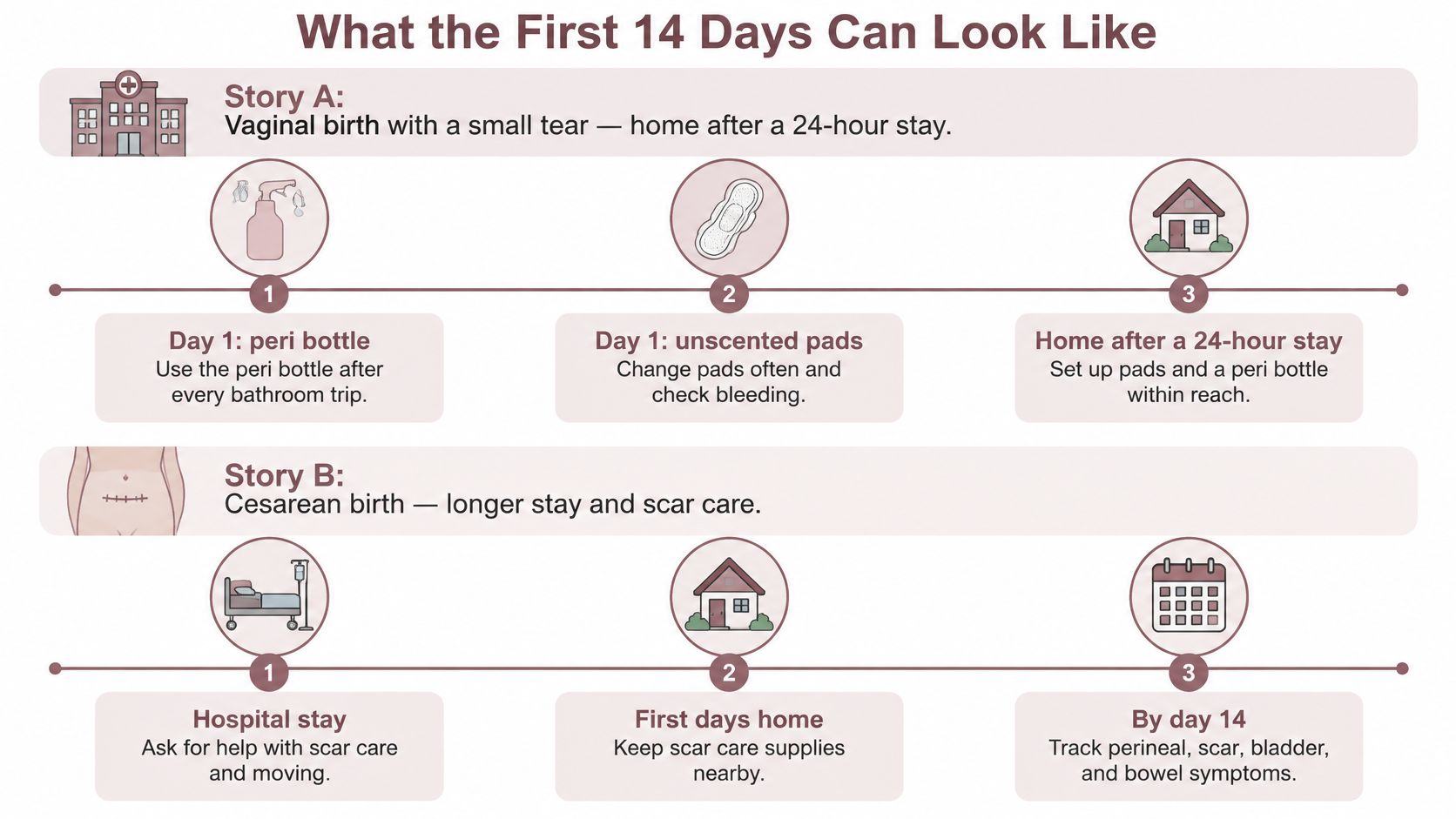
A tear that gradually becomes less sore
Say you come home after a vaginal birth with a small tear. You place a peri bottle and clean pads within reach, use a cool compress for comfort, and notice whether bleeding and pain are easing rather than judging recovery by a single bathroom trip.
At the early follow-up, you describe the stinging instead of saying everything is fine. The clinician assesses your recovery and helps you decide whether the discomfort fits healing.
Later, the ache is less intrusive, but breastfeeding hurts. You ask for feeding support rather than assuming every postpartum pain has the same cause or trying to solve it with vulvar care.
A cesarean wound that needs attention
In another hypothetical recovery, you have an unplanned cesarean. You still need comfortable pads and gentle external hygiene, while your abdominal incision has its own care instructions.
Then you develop a new fever and redness around the incision. You call the maternity service for same-day assessment rather than washing more vigorously, adding an oil, or waiting for the scheduled review.
A visual explanation can also be useful when discussing recovery with your support person.
When nobody can visit at home
After a home birth, an unavailable visitor shouldn't mean an absent check. Ask the maternity service to arrange an outpatient assessment and explain any transport barriers before the appointment is missed.
The WHO postnatal-care guideline reports median routine postnatal-care coverage within two days of birth of 71% for women and 64% for newborns globally. Those figures describe an access gap, not a reason to accept one.
You can say plainly that you need a postnatal assessment because you're soaking pads, have a fever, or your baby is breathing fast. Name the actual symptom when you call, and use emergency services if it's severe.
Gentle external comfort never replaces evaluation for hemorrhage, wound infection, or urinary disease. Help at home should make getting that evaluation easier, not persuade you to postpone it.
Pelvic and Vulvar Healing After Six Weeks
A postnatal review isn't a graduation ceremony. You can be medically stable and still have tenderness, dryness, bladder symptoms, or fear about penetration that deserves a plan.
Tearing, episiotomy, assisted birth, and cesarean delivery can leave different combinations of perineal, scar, bladder, and bowel concerns. Your delivery method alone doesn't tell a clinician how comfortable you feel.
This summary can help you name the area that needs assessment.
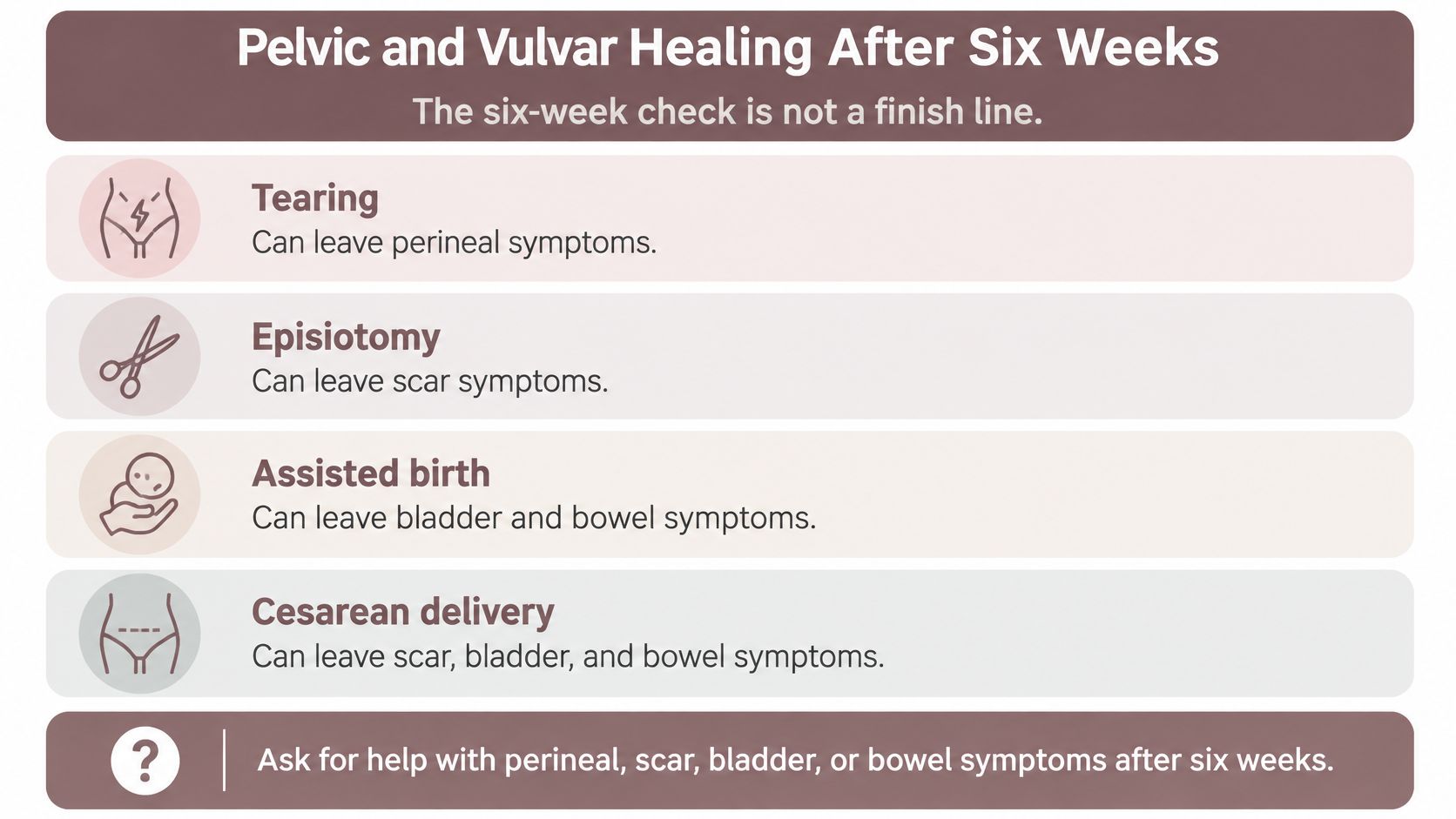
Common doesn't mean you must tolerate it
Dryness can be more noticeable while breastfeeding, and you may feel hesitant about touch or penetration after pain or a frightening birth. Neither means you owe anyone an attempt at sex to prove you've recovered.
Mild leakage when coughing may be something you've heard other parents describe. That doesn't make it unworthy of treatment, especially if you're planning outings around toilets or avoiding movement.
- Tenderness needs a trajectory: Tell your clinician if it isn't improving or if ordinary activities remain painful.
- Sexual pain needs assessment: Don't repeatedly push through penetration that hurts. Describe whether pain is at the entrance, deeper inside, or around a scar.
- Bladder and bowel symptoms count: Leakage, straining, difficulty emptying, recurrent urinary symptoms, or vaginal pressure deserve discussion.
- Skin changes need examination: Persistent tearing, itching, or sensitivity shouldn't be managed indefinitely by changing products.
Ask for assessment, not just reassurance
A gynecologic examination can help identify wound, skin, infection, or prolapse concerns. Pelvic-floor physiotherapy can assess muscle function and guide rehabilitation; it isn't a prescription to squeeze harder.
Learning about pelvic-health priorities beyond Kegels can help you explain symptoms and ask what kind of support fits. Seek urgent care instead of a routine referral when symptoms are severe, sudden, or accompanied by the warning signs already described.
The WHO maternal-care recommendations include assessment of perineal healing, cesarean wounds, urinary function, mood, and contraception across postnatal care. Your wellbeing belongs in the appointment alongside your baby's.
Recovery may unfold over months, with follow-up guided by symptoms rather than a deadline. A topical product shouldn't become a way to avoid examination for persistent pain, suspected infection, or bulging and pressure.
Book a follow-up if symptoms limit daily life, and use this sentence if you're struggling to be heard:
This pain is limiting daily life, and I want my perineum, scar, bladder, and mood assessed, not only the baby weighed.
Confirm Your Contacts and Comfort Plan
You don't need a complicated recovery system. You need an appointment you can reach, a response plan for concerning symptoms, and supplies that make basic care less uncomfortable.
Make these actions practical enough that someone helping you can follow them too.
- Confirm the next human contact. Use the contact calendar to identify the appointment you need next. Write down who's responsible, how you'll get there, and what to do if it's cancelled; if you've missed a check, ask to rebook.
- Keep the symptom table accessible at night. Save it on your phone or print it beside the bed. Add the maternity service and emergency contact details, and tell your support person which symptoms mean you shouldn't wait for an office to reopen.
- Put the external-care kit where you'll use it. Keep warm water, unscented pads, a peri bottle if needed, and breathable underwear within reach. Leave douches, fragranced sprays, and essential oils away from healing tissue.
Add comfort only after the care plan is clear
Once those arrangements are written down, our Momotaro Apotheca Pregnancy and postpartum collection offers organic products as an optional comfort layer, not a substitute for assessment. If you're pregnant, breastfeeding, or under medical care, consult your healthcare provider before adding a balm or other product.
A shop quiz may help organize preferences around dryness, itch, or irritation, but it can't diagnose their cause. Don't let a product recommendation override new symptoms or delay an examination.
The next human checkup comes first. Comfort care should support your recovery while you receive appropriate medical care, never stand in for it.
Our Pregnancy and postpartum collection offers organic products to support comfort during pregnancy and postpartum recovery. Visit Momotaro Apotheca to explore the collection and educational resources, then discuss any new product with your clinician before adding it to your care plan.


