


Recurring Yeast Infection Symptoms and What They Really Mean
Recurrent vulvovaginal candidiasis usually means three or more symptomatic episodes within one year. It affects fewer than 5% of women, even though 75% have at least one yeast infection during their lifetime. Clinical guidance and review literature
You treat the itching, it eases, and then a few weeks later the burning returns. Maybe it happens after sex, around your period, or after a course of antibiotics. The discharge may look familiar, but the whole experience can start to feel less like an infection you caught and more like a problem your body keeps replaying.
That pattern deserves attention, not blame. Recurring yeast infection symptoms can reflect a confirmed Candida infection, but they can also come from a different Candida species, bacterial vaginosis, urinary irritation, contact dermatitis, hormonal changes, altered vaginal ecology, or a condition affecting the vulvar skin. Reaching for the same antifungal every time may soothe one episode while leaving the underlying driver untouched.
Table of Contents
- When Yeast Symptoms Keep Coming Back
- The Symptom Cluster You Should Actually Recognize
- How Recurring Yeast Symptoms Differ From BV, UTIs, and Irritation
- Why the Same Yeast Symptoms Keep Returning
- The Repeat-OTC Loop That Keeps Symptoms Coming Back
- What a Real Diagnostic Workup Looks Like
- Evidence-Based Prevention and Daily Vulvovaginal Care
- Key Takeaways and Common Questions
When Yeast Symptoms Keep Coming Back
The pattern can feel like a loop. The vulva starts itching, perhaps at night. Urine stings irritated skin, sex becomes uncomfortable, and discharge changes. You use the treatment that helped before, feel better, and assume the episode has ended. Then the symptoms return.
Older primary-care literature used four or more episodes in one year, so consumer health information still shows both thresholds for recurrent vulvovaginal candidiasis. The threshold has changed as clinical definitions have developed, but the practical message is steady: repeated symptoms need confirmation rather than automatic retreatment.
A recurring flare may be:
- Relapse: Symptoms improve, then return because treatment did not fully control the infection or because symptoms reappear after maintenance treatment ends.
- A different Candida species: Non-albicans species may respond differently to standard azole medicines.
- A mixed infection: Yeast may occur alongside bacterial vaginosis or another condition.
- A noninfectious problem: Product irritation, eczema, lichen sclerosus, or another vulvar skin condition can resemble yeast.
The timing offers useful clues, although it cannot prove the cause. Symptoms after intercourse may follow friction, semen-related environmental changes, lubricant ingredients, or an infection. A flare around menstruation may reflect hormonal and ecological shifts. Symptoms after antibiotics may follow disruption of protective vaginal bacteria.
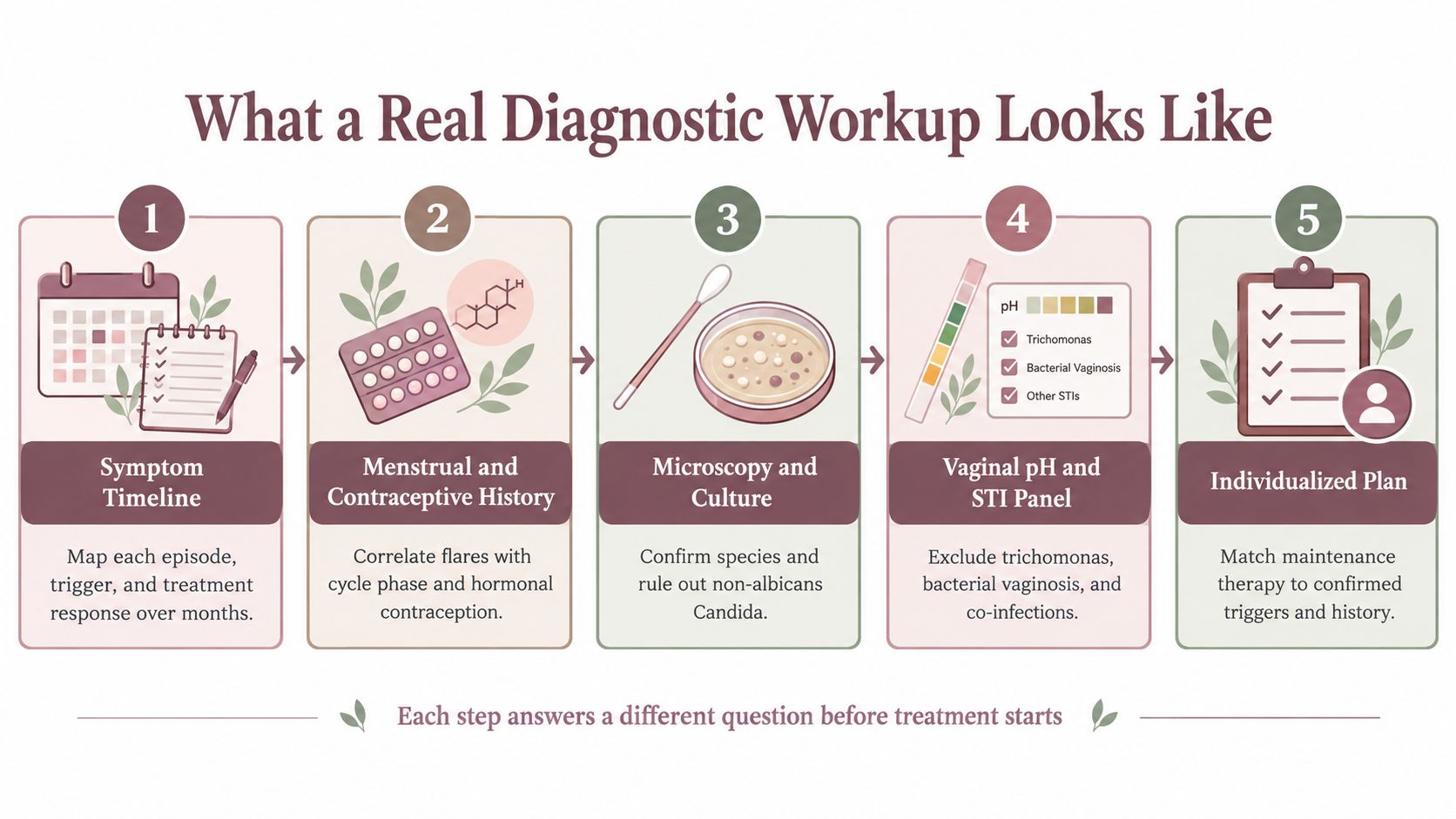
If the same symptoms keep returning, record the date, cycle phase, recent medicines, sexual activity, products used, and treatment response before an appointment. That record gives the clinician a timeline instead of a series of disconnected episodes.
RVVC affects fewer than 5% of women, according to clinical guidance, while population research estimates that about 138 million women worldwide are affected annually. These figures describe different views of the problem: one focuses on a clinical diagnosis, while the other estimates its global burden. The systematic review and global burden estimates are summarized by the University of Manchester.
The next step is to identify the symptom pattern, compare other likely causes, look for factors that keep symptoms going, and confirm the organism when testing is needed. Treatment works better when it follows that evidence instead of repeating the same antifungal by default.
The Symptom Cluster You Should Actually Recognize
Classic vulvovaginal candidiasis often feels intensely external. The itch may begin at the vaginal opening and spread across the vulva. Burning can become more noticeable when urine touches inflamed skin or during penetration. Soreness may make sitting, wiping, exercising, or wearing close-fitting clothes uncomfortable.
The usual symptom cluster includes vulvar or vaginal itching, burning, soreness, pain during sex, painful urination, and thick, odorless discharge. Some people develop swelling, small fissures, or raw skin at the vaginal opening. Discharge may have a clumpy texture often compared with cottage cheese, but not everyone has that appearance. The Centers for Disease Control and Prevention outlines this symptom pattern and the limits of symptom-based diagnosis.
Why the familiar signs can mislead you
Symptoms don't always arrive as a neat checklist. You might have severe external burning with little discharge, or notice soreness rather than itch. Repeated inflammation can also make the skin more sensitive, so the sensation changes over time.
Redness can be harder to see on Black or brown skin. The affected area may look dusky, violet, deeper brown, or just swollen and shiny rather than bright red. Mayo Clinic specifically notes that redness can be more difficult to identify on darker skin tones.
Look at the whole pattern instead of searching for one “tell”:
- Itch and burning: Often prominent, but neither symptom identifies yeast by itself.
- Discharge: It may be thick and clumpy, but it can also be scant, watery, or absent.
- Inflammation: Swelling, tenderness, fissures, and irritated tissue support a broader pattern of vulvitis.
- Odor: A strong fishy odor points away from uncomplicated candidiasis and toward other possibilities.
- Timing: A repeat flare after sex, menstruation, antibiotics, or a new product gives your clinician important context.
Friction can amplify symptoms even when the original infection is improving. Scratching can create tiny breaks in the skin, and scented washes, wipes, pads, lubricants, and tight synthetic clothing can keep the area inflamed. That doesn't mean the product caused an infection, only that it may be prolonging the discomfort or creating symptoms that look infectious.
One or two signs aren't enough to diagnose RVVC. A recurring pattern combined with examination and, when indicated, microscopy or culture is much more reliable than judging by discharge or itch alone.
How Recurring Yeast Symptoms Differ From BV, UTIs, and Irritation
Itch is a poor diagnostic shortcut. Yeast, bacterial vaginosis, urinary tract infections, sexually transmitted infections, and contact reactions can overlap, especially when burning is the main complaint.
| Feature | Recurring Yeast (RVVC) | Bacterial Vaginosis (BV) | Urinary Tract Infection (UTI) | Contact/Irritant Reaction |
|---|---|---|---|---|
| Main discomfort | Vulvar itch, burning, soreness, or pain with sex | Odor and discharge are often more noticeable than intense itch | Burning with urination, urgency, frequency, or bladder pressure | Stinging, rawness, itching, or burning on exposed skin |
| Discharge | Often thick and odorless, though it can be subtle or absent | Often thin and gray-white | Usually no unusual vaginal discharge | Usually no cottage-cheese discharge |
| Odor | Strong odor isn't typical | Fishy or amine-like odor is more suggestive | Urine odor may change, but vaginal odor isn't the defining feature | Product scent or no unusual odor |
| Skin findings | Swelling, fissures, tenderness, or inflamed tissue may occur | Vulvar inflammation may be mild | Vulva may look relatively normal | Diffuse irritation where a product, pad, lubricant, or fabric touched |
| Other clues | Episodes recur in a recognizable pattern | Symptoms may follow ecological changes without intense external inflammation | Urinary symptoms dominate | Symptoms track closely with exposure |
A UTI can make urination burn, but the pain often feels internal or comes with urgency and frequency. With yeast, urine may sting because it touches inflamed vulvar tissue. Contact irritation tends to follow exposure to a new soap, wipe, pad, detergent, lubricant, or topical product, and the skin may sting broadly without the typical discharge pattern.
BV can coexist with yeast, which is one reason a single symptom rarely settles the question. If you've been comparing symptoms online, this overview of BV, UTIs, and yeast infections can help you organize the differences, but it can't replace testing when symptoms persist.
When comparison isn't enough
Seek clinical evaluation rather than repeated self-treatment if symptoms are new, atypical, severe, associated with pelvic pain or fever, or returning soon after treatment. Sores, bleeding, a strong new odor, or possible STI exposure also change the assessment.
The same applies when the pattern seems obvious. A person can have intense itch without Candida, and a person with Candida may not have dramatic discharge. Persistent symptoms should prompt a broader differential and, when appropriate, organism confirmation.
Why the Same Yeast Symptoms Keep Returning
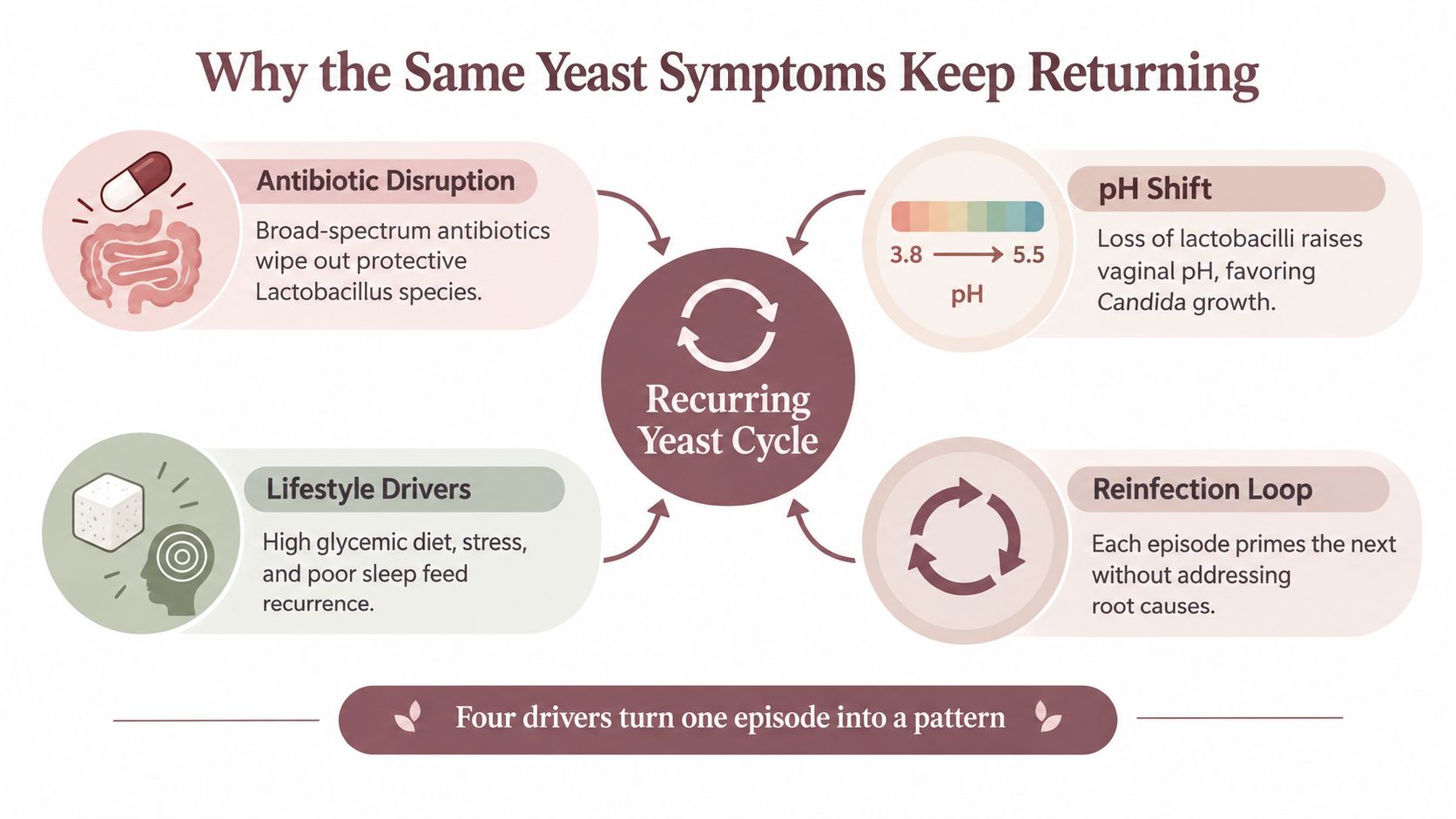
A flare that appears after antibiotics, around a predictable part of the menstrual cycle, or soon after treatment may reflect several interacting factors. Recurrence is not always a sign that you need a stronger version of the same product. Some people have an identifiable trigger, while others have no obvious underlying condition. The American Academy of Family Physicians reviews host and organism factors associated with recurrence.
The environment can change
Antibiotics can reduce protective vaginal bacteria along with the bacteria they target. That shift may give Candida more room to expand. If itching or discharge begins during or after an antibiotic course, record the medication and timing. A timeline gives a clinician more useful information than treating every later flare as an isolated event.
Hormonal changes can also influence the vaginal environment and the way Candida interacts with host defenses. Menstrual-cycle changes, pregnancy, and estrogen-containing contraception may all be relevant. A recurring mid-cycle or premenstrual pattern deserves a discussion of menstrual and contraceptive history, while still leaving room for other causes.
Glucose regulation is another factor clinicians may consider. Diabetes or impaired glucose tolerance is associated with recurrence, although many people with recurrent vulvovaginal candidiasis have no diagnosed metabolic condition. Frequent or unusually difficult-to-control episodes may justify asking whether glucose screening is appropriate, rather than trying another over-the-counter product.
The organism may not behave as expected
Consumer advice often assumes Candida albicans. Recurrent disease can involve non-albicans species, which may produce less dramatic discharge or respond less reliably to common azole treatment. These species account for an estimated 10% to 20% of recurrent cases, and the underlying process is not always clear. A review of azole resistance in non-albicans Candida provides further context.
Moisture, tight or occlusive clothing, mechanical irritation, immune suppression, and frequent sexual activity can sustain irritation or make symptoms more noticeable. None of these factors proves reinfection, and sex does not show that a partner caused the problem. They can help explain why discomfort intensifies after friction, trapped moisture, or disruption of an already irritated tissue barrier.
A flare soon after treatment should change the question from “Which product should I buy?” to “Was Candida confirmed, and was the species identified?” That shift makes room for testing and for causes that are not yeast at all.
The Repeat-OTC Loop That Keeps Symptoms Coming Back
The cycle often starts with familiar symptoms: itching or burning appears, an over-the-counter antifungal brings temporary relief, and the same product is used again when discomfort returns. That may be reasonable for a previously confirmed, uncomplicated episode. A frequent pattern or incomplete response calls for a different question, because symptom relief does not prove that yeast was the cause.
A short course may be too limited for established recurrence, substantial inflammation, inadequate exposure, or a species that responds differently to azoles. Repeating treatment can also quiet symptoms caused by BV, irritation, or a skin disorder while the underlying condition continues. The medication becomes a reset button, not a diagnosis.
Know when self-treatment has stopped being informative
Clinician-guided evaluation makes sense when:
- The episodes are frequent: Three or more symptomatic episodes within a year meet the commonly used RVVC definition.
- Symptoms persist: Discomfort that continues after a complete course needs reassessment.
- The pattern changes: Fissures, marked swelling, lesions, unusual odor, or new pain deserve examination.
- Treatment repeatedly fails: Species identification and susceptibility-aware care may be needed.
| Factor | Repeat OTC Antifungals | Clinician-Guided Plan |
|---|---|---|
| Diagnosis | Relies mainly on remembered symptoms | Uses history, examination, and testing when indicated |
| Organism | Usually assumes common Candida | Can identify non-albicans species through culture |
| Treatment length | Often repeats the same short course | May use a longer induction or maintenance approach |
| Alternative causes | May leave BV, UTI, or dermatitis untreated | Builds a differential diagnosis |
| Follow-up | Usually stops when symptoms improve | Reviews relapse, side effects, and prevention |
A better question: “What evidence confirms yeast this time, and what would change the treatment if it isn't?”
For selected patients, care may involve longer induction treatment, suppressive therapy, or alternatives such as nystatin or medically supervised boric acid, particularly when testing identifies a non-albicans species. These options are not universal. Boric acid requires particular caution during pregnancy and must be kept away from children and pets.
For external comfort while arranging care, Complete Infection Defense Kit is a non-prescription bundle containing topical support, a probiotic, urinary and bladder support, and suppositories. Its product statements have not been evaluated by the Food and Drug Administration. It is not intended to diagnose, treat, cure, or prevent disease, and should not replace examination or antifungal treatment when an infection is confirmed.

What a Real Diagnostic Workup Looks Like
A useful evaluation begins before the examination. Write down when each episode started, what symptoms appeared, where you were in your menstrual cycle, which products or medicines you used, whether antibiotics preceded the flare, and how completely treatment worked. Include contraception, diabetes risk, pregnancy possibility, immune-modifying medicines, and sexual or urinary symptoms.
The clinician may inspect the vulva and vagina for swelling, fissures, inflammation, lesions, and discharge. A vaginal pH reading can help distinguish candidiasis from BV, although pH alone can't identify every condition. Saline microscopy may look for clue cells or trichomonads, while potassium hydroxide preparation can reveal yeast forms or hyphae.
Why culture matters in recurring cases
When episodes are frequent, atypical, or unresponsive to standard azoles, a yeast culture with species identification can answer a question that symptoms can't. It may distinguish Candida albicans from non-albicans species and help guide a different treatment strategy.
The broader workup depends on the findings. A clinician may consider bacterial testing, STI screening, urine testing, glucose assessment, or evaluation for a vulvar dermatosis. A biopsy may be appropriate when the appearance raises concern for conditions such as lichen sclerosus, particularly when itching and fissuring continue without microbiological confirmation.
An at-home test may help you decide what to ask, but it has limits. This guide to testing for a yeast infection at home can support preparation, while persistent or recurrent symptoms still warrant professional interpretation.
A good workup isn't an obstacle to treatment. It protects you from spending months treating the wrong organism, the wrong body site, or the wrong diagnosis.
Evidence-Based Prevention and Daily Vulvovaginal Care
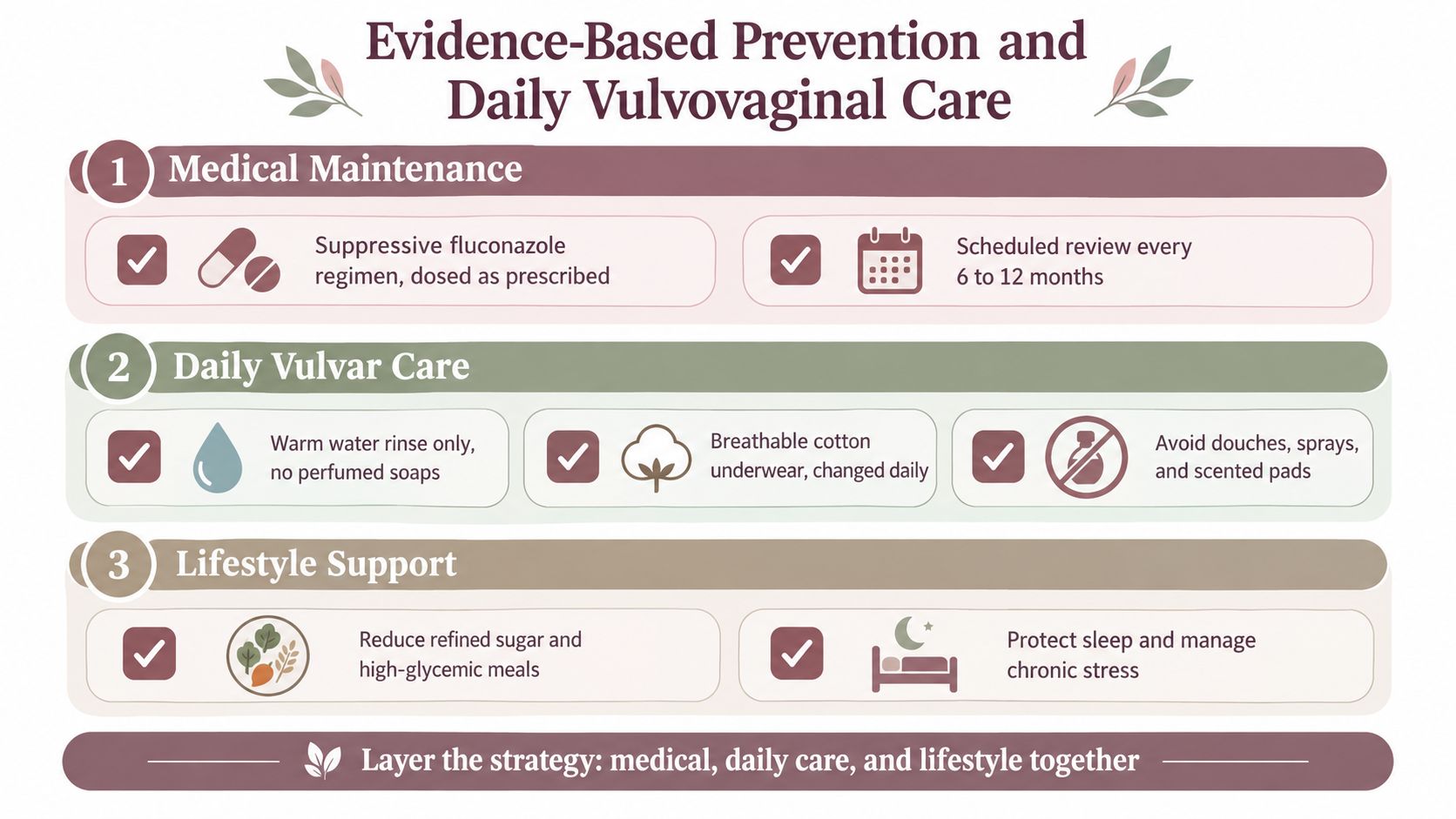
Prevention works best as a layered plan, not a single hygiene trick. Medical suppression may be appropriate after confirmed recurrent candidiasis, while daily care reduces avoidable irritation and lifestyle review helps identify patterns that keep reappearing.
Start with the strongest levers
Follow the prescribed antifungal plan fully, including any maintenance phase. Suppressive fluconazole regimens can help selected patients, but the medicine, dose, duration, interactions, pregnancy considerations, and monitoring belong with a clinician. Treatment should follow confirmation, particularly because non-albicans infections may need another approach.
For daily care, keep the routine deliberately boring:
- Clean gently: Warm water on the vulva is often enough. If you use cleanser, choose a mild, fragrance-free option and don't wash inside the vagina.
- Reduce friction and moisture: Change out of wet clothing, choose breathable fabrics, and avoid staying in damp underwear.
- Skip disruption: Douches, sprays, scented pads, fragranced wipes, and perfumed products can irritate tissue and disturb the local environment.
- Protect the barrier: Use adequate lubrication during sex and pause penetration when tissue feels raw or fissured.
Treat prevention claims with healthy skepticism
Good glucose control matters for people with diabetes or impaired glucose regulation. That doesn't mean a restrictive diet can cure confirmed candidiasis, and it doesn't mean every recurrence results from eating sugar. Probiotics may be discussed as supportive care, but they shouldn't replace diagnostic testing or prescribed treatment.
Condoms can reduce exposure to semen and may help some people identify whether intercourse contributes to flares. They don't prove that a partner caused the infection, and routine partner treatment isn't generally assumed for uncomplicated VVC. Avoiding unnecessary antibiotics is sensible, but don't decline a needed antibiotic because you're worried about yeast. Tell the prescriber about your history and ask what monitoring or follow-up makes sense.
Products for external soothing can support comfort, but they're not equivalent to antifungal treatment. For a candid, non-prescription perspective on comfort-focused care, you can review Revivol-XR yeast infection relief, then check every ingredient against your own sensitivity history. Stop any topical product that stings or worsens symptoms.
A practical prevention log can reveal what memory misses. Record cycle timing, antibiotics, products, sex, moisture, symptoms, test results, and treatment response. This guide to preventing recurring yeast infections can complement that record, but prevention should remain tied to confirmed causes rather than a growing list of rituals.
Key Takeaways and Common Questions
Recurring symptoms aren't automatically recurrent candidiasis. The clinical benchmark is three or more symptomatic episodes within one year, and persistent symptoms may reflect Candida, another infection, irritation, or a vulvar skin condition. Confirmation matters more as episodes become frequent or treatment stops working.
- Does recurrence mean my immune system is damaged? Not necessarily. Many cases are idiopathic, meaning no obvious predisposing condition is found. A clinician may still review diabetes, medicines, immune status, and other relevant factors.
- How long does suppressive fluconazole last? The duration is individualized. It depends on confirmed diagnosis, species, recurrence pattern, pregnancy status, other medicines, and response. Don't start or extend it without medical guidance.
- Does my partner need evaluation? Usually, recurrent symptoms aren't proof that a partner is reinfecting you. Evaluation may make sense if a partner has symptoms or if STI exposure is possible.
- What about perimenopause or menopause? Hormonal tissue changes can cause dryness and irritation that resemble yeast. Persistent fissures, pale or fragile skin, or itching without confirmed Candida should prompt assessment for skin conditions such as lichen sclerosus.
If symptoms keep returning, bring a written timeline and ask whether microscopy, culture with species identification, glucose screening, or a broader vulvar evaluation is appropriate.
Momotaro Apotheca offers plant-based, non-prescription vulvovaginal care, including topical products and curated routines for irritation, yeast-related discomfort, BV concerns, and urinary support. Visit Momotaro Apotheca to review the options, and use them as comfort support alongside appropriate clinical diagnosis and treatment.


