


Urinary Tract Infection Symptoms Older Adults: When to Act
Confusion, a fall, or cloudy urine is often called an “atypical UTI symptom” in older adults. But none of those signs, on its own, proves there's an infection. At the same time, an older person can have a UTI without reporting the familiar burning sensation.
For an adult child at the bedside, the useful question isn't just whether something has changed. It's what changed, how it differs from the person's usual pattern, and whether the changes add up to a reason for care today. New urinary symptoms matter more than urine appearance alone, and temperature needs to be compared with the person's normal.
Table of Contents
- Symptoms That Signal a UTI in Older Adults
- Red Flags and How Fast to Act
- Why UTI Symptoms Look Different With Age
- Confusion, Falls and Bacteria Without Symptoms
- How Caregivers Track Changes at Home
- Confirm the Infection Before Treating It
Symptoms That Signal a UTI in Older Adults
The familiar list of burning and urgency can miss older adults who can't describe discomfort clearly or who have other urinary conditions. Use a ranked checklist instead: new urinary symptoms and meaningful temperature changes carry more weight than confusion, a fall, or a change in urine appearance. No burning doesn't rule out infection.
A practical threshold is new dysuria alone, or at least two compatible new findings when dysuria is absent. This threshold is described in UK primary-care guidance for diagnosing urinary tract infections.
| Symptom or finding | Strength as a sign of infection | Why it matters |
|---|---|---|
| New dysuria, or burning while urinating | Strong | The most specific localized sign. New dysuria alone is treated as significant. |
| New urgency or frequency | Moderate, if new | Can overlap with an overactive bladder, prostate enlargement, or diuretic use. |
| New incontinence | Moderate, if new | May be the main noticeable change for someone with dementia or communication limits. |
| New suprapubic, or lower-belly, pain | Strong, if new | Can point to bladder involvement. |
| Flank or side pain | Urgent | May signal kidney involvement rather than bladder symptoms alone. |
| Visible blood in urine | Strong | Needs same-day clinical assessment. |
| Temperature of at least 38°C | Strong systemic sign | Seek clinical assessment rather than relying on self-care. |
| Temperature below 36°C | Systemic sign | Can be a warning sign, especially with a marked decline. |
| Rise of 1.5°C above the person's usual temperature on two readings within 12 hours | Systemic sign | Compare readings with the person's own baseline. |
| Confusion or new delirium | Nonspecific | Not diagnostic on its own. |
| A fall | Nonspecific | Not diagnostic on its own. |
| Cloudy, dark, or strong-smelling urine | Weak | Can occur without an infection. |
New urinary symptoms are more useful than a urine test alone because bacteria can be present without infection-related symptoms. UK clinical guidance also notes that a person's temperature may need to be understood against their usual baseline, not just judged by a single reading.
At the bedside: Count only findings that are new, compare them with the person's usual pattern, then use the urgency tiers below to decide how quickly to act.
Red Flags and How Fast to Act
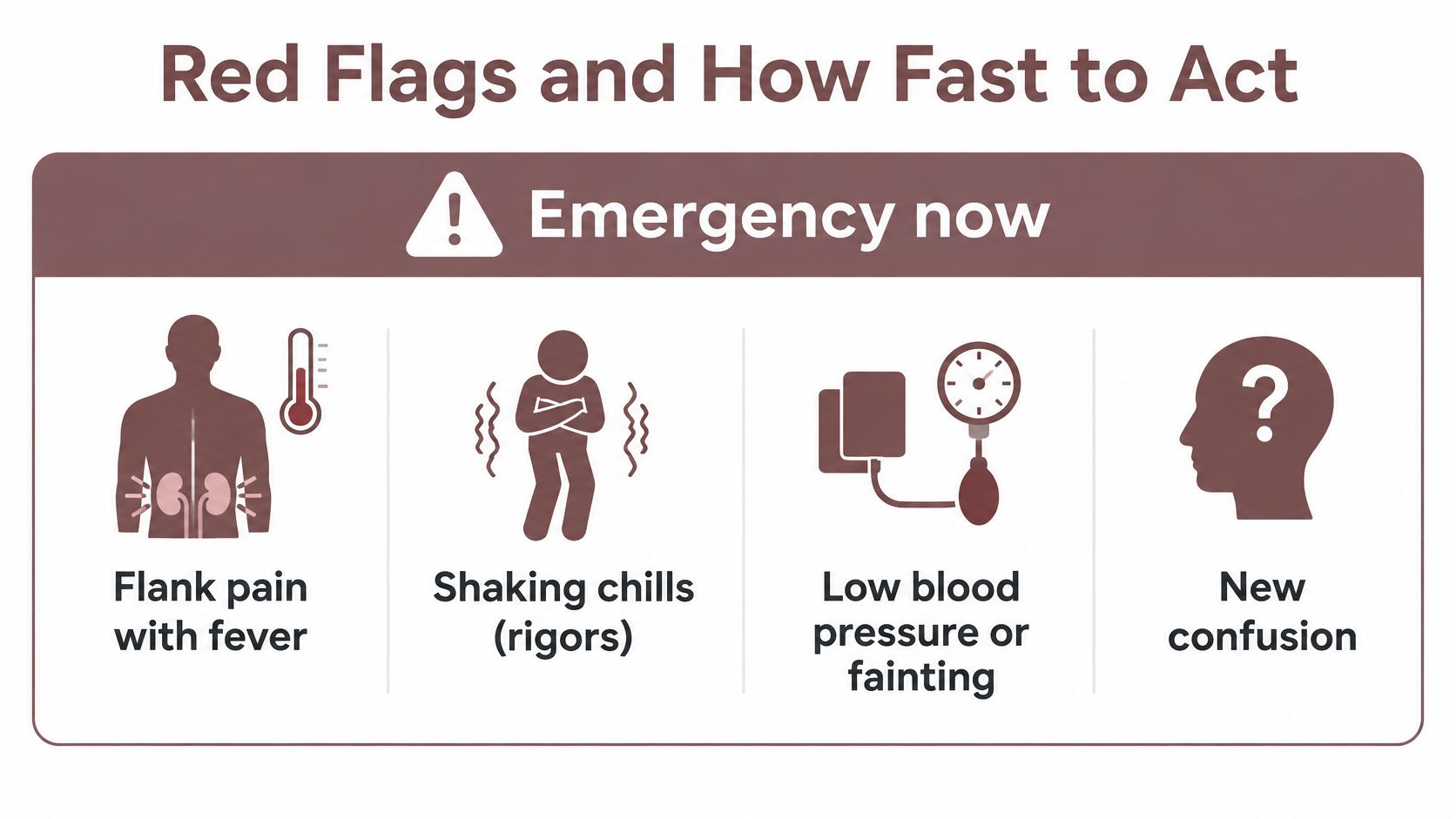
Emergency now is the first tier. Flank pain with fever, shaking chills, fainting or low blood pressure, or new confusion with hard-to-rouse drowsiness can signal serious illness. So can vomiting that prevents the person from keeping fluids down, or a temperature below 36°C alongside marked decline. These signs need emergency assessment, not home treatment.
Same day is the next tier. Contact a clinician today if there's new dysuria, even on its own, or at least two compatible new findings without emergency signs. These can include fever, new urgency or frequency, new incontinence, lower-belly pain, visible blood, or worsening function. A clinician can assess whether these changes fit a UTI or need another explanation.
Routine review fits a stable person whose urine looks cloudy or smells unusual but who has no new symptoms and no fever. Don't treat appearance alone as proof of infection. Note the change, look for other causes, and discuss it at the next scheduled review if the person remains well.
| Urgency tier | Typical findings | What to do |
|---|---|---|
| Emergency now | Flank pain with fever, rigors, low blood pressure or fainting, hard-to-rouse drowsiness, vomiting with fluids not kept down, or marked decline | Call emergency services or go to the emergency department now. |
| Same day | New dysuria alone, or at least two compatible findings without emergency signs; visible blood in urine | Contact a clinician today for assessment. |
| Routine review | Cloudy or odd-smelling urine, no new symptoms, no fever, and a stable baseline | Look for other causes and review at the next scheduled visit. |
Judge each tier against the person's usual temperature, behavior, mobility, and ability to drink. Serious illness in an older adult may not look exactly like it does in a younger person.
Use the highest tier that applies. If you're unsure whether a change is an emergency, call a clinician or emergency service rather than waiting for the picture to become clearer.
Why UTI Symptoms Look Different With Age
A smoke alarm can sound because toast is burning, but you still check the kitchen before calling the fire brigade. In the same way, a new change in an older person deserves attention, but it doesn't identify the cause by itself. Age-related health changes can make symptoms less typical, while also making it easier to mistake a non-infection for one.

After menopause, changes in the urethra and bladder lining can affect comfort and urinary symptoms. Prostate enlargement can narrow urine flow. A person with memory loss may not be able to explain burning, and a caregiver may instead notice new urgency, leakage, or reluctance to use the toilet. These clues need interpretation alongside the person's baseline and other signs.
UTI incidence rises with age among women in a UK observational study covering 2004–2014. The figures below are annual incidence rates, not the chance that any one new symptom is an infection. The study of UTI incidence and symptom patterns in older women also describes how common urinary symptoms can overlap with other conditions.
| Age group | Incidence per 100 person-years | What changes |
|---|---|---|
| 65–74 years | Approximately 9–11 | Risk is already rising after menopause. |
| 75–84 years | 11.4–14.3 | Symptoms may be less typical. |
| Over 85 years | 14.7–19.8 | Almost 30% report a UTI in a year. |
In that study, more than 10% of women over 65 reported a UTI during the previous year, rising to almost 30% of women over 85. Higher risk doesn't mean every new behavior or urine change is infection. Normal ageing, genitourinary conditions, and bacteria in the urine without infection can all complicate the picture.
For a plain-language overview of possible causes and risk factors, see what causes a UTI.
A urine test can help a clinician, but it can't replace the symptom story. Because classic signs may be harder to recognize or report, assessment should focus on new symptoms, temperature, baseline, and clinical judgment rather than a test result alone.
The video below offers another overview of urinary tract infection symptoms and care.
Confusion, Falls and Bacteria Without Symptoms
The myth is that confusion, falls, weakness, or lost diabetic control automatically mean a UTI. These changes can occur during illness, but they don't diagnose a urinary infection on their own. Sudden confusion can also come from dehydration, medicine effects, pain, constipation, pneumonia, stroke, or low blood sugar. A clinician needs to consider those possibilities, especially when urinary symptoms are absent.
An older person with dementia may not be able to report burning or urgency reliably. A small 2024 study of 78 community-dwelling people over age 50 with dementia found no significant association between self-reported UTI symptoms and confirmed infection status, according to the research report. That finding doesn't make symptom assessment useless. It underlines why caregivers should share observed changes and why clinicians need to consider the whole picture.
Bacteria in a urine test aren't the whole diagnosis
Asymptomatic bacteriuria means bacteria are present in urine without attributable urinary symptoms. It's often found during testing for another reason. A positive culture or dipstick therefore doesn't, on its own, prove that a person has a symptomatic UTI.
| Setting or study | Bacteria without symptoms | Context |
|---|---|---|
| Otherwise healthy older women and men | 4–19% | Review estimate. |
| Community-dwelling older people | 5–20% | Clinical review estimate. |
| Institutionalized older adults | 15–50% | Can be as high as 50% in facility residents. |
| Care-home residents by age 80 | About half | UK guidance estimate. |
| Hospitalized older adults, Alberta 2024 | 43.3% (103 of 238) | Bacteriuria was present without documented symptoms. |
These estimates come from different reviews and settings, so they aren't interchangeable. The Infectious Diseases Society of America guideline on asymptomatic bacteriuria explains why a positive urine test needs to be interpreted alongside symptoms and the person's clinical condition.
In a 2024 Alberta study of hospitalized older adults, 44.6% (106 of 238) had a UTI diagnosis supported by documented clinical and microbiological findings, while 43.3% (103 of 238) had bacteriuria without documented symptoms. The study of UTI diagnosis in hospitalized older adults illustrates why clinicians distinguish a symptomatic infection from bacteria detected in urine.
A separate 2026 cohort of hospitalized patients aged 60 and older found urinary urgency, frequency, or dysuria in 64.5% of patients with pyuria and 45.7% of those without pyuria, in a BMC Geriatrics study. Pyuria, like bacteriuria, doesn't settle the diagnosis by itself.
When observation can be safer than antibiotics
IDSA guidance recommends looking for other causes and observing, rather than automatically prescribing antibiotics, when an older adult with cognitive or functional impairment has bacteriuria and delirium but no local urinary symptoms, fever, or hemodynamic instability. The same approach applies after a fall when urinary or systemic signs of infection are absent. If the person is unstable or deteriorating, seek urgent care instead of assuming the change is harmless.
Antibiotics can cause adverse effects and contribute to Clostridioides difficile infection and antimicrobial resistance. Treating bacteria in urine without evidence of symptomatic infection can expose someone to those risks without a demonstrated benefit.
How Caregivers Track Changes at Home
A short, factual diary can help you describe what changed without having to diagnose the cause. The aim is to give the clinician a clear comparison with the person's usual temperature, continence, behavior, and comfort.
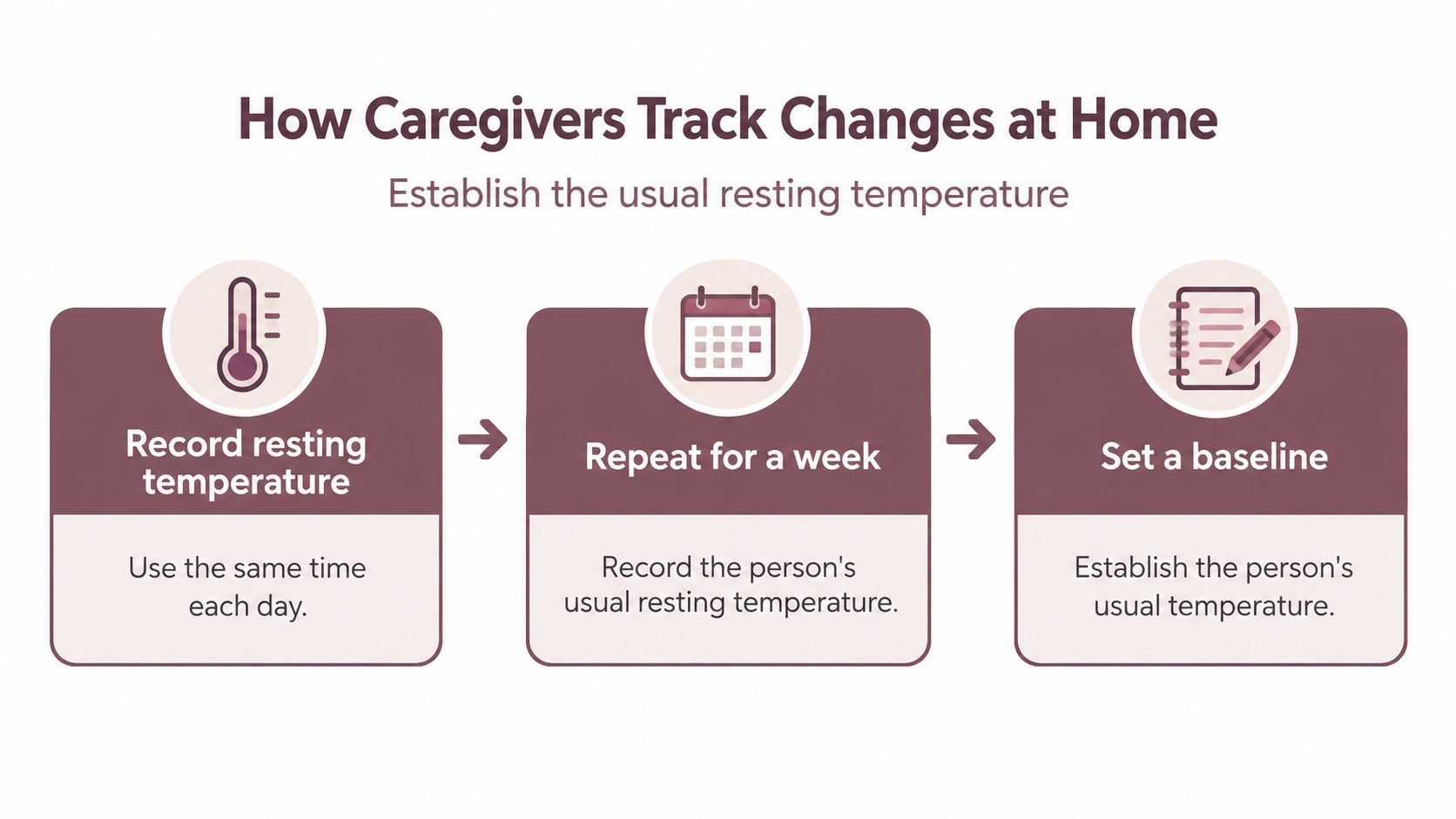
- Set a temperature baseline. Record the person's resting temperature at the same time each day for a week. That gives you a usual reading to compare with if they seem unwell.
- Note toilet-pattern changes. Record new leakage, dribbling, more frequent trips, or more nighttime trips. The change from usual matters more than a longstanding symptom.
- Track drinking. Write down whether fluid intake has dropped. Less drinking may help explain a change in how the person feels, but it doesn't rule infection in or out.
- Describe behavior in plain words. Note what happened and when, such as “more restless after lunch.” This gives the clinician a concrete account when memory or communication makes it hard for the person to explain discomfort.
- Watch for pain clues. Grimacing while urinating, lower-belly or back discomfort, or reluctance to move may help identify a problem the person can't describe.
- List medicine changes. Include recent additions, dose changes, or medicines stopped, so the clinician can consider whether they relate to the symptoms.
- Bring the diary to the appointment. Point out any entry that fits an urgent or same-day tier. If there's a catheter, note its type, when it was last changed, and any blockage or leakage around it. Bacteria in a catheter bag alone doesn't establish an infection.
For practical help reducing fall hazards at home, see these fall prevention tips for older adults. They're useful alongside symptom tracking, but a fall itself still needs to be interpreted with the person's other changes.
For general background on maintaining urinary health, you can also read about urinary tract health.
For example, if a daughter records her mother's temperature 1.6°C above her baseline and also notes new evening confusion, those are two changes worth reporting to a clinician the same day. The example is a prompt to seek assessment, not a diagnosis; the clinician still needs to evaluate the full situation.
Confirm the Infection Before Treating It
If symptoms meet the action threshold, the next step is clinical assessment, not guessing from urine appearance. A clinician can take a history, examine the person, compare temperature with their baseline, review medicines, and decide whether urine testing and culture are appropriate.
When possible, a urine culture can help guide treatment. A dipstick result alone is less reliable in older adults, and bacteria may be present without infection symptoms. A clinical review of diagnosis and treatment in older adults emphasizes combining symptoms and clinical context rather than relying on urine findings alone.
Bring specific questions to the visit:
- Which findings meet the threshold for suspected UTI? Ask which changes are new and whether they form a compatible pattern.
- Is a urine culture needed? Ask how the result will be interpreted alongside symptoms.
- What other causes have been considered? Mention changes in hydration, medication, pain, bowel habits, breathing, or blood sugar when relevant.
- What should we watch for overnight? Ask which new signs mean emergency care and how to reach help if the person worsens.
- If UTIs keep returning, what prevention options fit this person? Ask the clinician to consider health conditions, medicines, and individual risks.
Persistent bladder discomfort can also have non-infectious causes. If symptoms recur but testing doesn't confirm infection, discuss other possibilities such as interstitial cystitis or bladder pain syndrome with a clinician.
For people considering non-prescription urinary wellness products, the Bladder & Belly Kit contains a probiotic and a urinary tract and pelvic health supplement. It isn't a substitute for diagnosing or treating an established infection. Consult a medical professional before starting a supplement, especially if the person takes medication or has a medical condition.
Today, book the assessment, bring the symptom diary, and call emergency services if any emergency-tier sign appears.
Momotaro Apotheca offers plant-based products for vulvovaginal care and urinary tract wellness, including options intended for supportive daily care rather than treatment of an established UTI. Visit Momotaro Apotheca to explore its educational resources and product information, and consult a clinician about symptoms or supplements.


