


Vaginal Dryness Products: How to Choose What Works
Most advice about vaginal dryness products starts with the wrong question: “Which product is best?” That assumes a lubricant, moisturizer, balm, and hormone treatment all solve the same problem. They don't.
A product that makes sex less friction-heavy may do almost nothing for daily discomfort. A moisturizer that supports ongoing comfort may be the wrong choice for immediate penetration. The smart purchase depends on the job, the tissue involved, your sensitivities, and whether the problem is temporary friction or persistent vaginal dryness.
| Your need | Start with | Don't confuse it with |
|---|---|---|
| Ongoing internal comfort | Vaginal moisturizer | A lubricant used only during sex |
| Immediate friction relief | Water-based or silicone lubricant | A daily treatment |
| External vulvar irritation | Minimal topical balm | An internal vaginal product |
| Persistent dryness linked to low estrogen | Clinician-guided treatment | A cosmetic “natural” claim |
Table of Contents
- Stop Buying the Wrong Thing
- The Four Product Categories You Are Choosing Between
- Ingredients, pH, and Osmolality That Matter Most
- Moisturizers, Lubricants, and Balms Compared Side by Side
- Hormonal and Non-Hormonal Options Without the Spin
- Matching the Product to the Moment
- A Simple Decision Framework and When to See a Clinician
Stop Buying the Wrong Thing
The most common shopping mistake is buying a personal lubricant for daily comfort. Lubricant is designed to reduce friction during a specific activity. It can make penetration or solo play more comfortable, but it usually doesn't function as an ongoing treatment for dryness between sexual activity.
The opposite mistake happens too. People buy a product marketed as a vaginal moisturizer, then discover it behaves like a thin lubricant that disappears quickly. Some brands just repackage a water-based lubricant with softer language about hydration. That marketing blurs the difference between temporary slip and longer-lasting moisture support.
Vaginal dryness is one symptom, but the use cases are different:
- Chronic comfort: You feel dry, tight, irritated, or generally uncomfortable during the day.
- Partnered sex: Friction rises during penetration and you need immediate slip.
- Solo comfort: A toy, finger, or dilator needs lubrication that won't create unnecessary drag.
- Tissue recovery: The vulvar or vaginal tissue feels irritated after sex, hormonal changes, treatment, or another source of inflammation.
Those situations can overlap, but they don't automatically call for the same product. Independent clinical reviews distinguish lubricants, which provide short-term friction relief, from moisturizers, which are intended for longer-term symptom control. They also find no strong head-to-head evidence proving that one over-the-counter product class wins for everyone. Choice depends more on use case, formulation, tolerability, pH, and osmolality than on words such as “premium,” “clean,” or “ultra-hydrating” (this clinical review of vaginal moisturizers and lubricants).
The label trick to ignore
A product can contain water, aloe, glycerin, or botanical extracts and still be a lubricant rather than a moisturizer. Read the directions. If the instructions say to apply immediately before sex, the product is functioning as a lubricant. If it's intended for scheduled use between sexual activity, it's functioning as a moisturizer.
That distinction matters because applying a lubricant repeatedly to irritated tissue can expose you to ingredients that aren't necessary for everyday use. It can also leave you thinking your “moisturizer” failed when the actual problem was a category mismatch.
Practical rule: Choose the product for the moment first. Choose the ingredient story second.
A useful overview of how these categories fit into intimate care is available in this guide to intimate wellness products. The rest of your decision should follow the same logic: identify the job, then choose the simplest product that can do it.
The Four Product Categories You Are Choosing Between
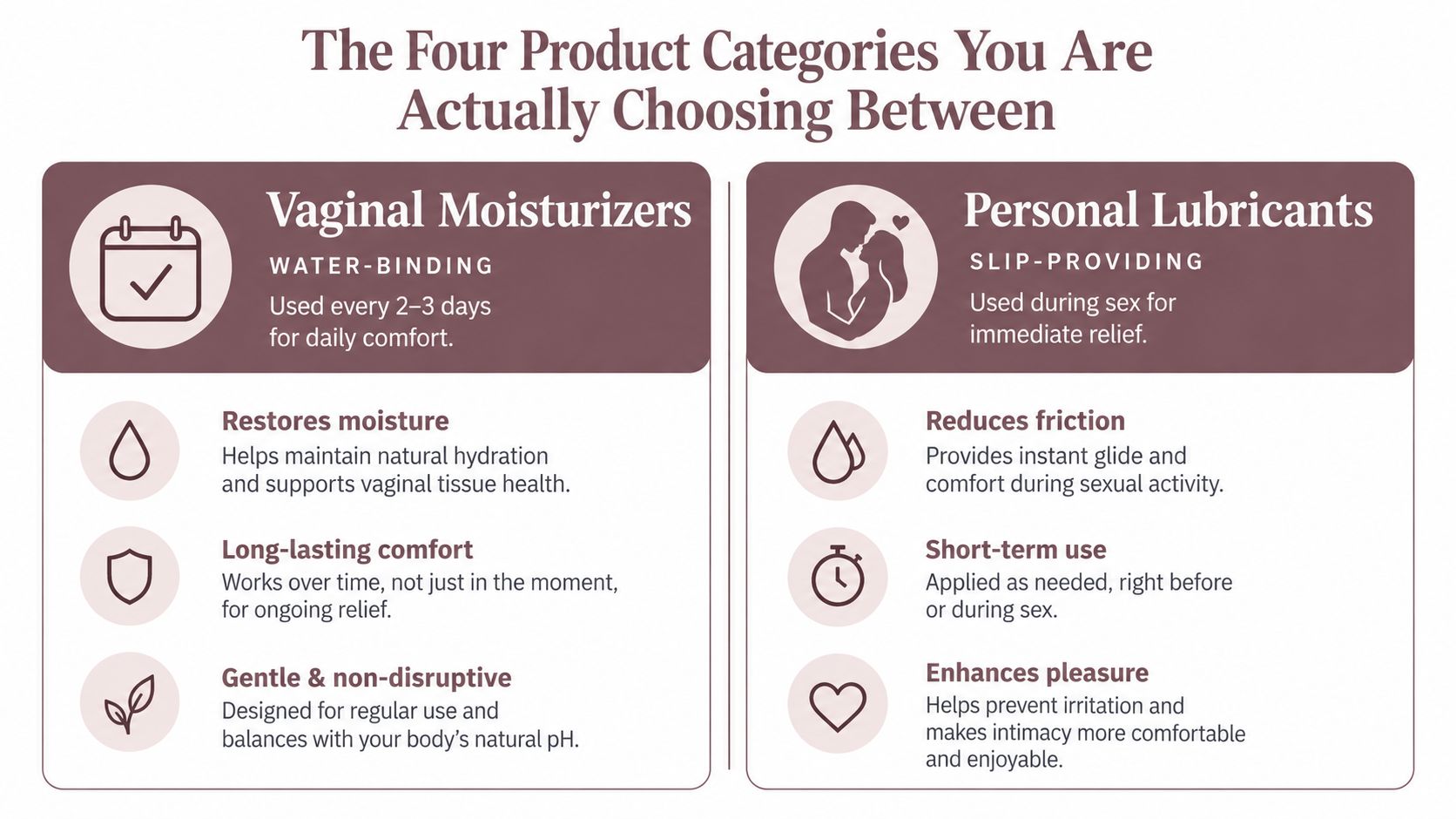
Start with the category, not the marketing label. Vaginal dryness products fall into four practical categories, and each has a different job.
Vaginal moisturizers
A vaginal moisturizer is designed for ongoing internal comfort, rather than one sexual encounter. Common non-hormonal options include hyaluronic acid suppositories and polycarbophil-based gels. These ingredients bind or retain water, giving some people a longer-lasting feeling of moisture than a basic lubricant. For a closer look at formulation choices, see this guide to an organic vaginal moisturizer.
A randomized trial comparing polycarbophil vaginal moisturizing gel with hyaluronic acid gel found improved vaginal health scores in both groups. Polycarbophil was non-inferior to hyaluronic acid, with final mean scores of 16.36 ± 2.66 versus 16.60 ± 2.50 after the trial period (the randomized polycarbophil and hyaluronic acid trial). That supports moisturizers as a legitimate product category, while leaving room for differences in tolerability, formulation, and personal response.
Personal lubricants
Lubricants provide immediate slip for sex or other friction-producing activity. Water-based formulas rinse away easily and generally work with latex condoms. Silicone lubricants usually last longer, which helps when reapplication would interrupt sex, though you should check compatibility with silicone toys.
A lubricant manages friction. It does not treat low-estrogen tissue, recurring irritation, or an underlying infection. Apply enough to prevent discomfort, and discontinue the formula if it stings, burns, or leaves you irritated afterward.
Topical vulvar balms and oils
Balms and oils belong on the external vulva, unless the label specifically approves internal use. Coconut oil, jojoba oil, shea-based formulas, and petrolatum-style barriers can reduce rubbing from clothing, sweat, or post-sex sensitivity.
Do not assume an external balm is a vaginal lubricant. Oil can weaken latex condoms, while heavier formulas may feel occlusive or aggravate sensitive skin. A balm can protect external skin and still be the wrong product for penetration.
Hormone-based options
Hormonal treatment includes low-dose vaginal estrogen creams, tablets, and rings, vaginal DHEA products, and systemic hormone therapy. These treatments act on hormone-responsive tissue instead of only adding surface moisture.
The choice between hormonal and non-hormonal care depends on symptom severity, medical history, cancer history, breastfeeding, personal preference, and signs of genitourinary syndrome of menopause. A Vaginal Suppository is a non-hormonal Momotaro Apotheca catalog option positioned for vaginal wellness and infection-related support. It should not replace diagnosis or prescribed treatment.
Ingredients, pH, and Osmolality That Matter Most
Pretty packaging cannot tell you whether a formula will tolerate well. pH, osmolality, preservatives, fragrance, and sensation additives matter more than labels such as organic, feminine, intimate, or natural.
The vagina is naturally acidic, while vulvar skin has different needs. A product made for internal use should account for vaginal acidity, not merely claim to be “balanced.” A formula may feel smooth at first and still irritate tissue if its chemistry does not suit the area.
Osmolality gets overlooked in product marketing. It describes how strongly a formula draws water toward itself. Highly concentrated water-based lubricants can pull water from epithelial cells, contributing to irritation and tissue disruption. Most labels do not disclose osmolality, so ask the manufacturer directly or choose a formula with a short, transparent ingredient list.
What deserves suspicion
Glycerin and propylene glycol are not automatically harmful in every formula. High concentrations can still be a poor fit for anyone prone to burning or recurrent irritation. If glycerin is a concern, this review of a glycerin-free water-based lubricant shows what a minimalist formula looks like.
Fragrance, warming agents, tingling additives, flavors, glitter, and numbing ingredients such as benzocaine add sensation or scent that sensitive tissue does not need. Petroleum jelly has a legitimate role as an external barrier, but it is a poor default for penetration. It can interfere with latex condoms and may be difficult to remove. Chlorhexidine, methylisothiazolinone, and unnecessary preservatives also warrant caution when tissue is already reactive.
| Concern | Avoid | Safer alternative |
|---|---|---|
| Excessive humectant concentration | Glycerin-heavy or propylene glycol-heavy formulas | A minimalist moisturizer or lubricant with transparent ingredients |
| Unnecessary sensory additives | Warming, tingling, fragrance, flavor, or numbing agents | Fragrance-free, unscented formulas |
| Condom incompatibility | Oils and petroleum-based penetrative lubricants with latex condoms | A condom-compatible water-based or silicone lubricant |
| Harsh preservatives | Chlorhexidine or methylisothiazolinone when avoidable | A short, clearly disclosed ingredient list |
| Unknown formulation chemistry | Products that hide pH or provide no formulation details | A manufacturer that discloses pH and answers osmolality questions |
Match the formula to the problem. Hyaluronic acid and polycarbophil-based moisturizers make more sense for ongoing internal dryness than a basic slip product. Silicone ingredients such as dimethicone can provide longer-lasting lubrication than some water-based products, but check compatibility with your condoms and toys.
For immediate sexual friction, Coconu Water Based Lubricant is described as using organic coconut water instead of aloe. Its listed details include a pH-balanced formula, hypoallergenic positioning, latex-condom safety, and toy compatibility. Those details help with product selection, but your own tolerance remains the final test.
Ask three questions before buying:
- Is this intended for daily moisture or immediate friction relief?
- Does the manufacturer disclose pH and provide meaningful osmolality information?
- Can I identify every fragrance, preservative, humectant, and sensation additive in the formula?
Vague answers are a reason to keep shopping.
Moisturizers, Lubricants, and Balms Compared Side by Side
The non-hormonal categories aren't rivals in the way product pages suggest. They solve different problems.
A moisturizer makes sense when dryness persists between sexual activity. A lubricant makes sense when friction is the immediate issue. A balm makes sense when the external vulva needs a protective layer against rubbing, sweat, tight clothing, or post-sex discomfort.
| Product Class | Best Use Case | Duration of Effect | Typical pH | Key Trade-Off |
|---|---|---|---|---|
| Vaginal moisturizer | Ongoing internal dryness | Longer than a single sexual encounter | Formulation-dependent and designed for vaginal use | Needs consistent use and may not provide enough slip for sex |
| Water-based lubricant | Immediate sex or toy-related friction | Shorter, with possible reapplication | Should be formulated for vaginal tissue | Easy to clean, but some formulas dry or become tacky |
| Silicone lubricant | Longer-lasting sexual lubrication | Often longer-lasting than water-based formulas | Product-dependent | Can be harder to wash off and may not suit silicone toys |
| Topical balm or oil | External vulvar dryness and rubbing | Varies by barrier strength and skin tolerance | Not a vaginal pH treatment | Oils may weaken latex condoms and aren't ideal internal lubricants |
Moisturizers for the background problem
Hyaluronic acid and polycarbophil products are the most sensible starting points when the complaint is persistent dryness rather than one uncomfortable sexual encounter. They can be used according to the product's schedule, but don't use more often just because the tissue feels dry. More product isn't automatically more relief.
Their weakness is practical. A moisturizer may leave the tissue feeling better during the day but still require a separate lubricant for penetration. That isn't failure. It's two products doing two jobs.
Lubricants for the event
Water-based lubricants are versatile and usually easier to clean. Their main drawbacks are drying, tackiness, and the need to reapply. Silicone formulas tend to last longer and can be useful for water-based sex or situations where friction continues for a while, but check toy compatibility before use.
Avoid assuming that every water-based product is gentle. The clinical review cited earlier specifically emphasizes that formulation factors, including pH, osmolality, and tolerability, matter more than the broad “water-based” label.
Balms for the outside
A topical balm is a barrier product, not a vaginal moisturizer by default. It can be valuable when the problem is external rubbing, chafing, or irritated vulvar skin. It can also be useful after sex if the external tissue feels dry and tender.
Soothe & Restore Salve is described as an organic balm made with coconut and jojoba oils for external vulvovaginal comfort and moisture-barrier support. Because it's oil-based, treat it as an external balm and consider latex-condom compatibility before using it during sex.
Don't ask one product to be a moisturizer, lubricant, barrier, infection treatment, and hormone replacement all at once. That's how marketing creates confusion.
Hormonal and Non-Hormonal Options Without the Spin
Non-hormonal products aren't automatically safer, and hormonal products aren't automatically excessive. The right comparison is mechanism, symptom severity, contraindications, and evidence.
A randomized, multicenter trial of 172 postmenopausal women with vulvovaginal dryness found that a hormone-free moisturizing cream was non-inferior to 0.1% estriol cream after 43 days for symptom severity outcomes in a controlled setting (the randomized trial of hormone-free moisturizer versus estriol). That supports a legitimate role for non-hormonal care, especially when symptoms are mild or hormones aren't appropriate. It doesn't prove that moisturizers replace estrogen for every person with tissue atrophy.
| Option | Mechanism | Evidence Strength | Best Candidate |
|---|---|---|---|
| Hyaluronic acid moisturizer | Retains water at the tissue surface | Supported by comparative clinical research | Mild dryness or preference for non-hormonal care |
| Polycarbophil moisturizer | Forms a moisture-retaining film | Supported by randomized comparative research | Ongoing comfort between sexual activity |
| Vaginal estrogen | Acts on estrogen-responsive vaginal tissue | Strong clinical role for genitourinary menopause symptoms | Moderate or persistent menopause-related symptoms under clinical guidance |
| Vaginal DHEA | Local hormone precursor activity | Clinically established option requiring medical discussion | Selected people with persistent menopausal symptoms |
| Systemic hormone therapy | Treats broader hormone-related symptoms | Depends on the individual indication and risk profile | People needing systemic menopausal treatment, not dryness alone |
| Topical botanical or vitamin formulas | Surface soothing or barrier support | Product-specific and less consistent | External sensitivity or a preference for minimalist care |
Where hormones fit
Low-dose vaginal estrogen, vaginal DHEA, and related treatments target the biology of low-estrogen tissue. They're often more appropriate when dryness comes with recurrent urinary symptoms, fragile tissue, burning, or pain that keeps returning despite reasonable non-hormonal care.
Systemic hormone therapy is a broader decision. Don't start it solely because a lubricant failed, and don't assume a vaginal moisturizer can address every symptom of tissue atrophy. Breast cancer history, unexplained bleeding, current medications, pregnancy-related status, and breastfeeding all belong in the clinical conversation.
Where non-hormonal care fits
Hyaluronic acid and polycarbophil products are reasonable first options for mild symptoms, temporary hormonal shifts, or people who prefer to avoid hormones. People with a history of hormone-sensitive cancer may also begin with non-hormonal products, but “non-hormonal” doesn't mean “no medical advice needed.”
For broader menopause-related skin dryness and self-care context, these dry skin remedies from Skin Perfection can complement, but not replace, evaluation of persistent vulvovaginal symptoms. Vaginal tissue symptoms deserve their own assessment when they continue or worsen.
Matching the Product to the Moment
The fastest way to choose among vaginal dryness products is to name the moment when the problem appears.
Daily perimenopause comfort: Start with a vaginal moisturizer, such as a hyaluronic acid or polycarbophil-based product, used according to its directions. If it causes burning, stop it rather than adding a second product on top. Your backup is a simpler formula with fewer ingredients, followed by a clinician visit if dryness remains persistent.
Sex-related friction: Use a water-based or silicone lubricant at the time of sexual activity. Check condom compatibility and avoid oils with latex condoms. If a water-based product dries too quickly, a silicone option may be more practical. If both cause burning, stop experimenting and get evaluated for irritation, infection, pelvic floor dysfunction, or tissue changes.
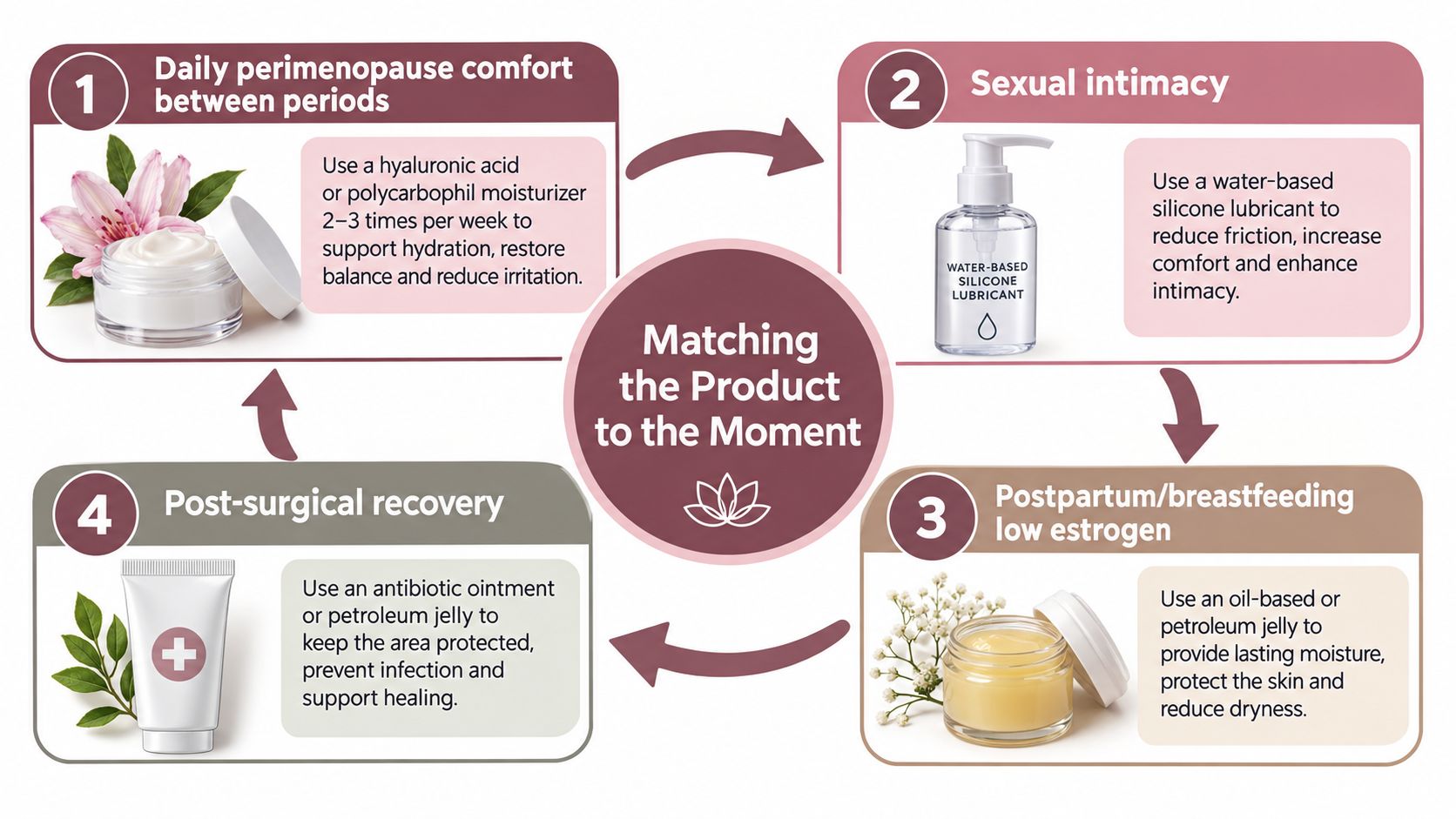
Postpartum or breastfeeding dryness: Begin with a non-hormonal moisturizer for ongoing comfort and a compatible lubricant for sex. Breastfeeding can coincide with lower estrogen, so persistent symptoms deserve a discussion with an obstetric or gynecologic clinician. Vaginal estrogen may be considered in some situations, but it's a medical decision, not a product-page decision.
Sensitive-skin flare days: Keep the external routine boring. A single-ingredient or minimalist external barrier may be more appropriate than a botanical blend with multiple extracts. Plain petrolatum can protect external skin, but don't use it as a penetrative lubricant with latex condoms. If petrolatum feels occlusive or irritates you, stop and ask a clinician about another barrier option.
Vulvodynia or lichen sclerosus history: Don't treat every flare as ordinary dryness. Use only products already known to be tolerated, avoid fragrance and sensation additives, and follow the treatment plan for the underlying condition. If the skin changes, cracks, bleeds, or becomes persistently painful, self-care has reached its limit.
The right product should reduce friction or discomfort. It shouldn't create a new burning sensation that you then try to manage with another product.
A Simple Decision Framework and When to See a Clinician
Use four questions, in order.
-
Is the problem ongoing comfort or immediate friction?
Ongoing dryness points toward a vaginal moisturizer. Sexual friction points toward a lubricant. External rubbing points toward a topical balm. -
Does the pattern suggest a hormone-related tissue change?
Menopause, postpartum hormonal shifts, breastfeeding, cancer treatment, and some medications can change vaginal comfort. If symptoms are persistent or severe, discuss the cause rather than endlessly testing products. -
What does your tissue tolerate?
Start with fewer ingredients. Avoid fragrance, warming or tingling agents, numbing ingredients, and formulas that leave you burning. A “natural” label doesn't override your skin's response. -
Can you verify the formulation?
Look for clear directions, condom compatibility, pH information, and useful answers about osmolality. If the company hides the formulation behind vague wellness language, choose a more transparent option.
| Your Situation | Start With | Watch For | See a Clinician If |
|---|---|---|---|
| Dryness between sexual activity | Vaginal moisturizer | Burning, discharge, or worsening irritation | Symptoms persist despite appropriate care |
| Friction during sex or toy use | Water-based or silicone lubricant | Condom or toy incompatibility, stinging | Sex remains painful |
| External vulvar rubbing | Minimal topical balm | Rash, swelling, blocked or irritated skin | Skin changes, sores, or persistent itching appear |
| Menopause-related dryness | Non-hormonal moisturizer or clinical hormone discussion | Bleeding or recurring urinary symptoms | Symptoms are moderate, severe, or recurrent |
| Postpartum or breastfeeding discomfort | Non-hormonal moisturizer and lubricant | Pain, infection symptoms, or poor healing | Symptoms persist or hormone treatment is being considered |
| Suspected infection | Clinical evaluation | Odor, unusual discharge, burning, or escalating pain | Don't self-treat repeatedly without diagnosis |
Get medical help for persistent burning, recurrent urinary tract infections, bleeding after sex, visible vulvar skin changes, suspected infection, or dryness that doesn't improve after a reasonable trial of appropriate non-hormonal care. Pain with sex isn't something you should normalize or cover indefinitely with more lubricant.
My recommendation is straightforward: use a vaginal moisturizer for ongoing comfort, reserve lubricants for sexual activity, keep balms external unless the label specifically says otherwise, and choose the simplest formula your tissue tolerates. Skip glycerin-heavy, fragranced, warming, tingling, and numbing products, and don't let “organic” marketing distract you from pH, osmolality, condom compatibility, or your actual symptoms.
If you're comparing gentle options for dryness, external irritation, and sex-related friction, visit Momotaro Apotheca to review its vulvovaginal care products and routines. Choose based on the specific problem you're trying to solve, and contact a clinician when symptoms suggest something more than ordinary dryness.


