


Yeast Infection Relief Cream: What It Is and How to Choose
“Just use Monistat” and “natural is always better” both skip the question that matters: what are you trying to treat? A yeast infection relief cream might contain medicine that treats Candida, ingredients intended to ease external irritation, or a balm designed for everyday comfort. Those jobs aren't interchangeable.
You don't need to choose between medicine and wellness as competing philosophies. You need a clear diagnosis, a product that does the job you need, and a point at which you stop experimenting and ask for medical help.
Table of Contents
- Why a Yeast Infection Relief Cream Is Not One Thing
- The Active Ingredients That Actually Treat a Yeast Infection
- Topical Cream vs Oral Treatment When Choosing Your Path
- Matching the Cream to What Your Symptoms Are Actually Telling You
- Safety Signals and Red Flags That Change the Plan
- Supportive Care That Goes Beyond the Cream
- Putting It All Together Before You Buy
Why a Yeast Infection Relief Cream Is Not One Thing
The phrase yeast infection relief cream describes a shopping category, not a single treatment. Packaging often puts itching, soothing, vaginal wellness, and infection relief close together. That can make different products look equivalent when they aren't.
Start by separating the intended jobs. An antifungal addresses the infection. A comfort product addresses how irritated skin feels. A supportive routine addresses care around the episode, without establishing that an infection has been treated.
The diagram shows these categories, but the product label determines what any individual formula does.
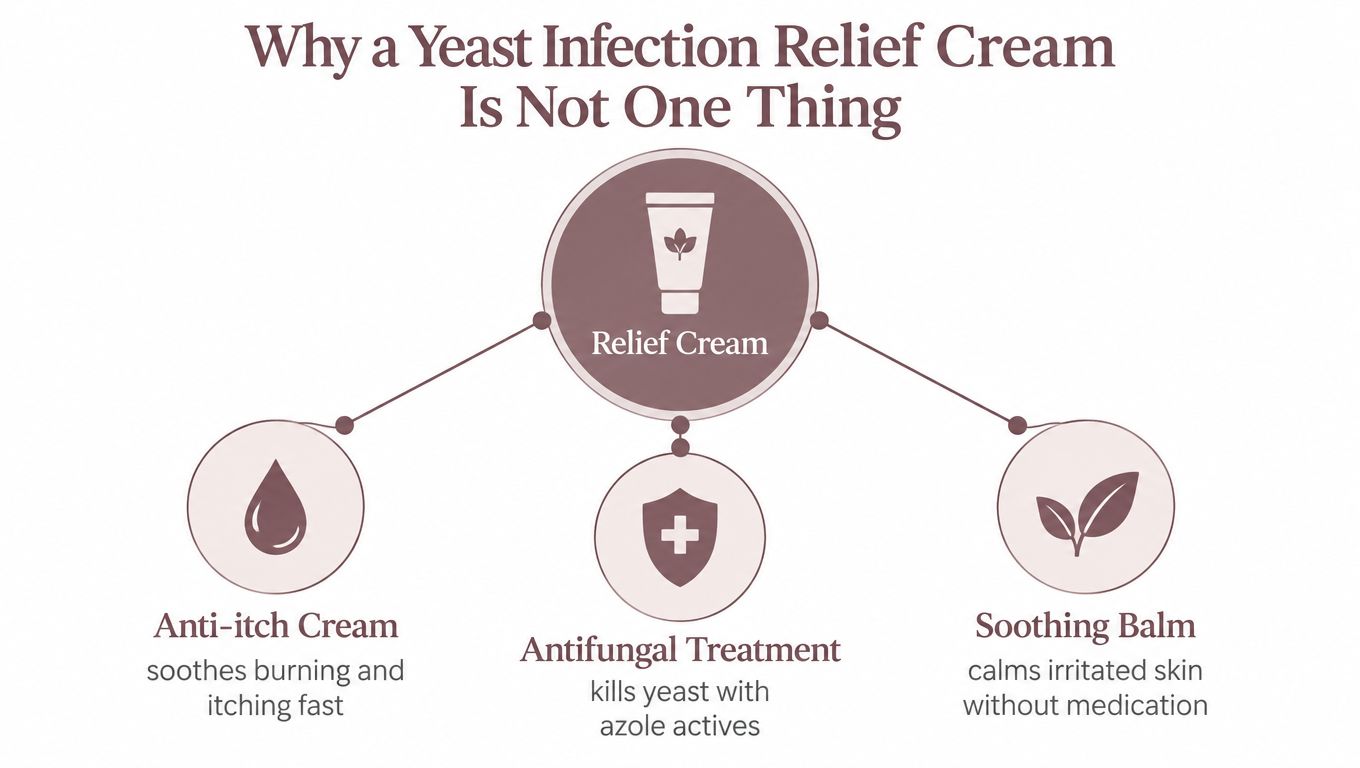
Match the product to its job
- Antifungal treatment: Medicines such as miconazole and clotrimazole treat vaginal candidiasis. Look for a named medicinal active ingredient and directions specifically for the intended use.
- External comfort: A cream marketed for vulvar itching or irritation may target discomfort without treating Candida. Don't assume that an anti-itch claim means the product is an antifungal.
- Supportive care: A plant-based balm may be intended for dryness, friction, or skin comfort. Its role doesn't become infection treatment because someone uses it during a yeast infection.
A useful example is someone whose skin feels calmer after applying a balm but whose abnormal discharge continues. The comfort benefit may be real. It doesn't answer whether the underlying vaginal problem has resolved.
Location matters, too
Vulvar means the external genital area. Vaginal refers to the internal canal. These words aren't interchangeable, and neither are products labeled for those locations.
An external comfort cream isn't automatically suitable for insertion. A vaginal antifungal may have specific application instructions that don't match the directions for an external balm. Read the route of use before reading marketing promises.
Practical rule: Ask “What does this product treat?” and “Where is it meant to go?” before asking which brand to buy.
This distinction also helps explain disappointing repeat purchases. If you're buying another soothing cream because the first didn't clear an infection, the problem may be a mismatch between product and purpose, not an insufficiently powerful formula.
The Active Ingredients That Actually Treat a Yeast Infection
Turn the package around. The active ingredient matters more than the largest promise on the front. For an antifungal medicine, you should be able to identify the ingredient, its concentration, its intended use, and the complete treatment directions.
These ingredient names can help you recognize medicinal products, though the illustration isn't a substitute for checking the actual label.
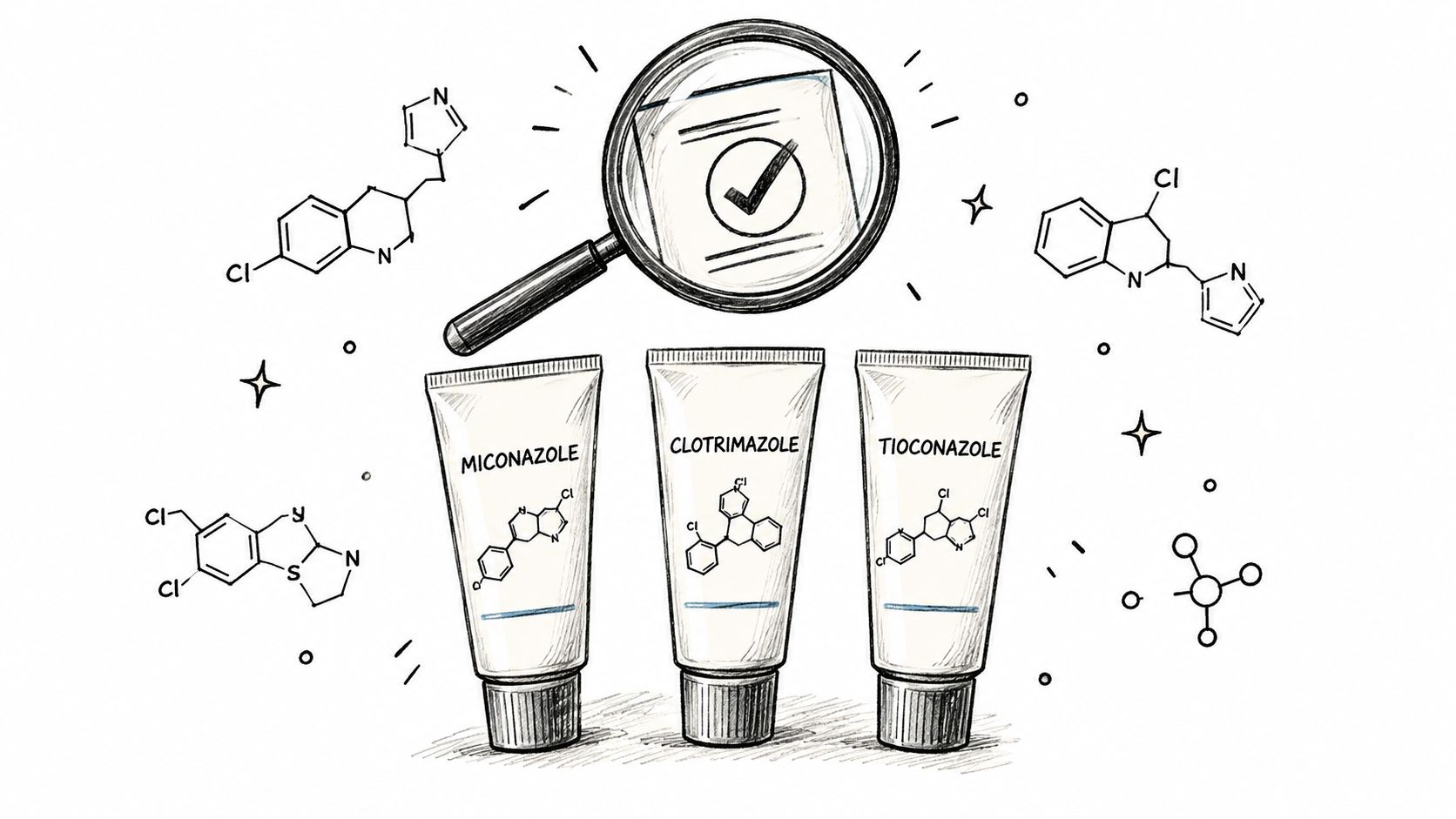
Read the medicine label before the marketing label
Azole is the name of a family of antifungal medicines. Miconazole and clotrimazole are established examples used for uncomplicated vaginal yeast infections. “Antifungal” describes a treatment role, not merely a soothing sensation.
Concentration and treatment duration belong together. FDA miconazole product records show an original approval date of January 30, 1974, for the record associated with Monistat 7, a 2% miconazole nitrate vaginal cream, and March 2, 2005, for Monistat 3, a 4% vaginal cream, illustrating the move from a seven-day regimen to a shorter three-day regimen at a higher concentration.
That history doesn't mean a higher percentage is automatically the better choice. Compare the whole regimen, not the concentration alone. Don't shorten a longer course by applying more cream, or assume a shorter course is appropriate for a complicated infection.
| Label detail | What to establish |
|---|---|
| Active ingredient | Is this a medicinal antifungal or a comfort formula? |
| Route of use | Is it intended for vaginal insertion, external application, or another use? |
| Course directions | What does completing this particular regimen require? |
| Warnings | Does your health situation require advice before use? |
For another format alongside the label checklist, the video below offers a visual reference.
Don't give botanical ingredients a medicinal job by assumption
Names such as tea tree, goldenseal, coconut oil, and jojoba oil can sound reassuringly familiar. Familiarity doesn't establish that a finished product treats vaginal Candida, nor does it establish suitability for internal use.
If you're considering nystatin or another alternative medicine, ask a clinician or pharmacist which formulation and indication apply to you. Don't transfer advice about a cream for another body site to vaginal treatment.
Likewise, words such as natural, homeopathic, and balance don't tell you whether a product has evidence for clearing an infection. Ask the concrete question: is the formula intended to treat Candida, support external comfort, or provide routine care?
A transparent comfort claim is more useful than an ambitious cure claim that the label can't substantiate.
Topical Cream vs Oral Treatment When Choosing Your Path
A pill is not a stronger choice, and a cream is not a gentler choice for every person. Diagnosis and health context come before delivery method. Convenience matters, but it should not decide whether you are treating the right condition.
For uncomplicated vulvovaginal candidiasis, topical azole medicines have a strong evidence base. Among patients who complete short-course topical azole therapy, approximately 80%–90% achieve both symptom relief and a negative follow-up culture, according to the CDC candidiasis treatment guidelines.
Notice what that result measures: relief plus a laboratory finding after treatment. It isn't a promise that every episode will respond, that all vulvar discomfort is Candida, or that treatment prevents future recurrence.
Topical vs Oral Yeast Infection Treatment at a Glance
| Factor | Topical Antifungal | Oral Antifungal |
|---|---|---|
| How it's used | Applied through the route specified for the vaginal medicine | Taken by mouth under the prescribed instructions |
| Practical fit | Requires comfort with application and completing the local regimen | Avoids vaginal application but still requires an appropriate treatment plan |
| External discomfort | An internal regimen doesn't automatically answer every external skin-care need | A pill isn't an external soothing product |
| Health context | Check the formulation, warnings, and suitability | Ask the prescriber to review your health context and other medicines |
| Persistent symptoms | Don't keep repeating courses without reassessment | Don't assume switching to a pill fixes an uncertain diagnosis |
| Pregnancy | Requires pregnancy-specific advice | Pregnancy changes which treatments are appropriate |
The most useful comparison isn't “cream versus pill” in isolation. It's whether the treatment matches an established infection, whether you can use it correctly, and whether your clinician has identified anything that changes the usual approach.
Convenience is a real trade-off, not a clinical shortcut
Some people would rather use a vaginal product than take medicine by mouth. Others find insertion uncomfortable, inconvenient, or difficult to manage. Those preferences deserve consideration once the treatment options are medically appropriate.
If an oral option such as fluconazole is being discussed, useful questions include: “Why does this fit my diagnosis?” “Does anything in my medication list change the choice?” and “What should I do if symptoms don't resolve?” For a topical option, ask about application, the complete course, and what degree of discomfort warrants stopping and calling.
Severe, recurrent, or nonresponsive symptoms need more than a preference-based decision. The CDC guidance cited above distinguishes these situations from uncomplicated infection and notes that suppressive maintenance treatment can control recurrence but is rarely curative over the long term.
Finishing treatment and preventing every future episode are different goals. A recurrence deserves a fresh assessment, not an automatic upgrade to a different delivery method.
Don't choose an oral medicine solely because the previous cream disappointed you. First establish whether the cream was the right medicine, whether the course was completed, and whether Candida was responsible.
Matching the Cream to What Your Symptoms Are Actually Telling You
Symptoms are information, not a diagnosis. The CDC guidance on candidiasis treatment recommends testing before treatment because yeast-infection symptoms can overlap with bacterial vaginosis, dermatitis, sexually transmitted infections, and other conditions; it also advises reassessment when symptoms return, fail to improve, or worsen.
Use the checklist as a prompt for questions, not a way to diagnose yourself. Itching, burning, discharge appearance, or a short symptom duration alone can't establish that an over-the-counter antifungal is appropriate.
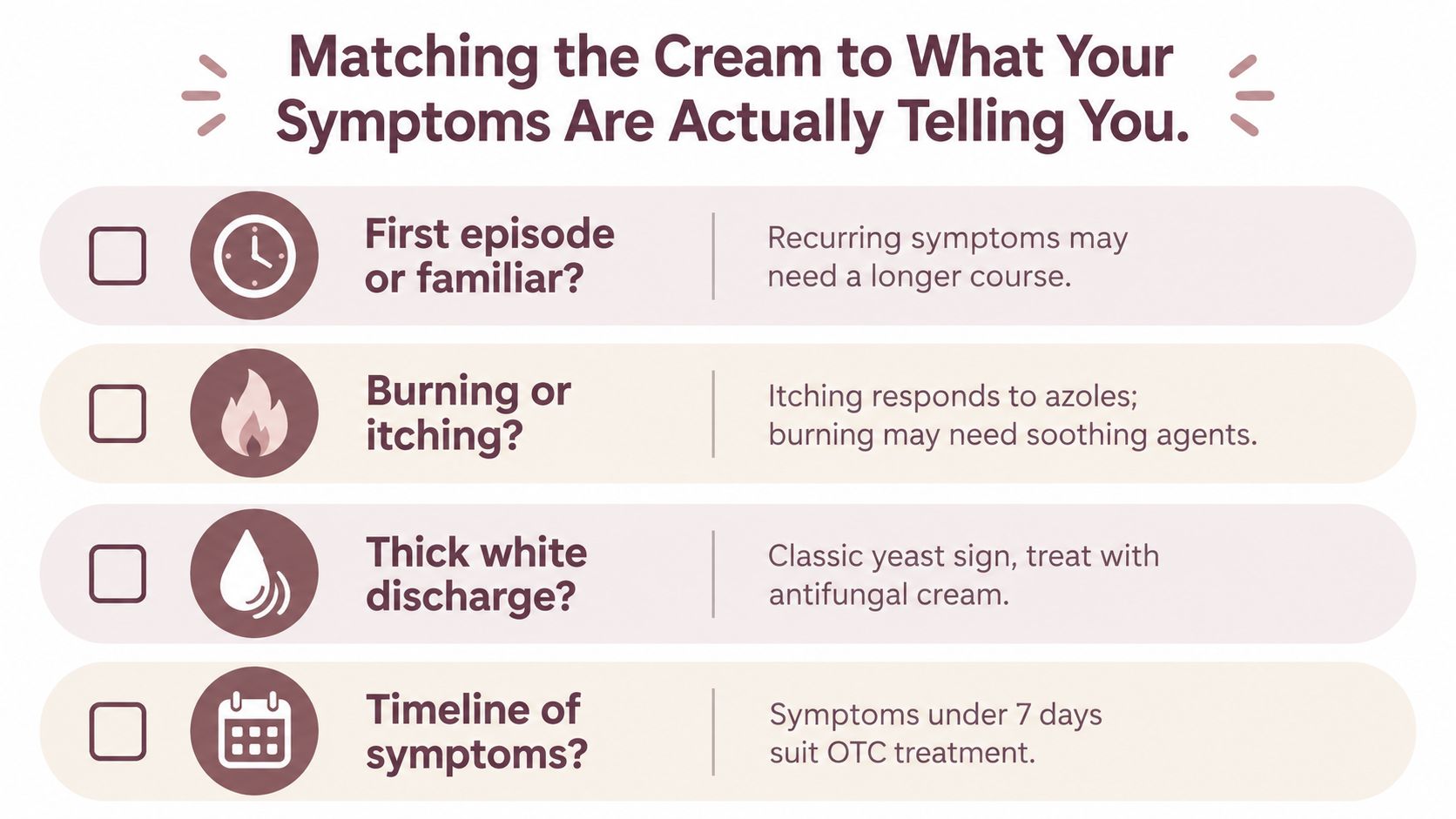
Start with what you know, not what you suspect
A first episode deserves diagnostic guidance. Without a previously established diagnosis, you're comparing unfamiliar symptoms with descriptions online. That isn't the same as knowing the cause.
A familiar episode provides useful history, but it doesn't guarantee the same explanation. Tell the clinician what happened before, what treatment you used, and whether the current symptoms differ.
Write down the details in plain language:
- Location: Is the discomfort on the external skin, inside the vagina, or difficult to localize?
- Discharge: Has it changed from your usual pattern?
- Timing: When did symptoms start, and what happened after treatment?
- Other symptoms: Is there urinary pain, significant soreness, or something else that doesn't fit your previous experience?
If urinary symptoms are part of the picture, the guide to UTI versus yeast infection symptoms can help you organize questions for a healthcare professional. It shouldn't be used to rule out an infection yourself.
Track the response without turning it into proof
Don't judge success only by whether an application feels soothing. Record whether the overall problem is improving, unchanged, or worsening, and follow the medicine's directions rather than inventing a new course.
For comfort-focused care, Soothe & Restore Salve is an organic balm containing coconut and jojoba oils, designed for dryness, itching, and irritation. That describes a supportive role, not evidence that it clears Candida or treats bacterial vaginosis.
A useful decision model is uncertain cause → testing; established infection → appropriate treatment; persistent or returning symptoms → reassessment. External comfort can be discussed alongside that process, but it shouldn't interrupt it.
Bring the actual packages or ingredient lists to an appointment. “I used a yeast cream” leaves important details unclear; the named product and its directions tell the clinician much more.
Safety Signals and Red Flags That Change the Plan
“Available without a prescription” doesn't mean “appropriate to repeat indefinitely.” Your health context can change the treatment plan even when symptoms seem familiar. Pregnancy, repeated episodes, diabetes, immune concerns, and unresolved symptoms all deserve more careful guidance.
The NHS guidance on thrush during pregnancy advises consulting a doctor or midwife before treatment. It notes that topical clotrimazole or a vaginal pessary may be used, while oral anti-thrush tablets should not be taken during pregnancy.
Treat the graphic below as a reminder to seek advice, not a complete prescribing guide. In particular, breastfeeding decisions require individualized review, and you don't need to reach a fixed episode count before asking about recurring symptoms.
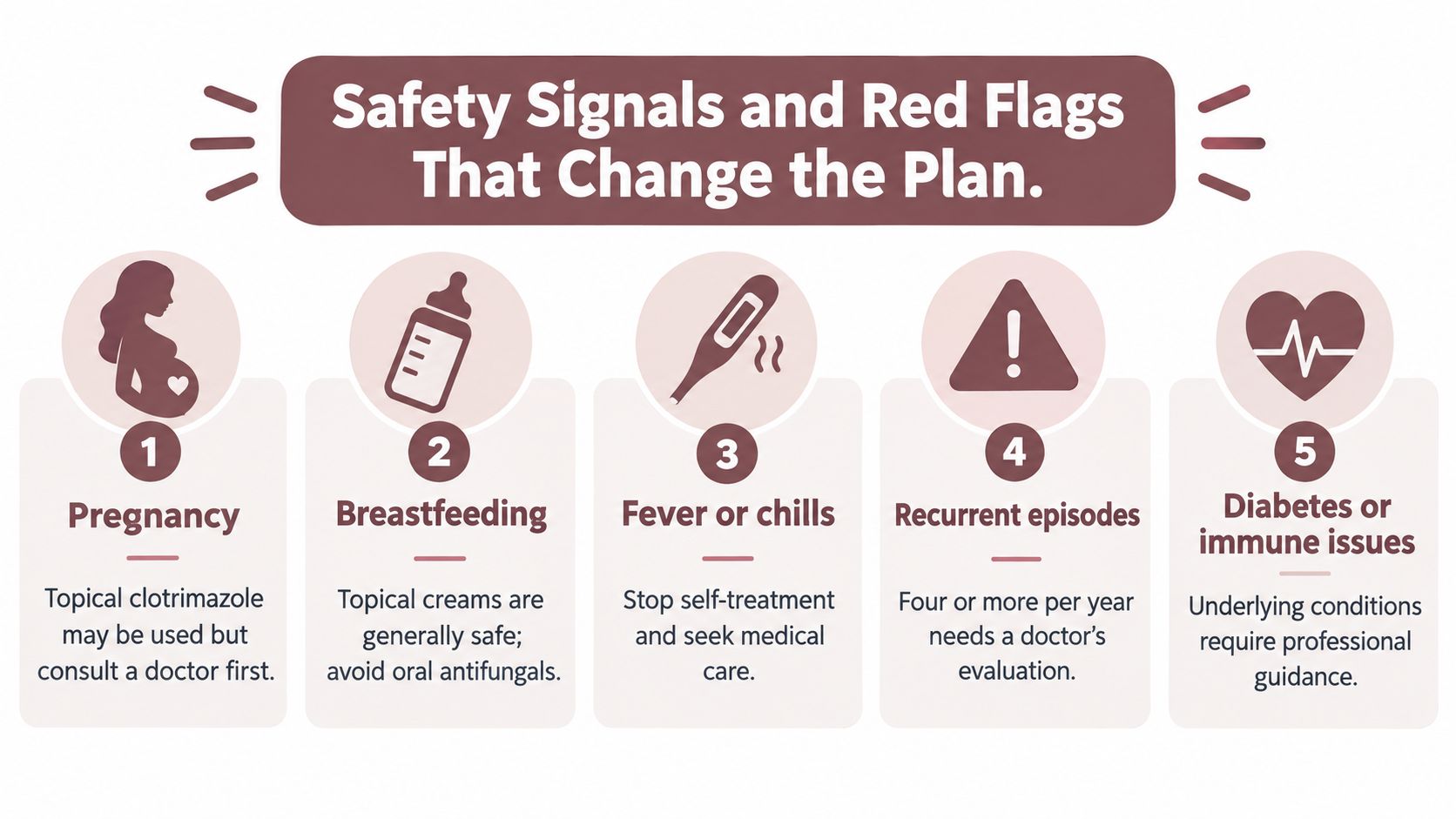
Ask for a plan that fits your circumstances
If you're pregnant, ask about the exact formulation and how to administer it. Don't improvise with an applicator, especially late in pregnancy; ask your doctor or midwife whether and how it should be used.
Breastfeeding and postpartum recovery shouldn't be treated as identical to pregnancy. Tell the clinician or pharmacist your current circumstances and ask about both the medicine and the application method. Don't extend pregnancy restrictions to breastfeeding by assumption.
Diabetes or immune-related health issues are also reasons to seek advice. Give the clinician the relevant history rather than relying on the familiar appearance of the symptoms.
Know when another tube isn't the next step
- Unusual discharge or urinary pain: Seek medical advice rather than assuming thrush, particularly with green or yellow discharge or significant soreness.
- Fever, chills, or pelvic pain: Seek prompt assessment instead of trying another comfort product.
- Repeated episodes: Ask whether testing or a clinician-directed regimen is needed.
- Persistent or worsening symptoms: Stop cycling through products and contact a healthcare professional.
You also can't reliably distinguish an ingredient reaction from worsening infection by sensation alone. If a new application is followed by substantially worse burning, swelling, or a rash, don't keep layering products to counteract it. Contact a clinician or pharmacist for advice, and seek urgent care for a severe reaction.
Before restarting: Write down what you used, how you used it, and what changed. That history is more useful than guessing which product is “stronger.”
For questions about testing options, how to test for a yeast infection at home offers a starting point for discussion. An at-home result shouldn't replace professional assessment when symptoms are severe, unusual, or unresolved.
Supportive Care That Goes Beyond the Cream
Supportive care should have a modest, clearly defined purpose: help you stay comfortable and make your routine easier to manage. It shouldn't become a collection of products that promise to fix an infection without establishing what caused the symptoms.
You can evaluate this layer separately from treatment. A routine doesn't need to be elaborate to be useful, and adding more ingredients makes it harder to identify what agrees with your skin.
Keep the routine understandable
- Clothing and friction: Choose options that feel comfortable, and consider reducing activities or clothing that aggravate already-sensitive skin.
- Bathing and products: Keep care simple rather than adding multiple cleansers, oils, or remedies at once.
- Comfort topicals: Check where they're meant to be applied and what they claim to do.
- Symptom notes: Record changes so you can discuss patterns without relying on memory.
Probiotics marketed with Lactobacillus or Bifidobacterium names raise a separate question from acute treatment. Don't assume that a strain name or a microbiome claim proves that a supplement will clear your infection or prevent recurrence. Ask what evidence supports the specific product and intended outcome.
The same caution applies to diet advice. Don't turn a yeast episode into a restrictive eating plan based on claims about “feeding yeast.” If diabetes is relevant, discuss its management with your healthcare team rather than treating dietary changes as a replacement for infection care.
Evaluate natural products by their actual purpose
A pH-conscious label doesn't establish an antifungal effect. Nor does a plant-based suppository become equivalent to a medicinal vaginal treatment because both are inserted internally.
For longer-term questions, the guide to preventing recurring yeast infections can help you prepare a conversation about routines and recurring symptoms. Keep confirmed infection treatment and comfort-oriented care distinct, even when both belong in your plan.
Putting It All Together Before You Buy
Before choosing a yeast infection relief cream, check:
- Purpose: Do you need antifungal treatment, external comfort, or supportive care?
- Diagnosis: Has Candida been established, or are you interpreting symptoms?
- Directions: Is the product intended for the location where you plan to use it?
- Health context: Does pregnancy, breastfeeding, recurrence, diabetes, or an immune concern change the decision?
- Follow-up: Do you know what to do if symptoms persist or worsen?
The right purchase isn't always another tube. Sometimes it's a comfort product with a clearly limited role; sometimes it's an appropriate antifungal regimen; sometimes the next step is an appointment. Choose according to the job, not the promise on the packaging.
Momotaro Apotheca offers plant-based vulvovaginal comfort products and educational resources for concerns such as dryness, itching, and irritation. Visit Momotaro Apotheca to review ingredient information and intended uses, and choose supportive care alongside, not instead of, appropriate treatment for a confirmed infection.


