


Post Coital UTI Prevention Habits That Actually Help
You finish having sex, get up to use the bathroom, and notice a sting when you pee. Maybe you feel an urgent need to go again, even though little comes out. If this has happened before, it's understandable to wonder whether you should wash more carefully, drink water, or take something right away. But a familiar pattern deserves attention, not blame, and one uncomfortable episode doesn't automatically mean you have a urinary tract infection.
Post coital UTI prevention works best when it matches the reason symptoms keep happening. Gentle comfort habits may help you feel better, but hygiene rituals haven't been shown to reliably prevent recurring infections. For people with documented, intercourse-linked UTIs, culture-guided medical options can make a bigger difference. The first step is figuring out which situation fits you.
Table of Contents
- Why Urinary Symptoms After Sex Need Context
- Identify Who Needs a Prevention Plan
- Build a Practical After-Sex Routine
- Compare Non-Antibiotic Prevention Options
- Ask a Clinician About Post-Coital Antibiotics
- Recognize Symptoms That Need Medical Evaluation
- Create Your Personal Prevention Checklist
Why Urinary Symptoms After Sex Need Context
After sex, burning or urinary urgency can feel like a clear sign of a UTI. Those symptoms can occur with a bladder infection, but they can also follow friction or irritation, or be caused by a vaginal infection or another condition. The timing matters, but it doesn't confirm the diagnosis on its own.
Say you have a single episode of stinging after sex, and it settles without returning. That's different from having symptoms repeatedly after intercourse, especially when urine tests have confirmed infections. A repeatable pattern can be linked to sex, while a one-off symptom may call for observation or assessment rather than a permanent prevention routine.
It can help to notice what you're experiencing. Burning when urinating and frequent, urgent trips to the bathroom can fit a lower urinary tract infection. Itching, unusual discharge, odor, or irritation may point toward a vaginal cause instead. If you're unsure how symptoms can overlap, this guide to UTI versus yeast infection symptoms can help you prepare questions for a clinician, but it can't diagnose the cause.
Start with the pattern, not a ritual
There isn't one after-sex scrub, wipe, or product that works for everyone. A more useful starting point is to sort prevention into four categories: low-risk comfort habits, personal risk factors worth reviewing, non-antibiotic options for selected people, and prescription prevention when the pattern and medical history support it.
This distinction matters because a complicated cleaning routine can make someone feel responsible for an infection they couldn't reliably prevent through hygiene. It can also delay care if recurring symptoms are treated as irritation or if irritation is repeatedly mistaken for a UTI.
If symptoms recur, write down when they begin and whether a urine culture confirmed infection. That simple record can help a clinician distinguish a repeatable post-sex pattern from occasional discomfort or a different diagnosis.
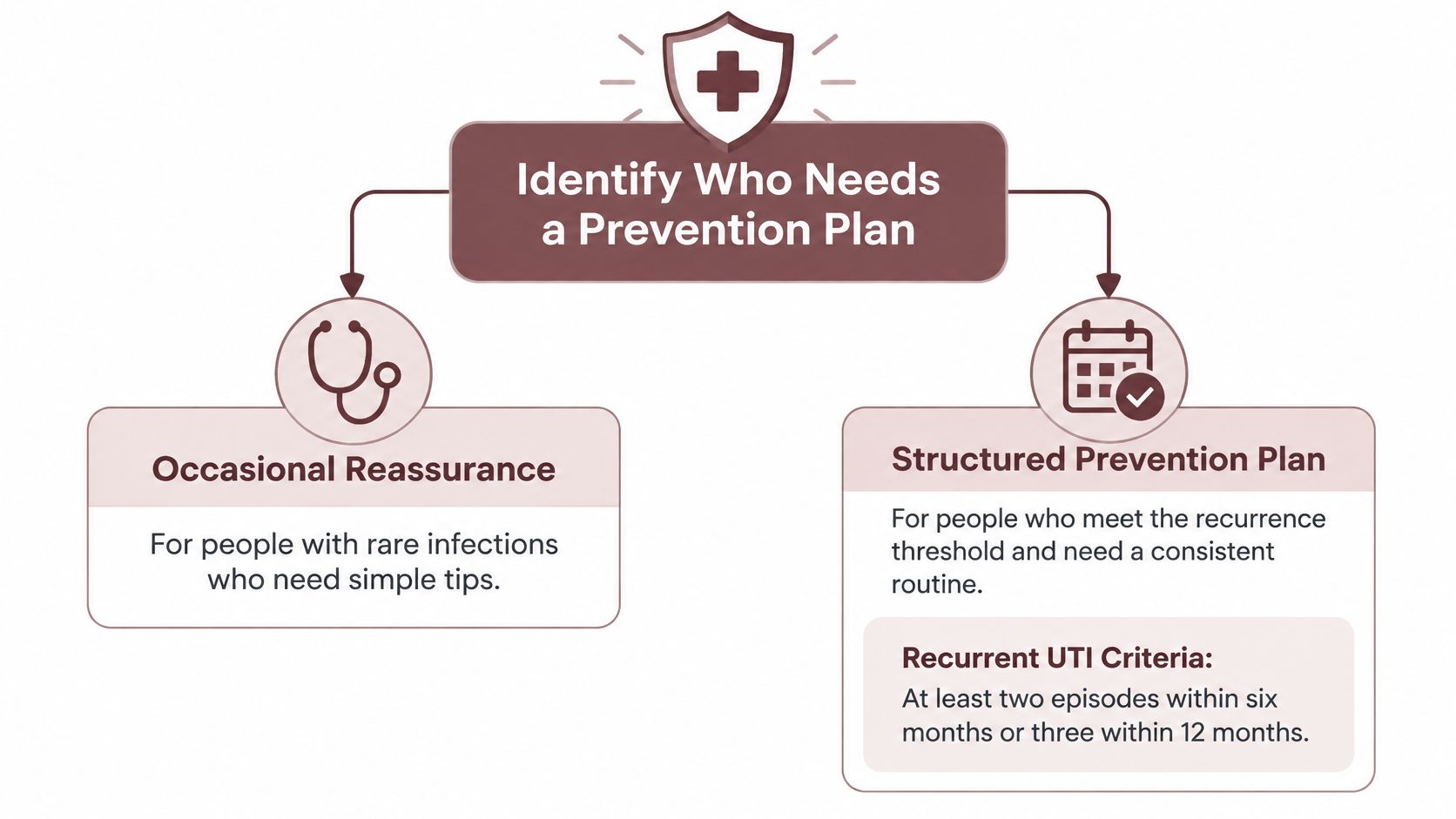
Identify Who Needs a Prevention Plan
A single episode doesn't necessarily call for a long-term plan. Recurrent UTI is generally defined as at least two infections within six months or three within 12 months. If symptoms repeatedly start soon after sex and those episodes have been documented as UTIs, a structured prevention discussion may be appropriate. Guideline information on recurrent UTIs also distinguishes this kind of recurrence from occasional symptoms.
Check what's been confirmed
For each episode, note the symptoms, when they began, and whether a urine test or culture confirmed infection. Burning after intercourse can feel consistent from one time to the next, but similar symptoms can have different causes. Culture results can help a clinician decide whether a prevention plan should target recurring bacterial UTIs or whether further assessment is needed.
A calendar note is often enough. Record the date, the relationship to sex, the symptoms, and any test results. Bring the list to an appointment rather than relying on memory, especially if you've had episodes treated with different antibiotics.
Review factors that change the decision
Before choosing an intervention, consider contraception, hydration, pregnancy status, kidney function, medications, and recurring vaginal symptoms. Spermicides and diaphragms may be worth discussing if UTIs repeatedly follow sex. Pregnancy or reduced kidney function can also change which prevention or treatment options are suitable.
Itch, discharge, odor, or ongoing irritation deserve mention too. Those symptoms can indicate that urinary discomfort isn't the whole story. The aim isn't to find a reason to dismiss your experience. It's to give a clinician enough context to recommend a plan that fits the pattern rather than treating every episode as identical.
Build a Practical After-Sex Routine
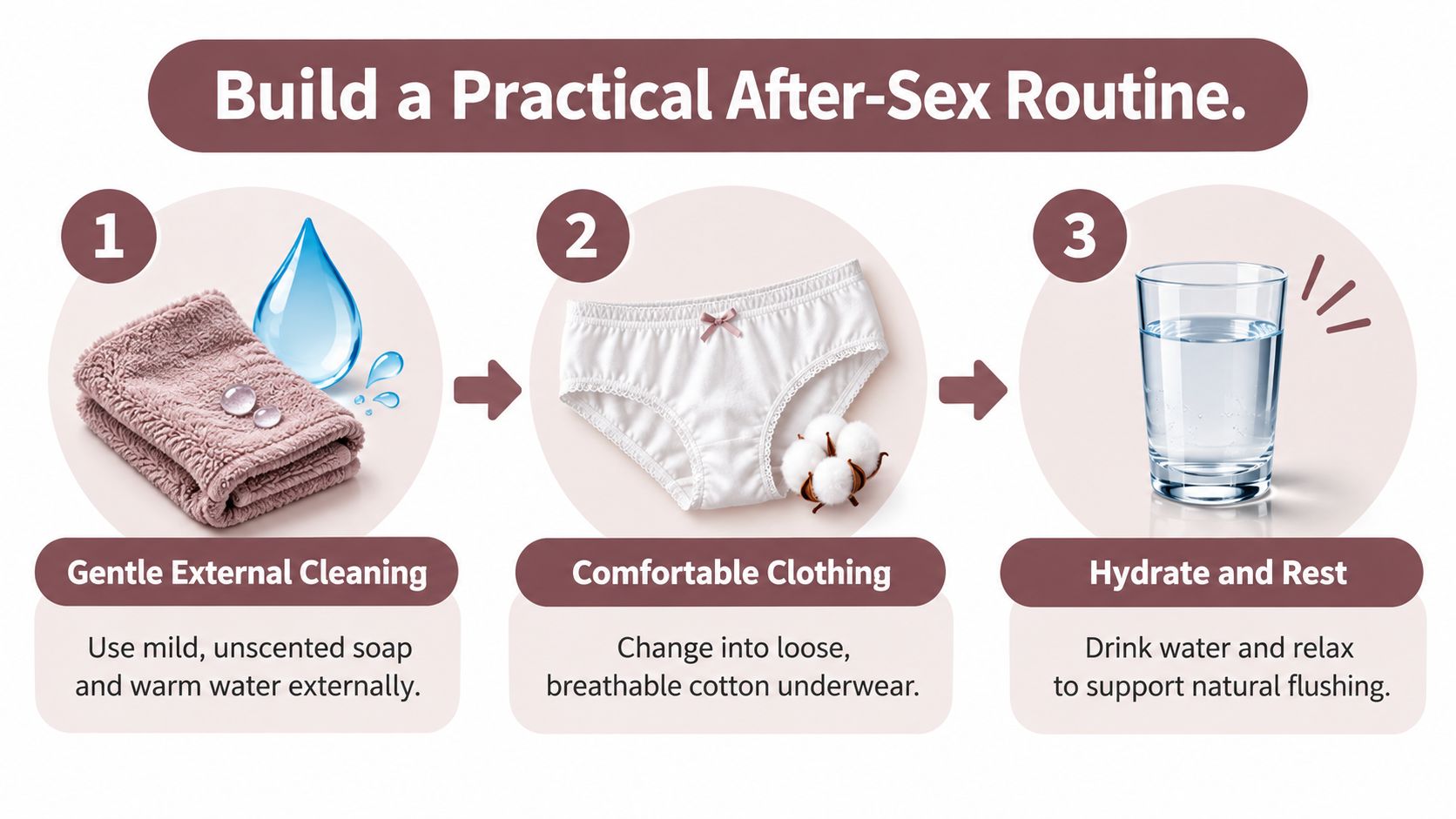
A routine should be easy to follow and comfortable, not a test you have to pass to prevent infection. Gentle external care can support comfort, but everyday hygiene habits such as post-sex washing or urinating haven't been shown to reliably prevent recurrent UTIs. Keep the routine simple and put more effort into reviewing factors that may be relevant to your pattern.
Keep cleaning gentle
If you want to wash, clean the external area gently with water. Avoid douching and harsh or fragranced products, which can irritate sensitive tissue. You don't need to wash inside the vagina or scrub to remove the possibility of infection.
Choose comfortable, breathable clothing if it feels good to you. Loose cotton underwear may help you stay comfortable, but it shouldn't be treated as a proven UTI-prevention measure.
Reduce friction when it matters
If dryness or friction makes sex uncomfortable, lubricant may help reduce irritation. Notice whether a particular product seems to cause symptoms, and stop using it if it brings on a reaction. Persistent irritation deserves assessment rather than repeated trials of unfamiliar products.
For example, someone who's had recurring UTIs might feel anxious after sex and want to clean repeatedly or change several habits at once. A gentler plan could be to avoid irritating products, use lubricant when needed, and track symptoms for discussion with a clinician. That's care, not a failure to do enough.
Treat evidence-supported changes differently
Two factors have more specific support than hygiene rituals. If you use a diaphragm or spermicide and have intercourse-associated UTIs, ask whether a different contraceptive method might suit you. And if you usually drink less than 1.5 liters of water daily, increased water intake is an option to discuss; the AUA guideline update supports increased intake for people below that level.
Urinating after sex is generally harmless if you want to do it, but it isn't a guarantee. You don't need to rush or turn it into a strict deadline.
Compare Non-Antibiotic Prevention Options
Non-antibiotic choices aren't interchangeable. Some address low fluid intake or tissue changes, while others have limited or unsettled evidence for preventing bacterial UTIs. If you're weighing supplements, this overview of supplements for UTI prevention can be a starting point for questions, not a substitute for diagnosis.
| Option | Who May Consider It | Evidence Boundary |
|---|---|---|
| Increased water intake | People whose daily fluid intake is low | The guideline support applies to people drinking less than 1.5 liters daily; it isn't a reason to force excessive fluids. |
| Methenamine | People seeking an antibiotic-sparing prescription option | It requires a clinician's assessment and isn't a supplement or a fit for everyone. |
| Vaginal estrogen | Peri- or post-menopausal people with relevant tissue changes | It addresses hypoestrogenic tissue, not intercourse itself; suitability is a medical decision. |
| Cranberry | People interested in an additional prevention option | Guideline discussion includes cranberry, but it shouldn't replace culture-based care or established prophylaxis. |
| D-mannose | People considering a supplement | Recent guidance advises against relying on D-mannose alone because newer studies didn't show benefit over placebo. |
| Oral probiotics | People interested in supporting general wellness | They haven't yet improved adult recurrent-UTI outcomes in the guideline evidence. |
| Vaginal Lactobacillus | People discussing investigational approaches with a clinician | Potential benefit remains investigational, with reports limited to early-phase trials. |
Match the option to the reason
For someone drinking little water, adjusting intake may be a reasonable discussion. For someone in or after menopause, vaginal estrogen may address tissue changes that aren't solved by cleaning after sex. Methenamine is a prescription, antibiotic-sparing option to discuss with a clinician, not a do-it-yourself replacement for evaluating recurring symptoms.
Cranberry, probiotics, and other supplements shouldn't be presented as guaranteed protection. Momotaro Apotheca offers a Urinary Tract & Pelvic Health Super Supplement as a plant-derived, flora-friendly product described as supporting urinary and pelvic health concerns. That product description doesn't establish that it prevents bacterial UTIs, so it shouldn't replace medical evaluation or a prescribed prevention plan.
Ask a Clinician About Post-Coital Antibiotics
For someone with documented, uncomplicated UTIs that repeatedly follow intercourse, a clinician may discuss taking a prescribed preventive antibiotic after sex. This is different from taking leftover medication whenever burning starts. The preventive approach is planned in advance, informed by the person's culture history and medical circumstances, and reviewed over time.
A foundational randomized trial involving 27 participants found that, over more than six months, 9 of 11 people receiving placebo developed a UTI, compared with 2 of 16 receiving a single postcoital dose of trimethoprim-sulfamethoxazole. In that trial, infection incidence fell from 3.6 to 0.3 episodes per patient-year, an approximately 92% reduction; the published trial was small, and its findings apply to selected people with recurrent UTIs, not everyone after sex.
A later systematic review and meta-analysis found a relative risk of 0.15 for intermittent prophylaxis compared with placebo, with a 95% confidence interval of 0.04 to 0.55. That corresponds to roughly 85% fewer infections in the treated group in the included evidence, though the confidence interval reflects uncertainty and relatively few postcoital trials were available.
Make the appointment specific
Ask whether your episodes meet the criteria for recurrent UTI and whether cultures support an intercourse-linked pattern. Discuss allergies, pregnancy status, kidney function, previous side effects, local resistance concerns, and the antibiotic option that fits your culture history. A prescription and dose should come from your clinician; don't reuse an old prescription or redose yourself after each urinary symptom.
If a clinician recommends postcoital prophylaxis, confirm exactly when to take it. Guidance describes a culture-compatible single dose within roughly 30 minutes to two hours after intercourse, with the precise plan determined by the prescriber. Ask what symptoms call for testing instead of another dose, and how to report side effects.
A follow-up plan matters too. Agree when to reassess whether the approach is working and whether it's still needed, commonly after several months. You can prepare questions using this guide to planning an OB-GYN appointment. The aim is targeted prevention with appropriate review, not automatic antibiotic use.
Recognize Symptoms That Need Medical Evaluation
Not every episode of burning after sex should be managed with the same routine. Burning during urination, urgency, and frequent urination can fit a lower urinary tract infection, particularly when they match a documented pattern. But symptoms alone can't always tell whether the cause is a UTI, vaginal irritation, yeast, bacterial vaginosis, an STI, or something else.
Fever, flank pain, vomiting, blood in the urine, or symptoms that persist need prompt medical attention. These signs can point to a kidney infection such as pyelonephritis or another diagnosis that needs assessment. Don't rely on extra water, cleansing, or a preventive dose as a substitute for care when warning signs appear.
Notice what doesn't fit your usual pattern
Consider two contrasting situations. If you've had culture-confirmed UTIs after sex and familiar urinary symptoms return, contact your clinician about testing and the plan you've agreed on. If the main symptoms are intense itching, unusual discharge, odor, or external irritation, ask about vaginal causes or STI testing rather than assuming it's another UTI.
A comparison of daily and postcoital prevention found similar reductions in recurrent UTI incidence in both groups: 3.66 to 0.031 episodes per year with daily ciprofloxacin and 3.62 to 0.043 with postcoital ciprofloxacin. The difference wasn't statistically significant, according to the randomized comparison. This supports discussing targeted dosing for appropriate patients, not self-diagnosing each new episode.
First-time urinary symptoms deserve professional advice, particularly if you're pregnant or have a medical condition that affects your risk. If a product causes a reaction, stop using it and seek advice if the symptoms persist or feel severe. Continuing an unfamiliar product while symptoms worsen can make it harder to identify what's causing the problem.
Create Your Personal Prevention Checklist
Your checklist should reflect your history, not a universal rule about what everyone must do after sex. If symptoms are rare, focus on comfort and get advice for first-time or persistent symptoms. If infections recur and are linked to intercourse, bring your symptom and culture history to a clinician and discuss options that fit your health and preferences.
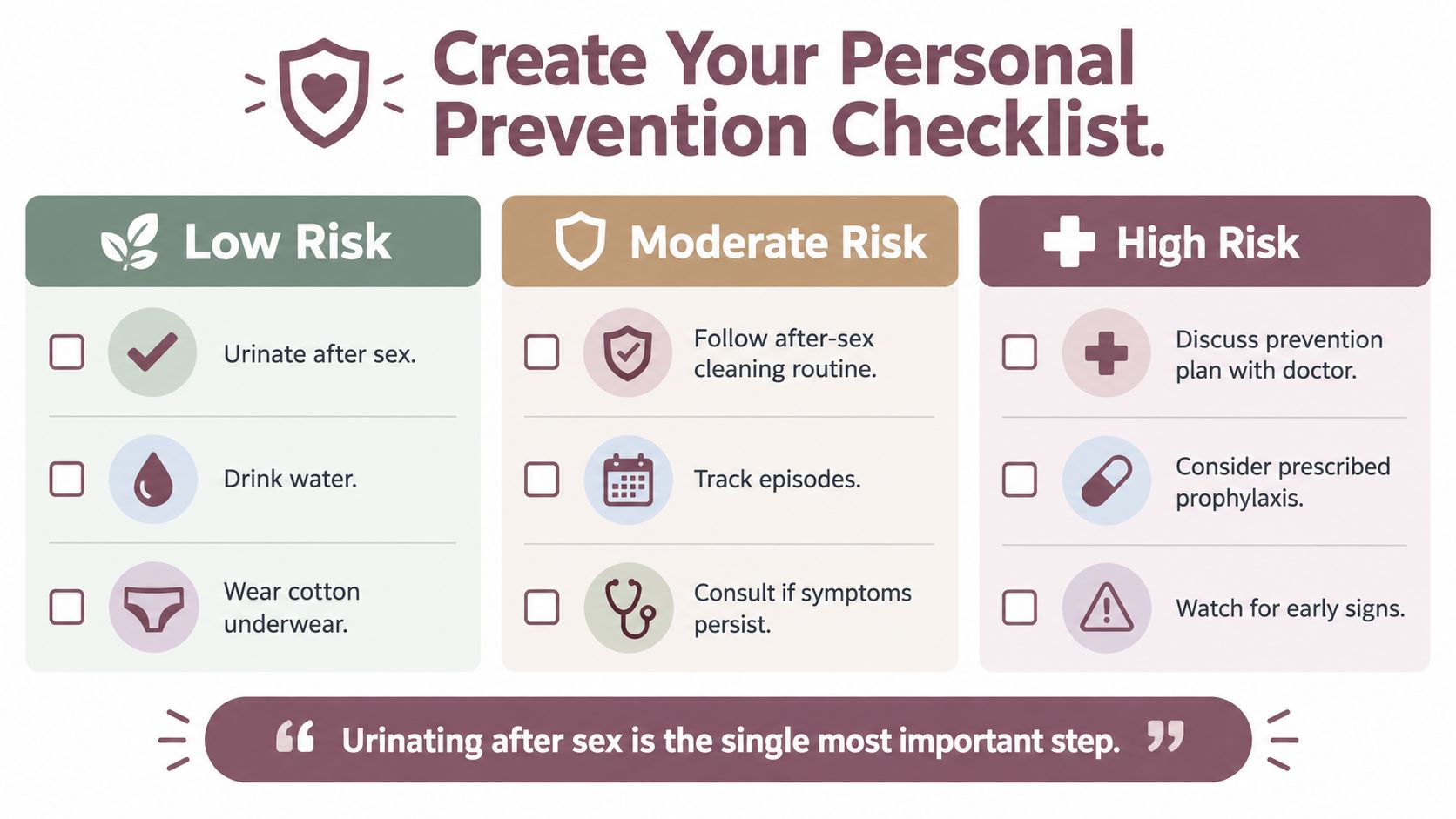
Urinating after sex may feel reassuring, but it hasn't been proven to prevent recurrent UTIs. Documented recurrence, contraception choices, low fluid intake, menopausal tissue changes, and repeated symptoms are better reasons to seek an individualized review.
Use this quick check to prepare:
- If symptoms are occasional: Keep external care gentle, avoid products that irritate you, and ask for medical advice if symptoms are new or don't settle.
- If episodes recur: Track timing and urine-culture results, then ask whether sex, contraception, or another factor appears connected.
- If you're considering non-antibiotic options: Ask which approaches match your circumstances and what their evidence can and can't tell you.
- If you're considering antibiotics: Discuss culture compatibility, safety factors, timing, side effects, and a reassessment plan with a clinician.
- If warning signs appear: Seek prompt care instead of trying to manage them with an after-sex routine.
A soothing product may support comfort, but it can't confirm an infection or replace treatment and evidence-based prevention. Let the pattern guide your next step, and don't blame yourself for symptoms that a hygiene ritual couldn't reliably prevent.
Momotaro Apotheca offers plant-based vulvovaginal care products and educational resources for concerns including urinary discomfort and irritation. If you're exploring supportive care alongside appropriate medical guidance, visit Momotaro Apotheca to learn about its offerings.


