


Best Feminine Pads for Sensitive Skin
Most advice about pads for sensitive skin is backwards. It tells you to buy the softest one, the thinnest one, or the brand with the prettiest “gentle” label, then hope your vulva agrees.
That's not how irritation usually works.
A pad is a layered product that sits against some of the body's most reactive skin. The part that feels plush in your hand can still hold heat, keep moisture close to the skin, use fragranced treatments, or rely on adhesives that your body hates. For many people, the issue isn't softness at first touch. It's friction, humidity, and chemistry over hours of wear.
That matters because pad complaints aren't rare in sensitive-skin populations. In a 2019 NIH review, 59% of people with sensitive genital skin reported menstrual pads, compared with 12% of those without sensitive genital skin, and another comparison in the same research table showed 54% versus 13% for menstrual-pad-related sensitivity outcomes in similar populations, as described in the NIH review on sensitive genital skin.
If you're trying to find the best feminine pads for sensitive skin, start reading pads like a stack of materials, not a comfort ranking.
| Sensitive-skin factor | What to look for | Why it matters |
|---|---|---|
| Top sheet | Soft, porous, low-friction surface | Direct contact affects rubbing and wet feel |
| Wicking | Pulls fluid away quickly | Less dampness sitting on skin |
| Core design | Absorbs without creating a swampy surface | Helps reduce prolonged moisture contact |
| Backsheet | Breathable barrier instead of sealed plastic feel | Lowers heat and humidity buildup |
| Adhesives and additives | No fragrance, no deodorizing treatments, simpler construction | Fewer common irritation triggers |
Table of Contents
- Why the Softest Pad Is Not Always the Best Feminine Pads for Sensitive Skin
- Anatomy of a Pad and What Each Layer Does to Sensitive Skin
- Material Showdown Organic Cotton vs Synthetic vs Hybrid
- Decoding Pad Labels Fragrance Free Hypoallergenic and More
- Real Life Scenarios Postpartum Perimenopause and Sensitive Skin Days
- A Sensitive Skin Pad Buying Checklist You Can Use at the Shelf
- Pairing the Right Pad with a Gentle Vulvar Care Routine
- Sensitive Skin Pad Questions Worth Asking Before You Buy
Why the Softest Pad Is Not Always the Best Feminine Pads for Sensitive Skin
A soft pad can still be a bad pad for sensitive skin.
That sounds unfair, because most of us shop by touch. If one pad feels silky and another feels papery, the silky one seems safer. But vulvar skin doesn't judge a pad by the first three seconds in your hand. It reacts to what happens after movement, sweat, menstrual fluid, pressure from underwear, and hours of contact.
Softness is only one layer of the story
The top surface can feel cushiony while the lower layers trap heat. A pad can also feel “cottony” while still relying on synthetic films, glue zones, or scenting agents that make wear miserable by midday.
What many shoppers call an allergy is often a mix of things happening at once:
- Friction against thin skin from a rough or draggy surface
- Humidity buildup when airflow is poor
- Wetness sitting too close to the body instead of moving down into the core
- Adhesive contact at the wings or edges
- Fragrance exposure from deodorized or scented products
The better filter is construction
If you want the best feminine pads for sensitive skin, ask a different question: how is this pad built?
That means checking five things before you care about brand reputation:
- Top-sheet fiber and how it feels after it gets damp
- Wicking behavior, meaning whether fluid moves away fast
- Humidity control from the backsheet and overall breathability
- Adhesive chemistry at the base and wings
- Absorbency match, without assuming “more absorbent” always means gentler
Practical rule: If a pad feels soft but leaves you hot, itchy, or rubbed raw after a few hours, the problem usually isn't your body being “too sensitive.” It's the pad's material stack.
People also get tripped up by daily liner habits. If you're wearing something every day, pad construction matters even more because exposure becomes repetitive. Momotaro Apotheca's guide on whether it's bad to wear panty liners every day is useful background if irritation shows up outside your period too.
Anatomy of a Pad and What Each Layer Does to Sensitive Skin
Pads look simple from the outside. They're not. Most are built like a sandwich, and each layer can either help or irritate sensitive skin.
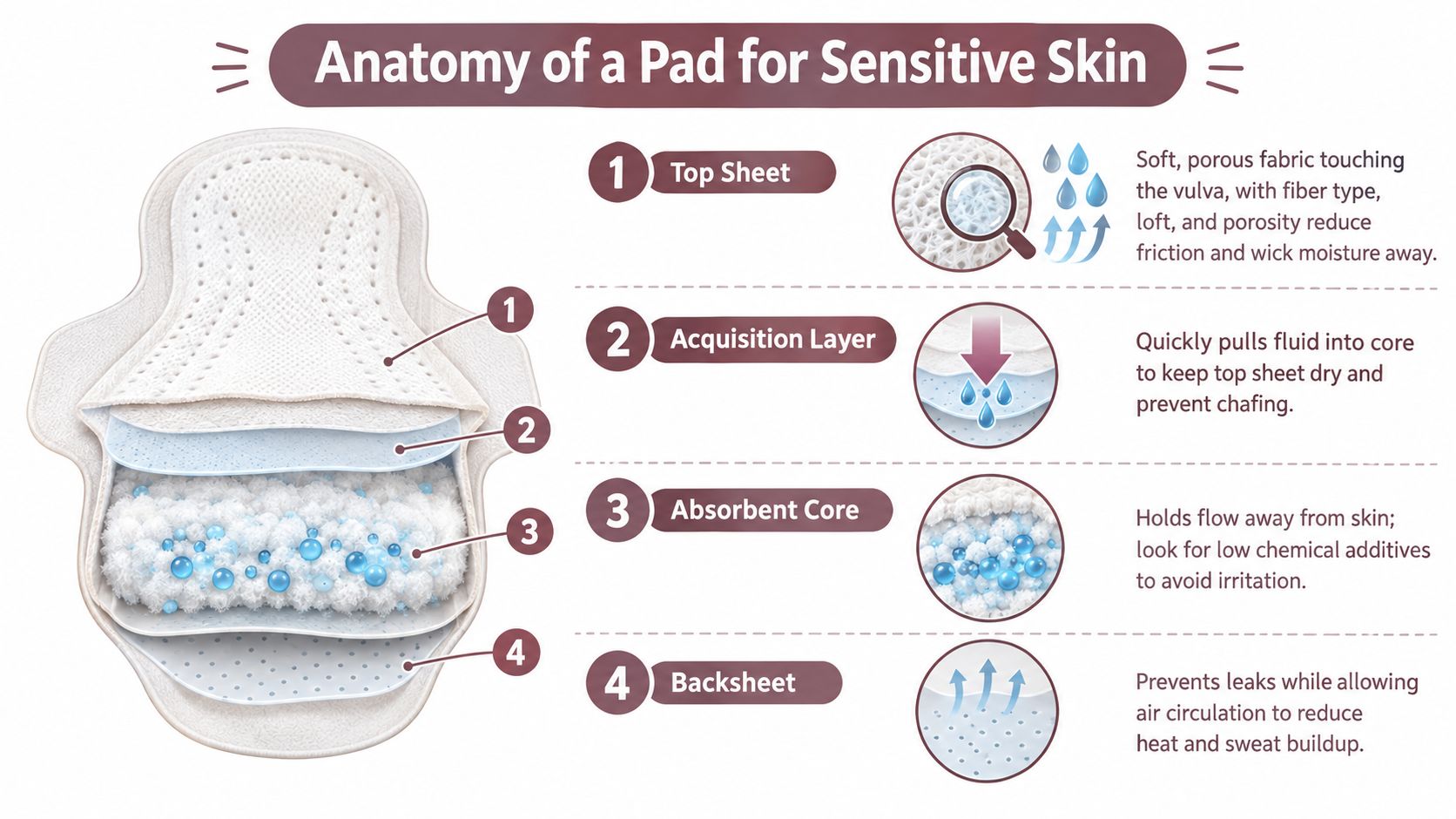
The top sheet
This is the part touching the vulva. Its job is to feel smooth while letting fluid pass through quickly.
Fiber type matters here. A lofty, porous surface can reduce drag and help moisture move downward. A slick film with tiny holes may wick fast in some designs, but if it feels grabby once damp, sensitive skin may read that as burning or chafing.
Common clue from real life: a pad feels fine when dry, then starts to sting after walking around for an hour.
The acquisition layer and absorbent core
Under the surface, many pads use a layer that grabs fluid and pushes it into the core. Then the core stores it, often with fluff pulp, absorbent gels, or both. Superabsorbent polymers come in. They help hold fluid away from the surface, which is useful, but absorbency alone doesn't guarantee comfort.
A recent review noted that irritation can be driven more by fragrances, adhesives, superabsorbent polymers, and top-sheet moisture and friction than by absorbency alone, and that poor wicking can raise humidity between skin and the top sheet, worsening dermatitis risk, as discussed in the review of menstrual-product materials and skin interaction.
The backsheet, glue, and extras
The backsheet stops leaks. Some are more breathable than others. A less breathable barrier can create a warm, damp microclimate that turns a minor sensitivity into a full afternoon of itching.
Then there's glue. The pad adhesive underneath and the wing adhesive at the sides can irritate the places where skin rubs against the groin crease or bikini line. Fragrance and lotion treatments can add another layer of risk. Terms like “fresh scent” are obvious, but “odor control,” “deodorizing,” and vague masking scents deserve the same suspicion.
For skin that's already rubbed raw, some people use a barrier-supportive topical after removing the pad, not on the absorbent surface itself. Soothe & Restore Salve is described by Momotaro Apotheca as an organic balm designed to comfort vulvovaginal dryness, itching, and irritation, with coconut and jojoba oil intended to help protect the moisture barrier and calm stressors such as sweat and friction.
A pad can cause itch without causing a true allergy. Heat, moisture, and rubbing are enough.
Material Showdown Organic Cotton vs Synthetic vs Hybrid
Pad materials get framed as a morality play. Cotton good, synthetic bad, end of story. Real life is less tidy.
Some people do best with an organic cotton contact layer because it feels less slick and less plastic against the vulva. Others find that a well-designed synthetic top sheet wicks faster and leaves them drier. Hybrid pads sit in the middle and are often the most realistic compromise.
Sensitive Skin Pad Materials at a Glance
| Material | Friction & Feel | Wicking & Absorbency | Humidity Control | Irritant Risk | Best For |
|---|---|---|---|---|---|
| Organic cotton top sheet | Often feels less plasticky and less slippery | Can feel comfortable, but performance depends on the core underneath | Often pairs well with breathable designs, though not always | Lower fragrance exposure if the product is also unscented and simply made | People who react to “silky” synthetic contact layers |
| Synthetic top sheet | Can feel smooth at first, sometimes draggy once damp | Often strong at moving fluid fast across the surface | Varies a lot by backsheet design | May be a poor fit if the product also uses scents, lotions, or heat-trapping construction | People who prioritize fast wicking and consistent surface dryness |
| Hybrid construction | Natural-feeling contact layer with engineered absorbent core | Usually stronger absorbency than all-fiber designs | Mixed, depends on breathable backing and overall build | Middle ground. Still worth checking for adhesives and additives | People who want comfort at the top without giving up performance |
What cotton does well, and what it doesn't
Organic cotton can reduce the “plastic wrap” feeling some people hate. It's often a good first experiment if your main complaint is rubbing or that hot, sealed-in sensation. It also helps to understand the limits of the label. A pad can be “made with organic cotton” only at the top layer while the rest is still synthetic.
If you want more context on that type of product language, Momotaro Apotheca has a related explainer on the benefits of using organic feminine care products.
Why synthetic isn't automatically the villain
Synthetic top sheets often wick quickly and distribute fluid evenly. For some bodies, that means less wetness sitting right at the vulva. The problem comes when a fast-wicking surface is paired with poor breathability or irritating additives. Then you get the worst combo: dry-ish feel at first, then heat, friction, and edge irritation later.
Hybrid pads can work well when your skin likes a gentler contact layer but you still need reliable absorbency. They're especially worth considering if your cycle is changing. The Perimenopause Support Kit from Momotaro Apotheca is a separate vulvovaginal care bundle designed to support perimenopausal transitions, including hydration and comfort for delicate vulvar tissue experiencing hormonal changes. That kind of life stage can change which pad materials feel tolerable.
Decoding Pad Labels Fragrance Free Hypoallergenic and More
Pad boxes love reassuring language. Your skin doesn't care about the vibe. It cares about what's in the pad and how the pad behaves after a few hours of wear.
Pad Label Claims Compared for Sensitive Skin
| Label Claim | What It Means | Irritation Risk Reduction |
|---|---|---|
| Fragrance-free | No added fragrance should be the baseline for reactive skin | Often meaningful because scent additives are a common reason products sting |
| Hypoallergenic | Usually a marketing term, not a guarantee of universal tolerance | Helpful only if the brand also explains materials and testing |
| Dermatologist-tested | Means some level of skin review or testing occurred, but details may be vague | Better than nothing, strongest when paired with low-irritancy or cumulative-irritation testing |
| Natural | Can refer to only part of the product | Limited value on its own |
| Organic cotton | Usually applies to one component, often the top sheet | Can be useful for contact comfort, but doesn't answer questions about core, glue, or backing |
| pH-balanced | More relevant to cleansers than pads | Often not very useful as a deciding factor for pads |
The labels that matter most
If you're highly reactive, the best labels are the boring ones.
Start with fragrance-free. Then look for plain material language, not mood language. “No added fragrance,” “unscented,” and evidence of skin-focused testing are more useful than “clean,” “natural comfort,” or “botanical fresh.”
A 2022 review of menstrual products and contact dermatitis noted that fragrance allergens have been detected in pads and liners at actionable levels, and that irritation reports are common, with 62.7% of respondents in one questionnaire-based study reporting skin irritation from sanitary pad use, while also stressing that not all irritation is allergy because friction, moisture retention, and material sensitivity can also drive symptoms, as summarized in the review on sanitary products and contact dermatitis.
Claims you can mostly ignore
“Natural scent” is still scent. “Cottony soft” may describe feel, not fiber content. “Ultra absorbent” tells you very little about humidity control or friction.
Don't let one good label cancel out three bad design choices.
If a package tells you the pad is organic, fresh, secure, and flexible, but won't clearly tell you whether it's scented or how the skin-contact layer is made, keep walking.
Real Life Scenarios Postpartum Perimenopause and Sensitive Skin Days
The same pad can feel perfectly fine one month and intolerable the next. That isn't random. Skin condition, hormones, healing, sweat, and activity all change the rules.
This visual lays out four common situations where pad choice needs to shift.
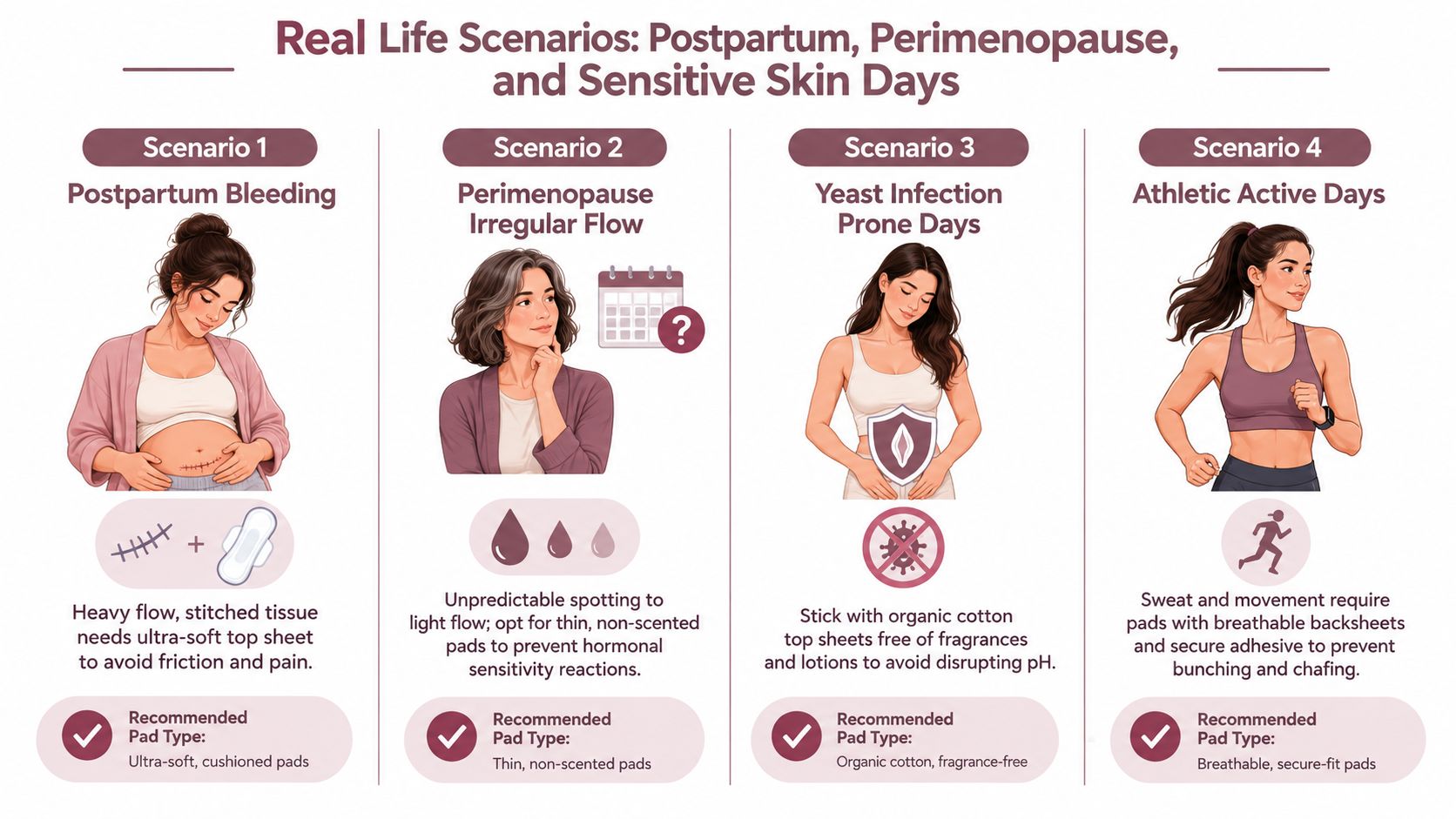
Postpartum and healing tissue
After birth, a pad isn't just dealing with flow. It may be sitting against swollen tissue, stitches, or skin that already feels bruised. In that setting, a pad with low-friction contact and gentler adhesives often matters more than a trendy ingredient story.
Bulky pads can also bunch in ways that create pressure points.
Perimenopause and drier skin
Hormonal shifts can make vulvar tissue feel thinner, drier, or easier to irritate. A pad that once felt neutral may suddenly feel abrasive. This is one reason people in perimenopause often need a softer-feeling contact layer plus less exposure to fragrance, edge glue, or heat buildup.
Sweat-heavy days and flare days
An exercise day changes pad performance because sweat adds moisture from the outside while the pad manages menstrual fluid from the inside. That can create a damp, rubbed environment fast. Breathable backing and a stable fit matter more than usual.
For a quick visual refresher on these tradeoffs, this overview is useful:
Then there are true flare days. If you have eczema-prone skin, lichen sclerosus, a recent wax, or you're recovering from a yeast or BV episode, your baseline tolerance drops. A pad you normally forget about can suddenly feel sharp, sweaty, or unbearably itchy by lunch.
- Postpartum: prioritize low friction and breathable construction
- Perimenopause: look for a gentler contact surface and fewer additives
- Workout days: choose stability plus airflow
- Flare days: simplify everything, including underwear, cleanser, and pad choice
A Sensitive Skin Pad Buying Checklist You Can Use at the Shelf
Most pad shopping happens under fluorescent lights while you're late for something. So the checklist has to be fast.
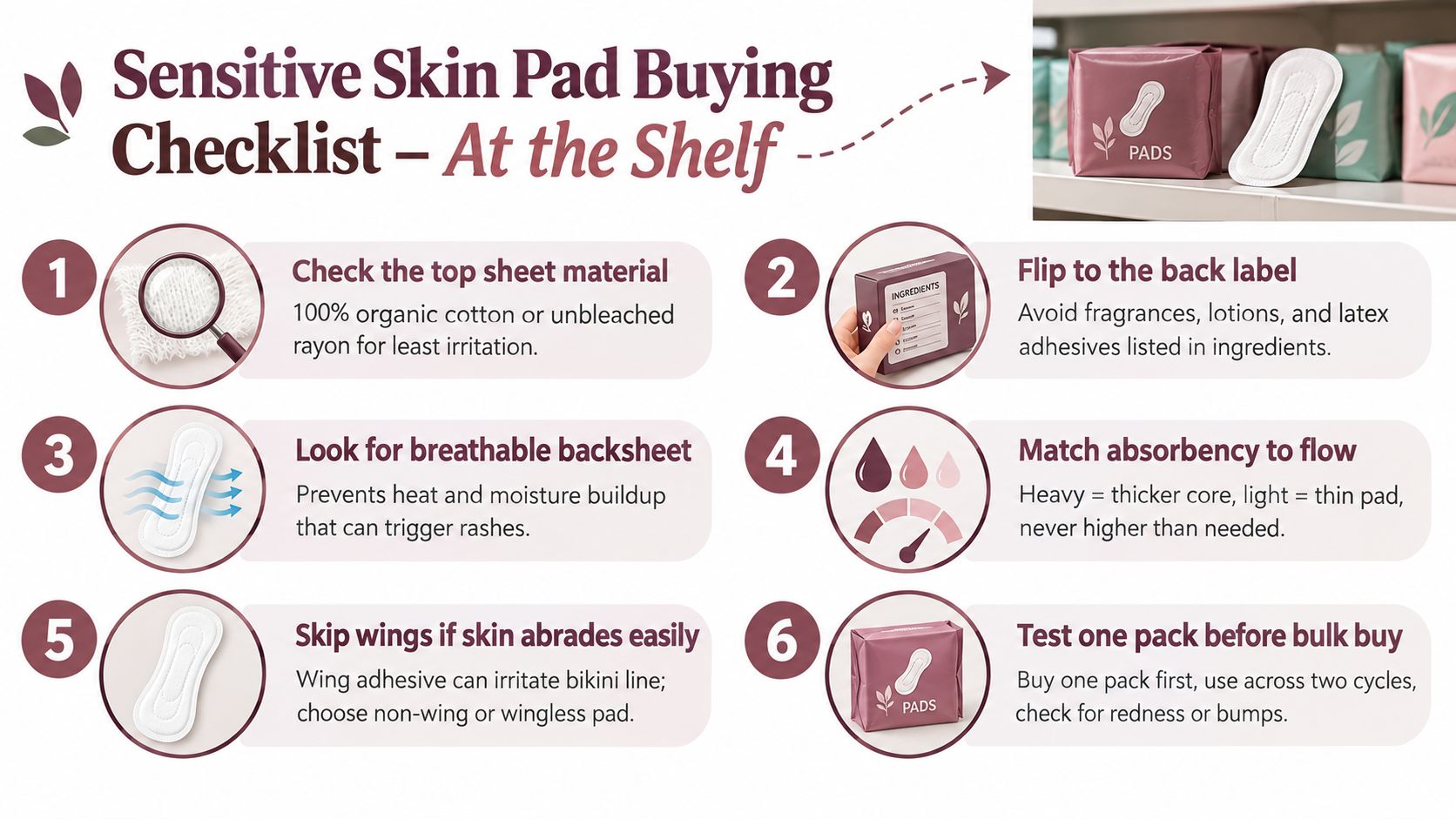
The shelf test
Use these questions in order:
-
What touches my skin?
Look for the top-sheet material first. If the box is vague, that's already useful information. -
Is it unscented in plain language?
“Fragrance-free” matters more than soft-focus language about freshness. -
Does the pad seem built for airflow?
Breathable backing and a less sealed feel can matter more than extra absorbency. -
Am I buying more absorbency than I need?
Bigger isn't always better. Overbuilt pads can create extra bulk, heat, and rubbing if your flow doesn't require them. -
What's happening at the wings and edges?
If your bikini line gets angry, wing adhesive may be part of the story. -
Is there any sign of actual irritation testing?
Dermatologist-tested is better than nothing. Clear mention of low-irritancy testing is stronger.
What low-irritancy evidence looks like
A useful historical benchmark comes from clinical testing. In a randomized comparison of sanitary-pad materials, self-declared sensitive-skin participants (n=15) and normal-skin participants (n=14) did not show a statistically significant difference in irritation, and both test materials were comparable to the negative control and less irritating than the positive control, according to the randomized pad-material comparison study.
That doesn't mean every pad on the shelf is gentle. It means specific constructions can be.
Shelf shortcut: If the box gives you clear material and testing information, it's usually a better bet than one packed with lifestyle claims.
Pairing the Right Pad with a Gentle Vulvar Care Routine
The right pad helps. It doesn't work alone.
Sensitive vulvar skin usually improves when you lower total irritation load across the day. That means less rubbing, less fragrance, less trapped moisture, and less aggressive cleansing. A good pad can't compensate for harsh wipes, tight leggings, or scented body wash used right on reactive skin.
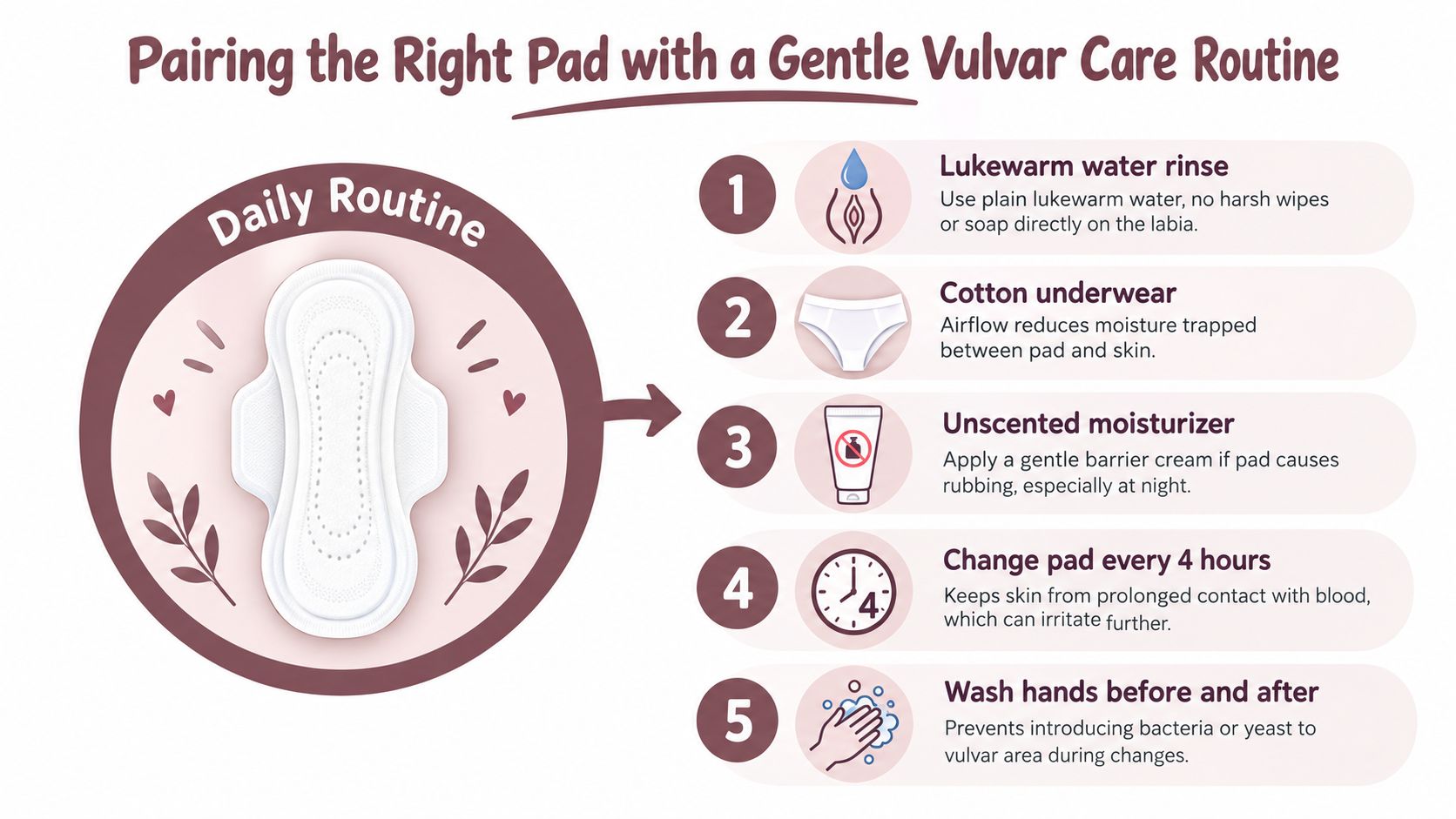
Daily habits that lower the irritation load
- Rinse: Use lukewarm water on the vulva instead of fragranced wipes or “freshening” sprays.
- Pat dry: Rubbing with a towel can make already-angry skin feel worse.
- Wear breathable underwear: Cotton or modal usually works better than fabrics that hold heat.
- Change pads consistently: Don't wait until a pad feels swampy.
- Give skin air when you can: At night or during very light flow, less occlusion can help.
If you need a cleanser, keep it boring. Momotaro Apotheca's guide to a gentle vaginal cleanser is a helpful reminder that the vulva usually does better with fewer irritants, not more products.
Barrier support matters more than people think
Vulvar skin can get irritated from mechanics alone. Sweat, pad edges, seams, and damp underwear all chip away at comfort. That's why people with eczema-prone skin often do better when they rethink body care broadly, not just menstrual products. If you're also reviewing shower products, this guide to unscented body wash options for eczema is relevant for reducing overall fragrance exposure.
Clinical testing backs the idea that finished-product irritation matters. A four-day cumulative irritation patch test in self-declared sensitive-skin subjects found negligible irritation from low-irritancy sanitary pads, with day-4 erythema scores of about 1.06 and 1.25 on a five-point scale, plateauing like a nonirritant control rather than rising like an irritant control, according to the four-day cumulative irritation patch test.
When it's time to call a clinician
Some symptoms shouldn't get blamed on “just sensitive skin.”
See a clinician if you keep having:
- Persistent itching or burning that outlasts your period
- Recurrent rashes in the same spots
- Skin changes such as whitening, cracking, or tearing
- Unusual discharge or odor that suggests infection
- Pain with contact that feels out of proportion to the product
That's when someone may need to evaluate for contact dermatitis, lichen sclerosus, vulvodynia, infection, or another cause that won't be fixed by buying a different pack of pads.
Sensitive Skin Pad Questions Worth Asking Before You Buy
The follow-up questions are usually better than the first question. “What pad is best?” sounds simple, but people really mean, “What kind of problem am I trying to solve?”
Sensitive Skin Pad FAQ at a Glance
| Question | Short Answer |
|---|---|
| Are organic pads always better than fragrance-free conventional pads? | Not always. Organic cotton may help some people, but fragrance-free and low-friction construction can matter more depending on your trigger. |
| How can I test a new pad safely? | Try one pack first. Some people also test contact on less sensitive skin such as the upper thigh before full wear. |
| When should I switch formats? | Consider it when pad edges chafe, when your flow is light enough, or when external contact keeps causing irritation. |
| Is irritation always an allergy? | No. Friction, dampness, heat, and pressure can all cause symptoms. |
| When should I get medical help? | If symptoms are intense, keep recurring, or don't settle after changing products and routine. |
Organic versus fragrance-free
This is the wrong fight if you treat it like a purity contest. Organic cotton can be helpful when your skin hates plastic-feeling contact layers. A fragrance-free conventional pad may still be the better choice if it wicks better, stays drier, and doesn't rub.
The question is: what seems to trigger your symptoms?
If you get:
- burning plus a hot, swampy feeling, focus on breathability and wicking
- itching exactly where edges or wings sit, focus on shape and adhesives
- a sharp reaction to scented products in general, make fragrance-free a priority
How to test a pad without making yourself miserable
You don't need a dramatic experiment. Buy one pack, not a case. Use it on different days of your cycle because a pad that feels fine on a light day may behave differently on a heavy day.
Some people also do a simple contact check by placing a dry strip of the material against less sensitive skin like the upper thigh first and watching for redness, itching, or bumps before relying on it for long wear. It's not a perfect stand-in for vulvar skin, but it can still flag an obvious problem.
The best feminine pads for sensitive skin are often the ones you barely notice after several hours, not the ones that feel luxurious for thirty seconds out of the package.
When another format makes more sense
Pads aren't mandatory if they keep causing problems.
A different format may be worth considering when:
- Your skin reacts to every adhesive product
- Pad edges rub during walking, workouts, or sleep
- Your flow is light enough that lower-contact options feel easier
- You're in a flare and need a break from constant external friction
If irritation keeps returning no matter what you buy, don't keep escalating to more “premium” pads. That's usually the point to look at the bigger skin picture.
Momotaro Apotheca makes certified organic, fragrance-free vulvovaginal care products for concerns like dryness, irritation, yeast discomfort, BV-related discomfort, and life-stage changes such as postpartum or perimenopause. If pad friction, sweat, or skin sensitivity are part of your bigger comfort picture, you can explore their education and care options at Momotaro Apotheca.


