


Period Panties Disposable
You're standing in a hotel bathroom before an early flight, or sitting through a long workday with a period that arrived at the worst possible time. You need protection that feels secure, doesn't require a sink, and won't leave you carrying damp laundry in your bag. The search for disposable period panties can feel surprisingly confusing, especially when product pages promise comfort, heavy-flow protection, and all-day wear without explaining how those claims fit your body.
Disposable period panties can be useful, but they aren't automatically safer, more sustainable, or suitable for every flow. Their value depends on capacity, fit, materials, wear time, skin sensitivity, and disposal needs. This guide focuses on those practical trade-offs so you can choose a product for the situation in front of you, not for an idealized marketing promise.
| Factor | Disposable period panties | Reusable period underwear | Pads or tampons |
|---|---|---|---|
| Main advantage | No washing and full-coverage fit | Lower ongoing waste and washable use | Familiar, flexible changing |
| Main drawback | Recurring waste and material questions | Laundry, drying, and storage | Adhesive movement or internal-product concerns |
| Best fit | Travel, overnight use, or no-laundry days | Home routines and planned cycles | Shorter wear windows or product layering |
| Capacity decision | Check the product's actual guidance and your flow | Check the garment's absorbency rating | Match the product to flow and change schedule |
Table of Contents
- Why Disposable Period Panties Exist
- How Disposable Period Panties Work
- Disposable vs Reusable Period Underwear
- The Environmental Impact of Menstrual Waste
- Health Considerations and Material Safety
- Sizing, Care, and Usage Guidelines
- When to Choose Disposable Period Panties
Why Disposable Period Panties Exist
You've packed medication, chargers, and clean clothes, but there's no realistic plan for rinsing menstrual underwear in an airport bathroom. Or you're recovering after birth, managing a long shift, or dealing with a heavier day when laundry is not part of the schedule. In those moments, a washable product may be environmentally appealing but practically impossible.

Disposable period panties are single-use garments with built-in absorbency. You pull them on like underwear rather than positioning a separate pad, and the absorbent area extends across the gusset and toward the back. That full-coverage shape can feel more stable than adhesive protection for people who move, sleep on their side, or dislike adjusting wings.
The construction is usually multilayered. A moisture-wicking top sheet sits against the skin, an absorbent core contains materials such as fluff and superabsorbent polymer, and an outer layer helps reduce seepage onto clothing. The design combines the familiar fit of underwear with the one-time-use convenience of a disposable hygiene product, but it doesn't make the garment unlimited or leak-proof under every condition.
Practical rule: Treat disposable period panties as one tool in a menstrual-care kit, not as a universal replacement for every product you already use.
The category also sits within a wider access issue. Menstrual products are essential, yet cost, availability, and the need for privacy can make product changes difficult. Conversations about the tampon tax and period poverty help explain why convenience can be a genuine need rather than a luxury.
For some people, single-use protection removes a barrier. You don't need to wash fabric in shared accommodation, carry a used pair through a day of travel, or wait for underwear to dry. That convenience comes with more waste and recurring purchasing, so the sensible question isn't whether disposable period panties are “good” or “bad.” It's whether their specific benefits justify those costs in your situation.
How Disposable Period Panties Work
Disposable period panties spread absorbency across a garment instead of concentrating it in the narrow strip of a pad. The top sheet is designed to move fluid away from the skin, while the absorbent core holds it within the garment. Elastic around the waist and legs helps keep the product close to the body, which reduces shifting that can create gaps.
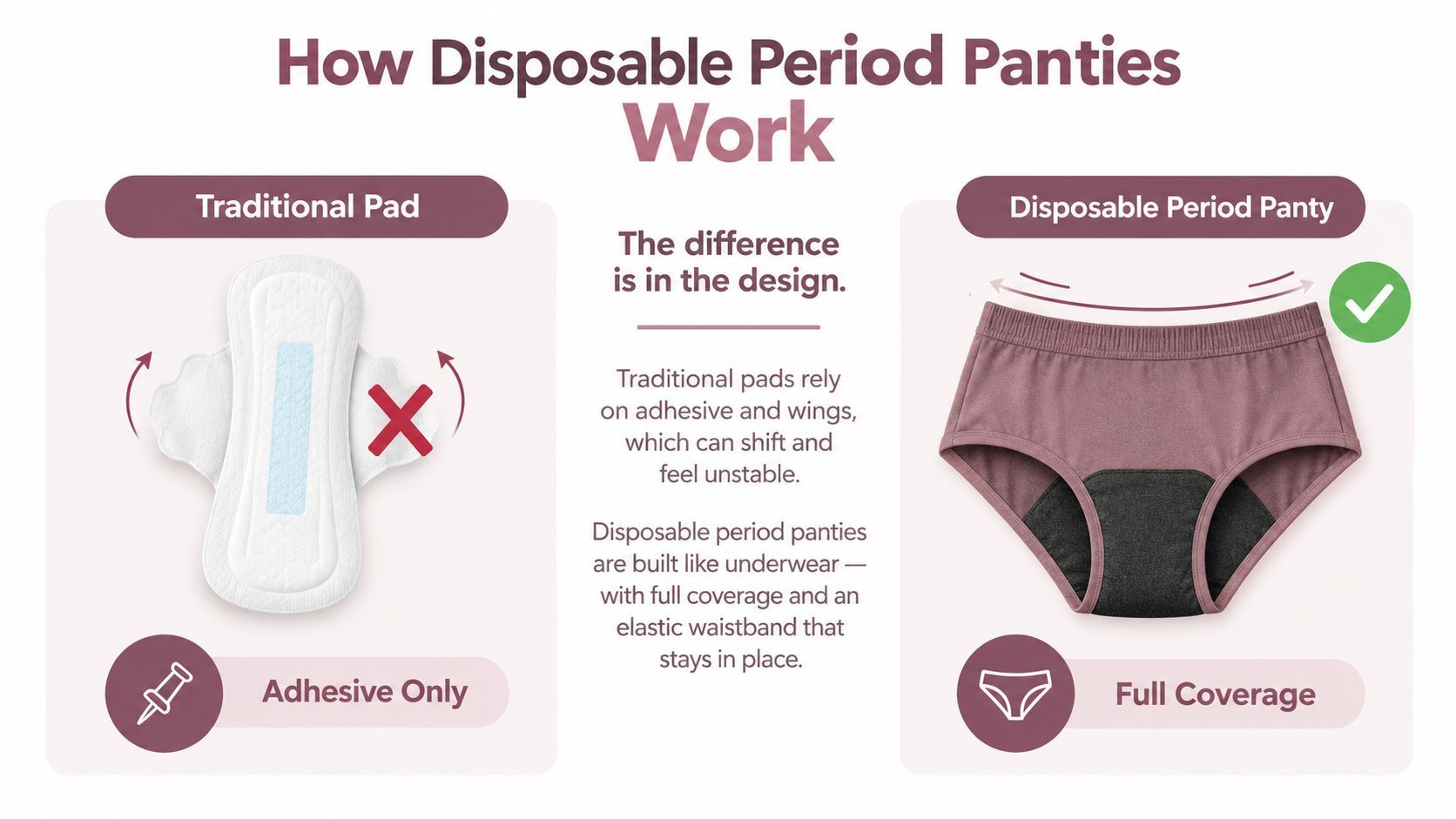
The underwear-like shape is the main mechanical difference. A pad relies on adhesive contact with your underwear and may move when the garment shifts. A disposable panty uses the whole garment's stretch and coverage to hold the absorbent zone in position. That can improve confidence during sleep or movement, but fit still matters. A loose leg opening can allow leaks, while a tight one can cause rubbing.
Capacity is where marketing needs context
Laboratory testing provides an important caution. In a 2024 study, period underwear held the least among the product categories tested, averaging about 2 mL, with individual samples holding under 3 mL. The same research reported modern disposable period products with typical capacities of roughly 20 to 50 mL. See the NIH-linked laboratory study on menstrual product capacity for the comparison.
That doesn't mean every disposable period panty performs identically, or that laboratory capacity predicts every person's experience. It does mean you shouldn't assume “underwear” equals high-volume protection. Some products may work well for light flow, spotting, or backup. A person with rapid bleeding or frequent gushes may need a product with a clearly stated capacity, more frequent changes, or an additional protection plan.
If you're assessing a product, ask:
- What flow level is it designed for? Look for light, moderate, heavy, or overnight guidance rather than relying on vague phrases.
- Where is the absorbent area? Wider back coverage can matter during sleep, while a deeper gusset may matter for front leakage.
- What does the manufacturer mean by capacity? “Pads' worth” and “tampons' worth” aren't standardized measurements across brands.
- What happens when it saturates? Wetness, odor, and visible leakage are practical signs that the garment needs changing.
For additional vulvovaginal support, Momotaro Apotheca's Complete Infection Defense Kit combines external and internal products intended to support concerns such as BV, yeast infections, and pH imbalance. It isn't a substitute for evaluating the menstrual product itself or seeking medical care for new or persistent symptoms.
A visual explanation can make the construction easier to understand:
Disposable vs Reusable Period Underwear
Disposable and reusable period underwear solve different logistical problems. A reusable pair asks you to manage washing, drying, and storage. A disposable pair asks you to manage purchasing, waste, and material selection. Neither option removes every inconvenience.
Performance and comfort
Reusable underwear can be dependable when you have enough pairs in rotation and access to laundry. It may feel more like ordinary underwear because the fabric is designed for repeated wear, although the absorbent layers can be thicker and may retain moisture if they become saturated.
Disposable versions are convenient when you need a fresh garment without a wash cycle. Their full-coverage construction can help with movement and overnight positioning, but you'll still need to match the product to your flow. A garment that fits well but reaches saturation quickly won't protect you just because it resembles underwear.
Cost and routine
The financial trade-off is straightforward in principle. Disposable products create a recurring purchase, while reusable products generally require more planning at the beginning and ongoing care afterward. The right choice depends on whether your priority is low effort today or lower product consumption over repeated cycles.
| Decision point | Disposable | Reusable |
|---|---|---|
| Changing away from home | Fresh pair, no rinse required | Used pair needs containment and later washing |
| Laundry | Not required | Required |
| Storage | Pack clean spares and disposal bags | Keep enough clean pairs in rotation |
| Skin considerations | Review fibers, finishes, fragrance, and testing | Review fabric, detergent, rinse quality, and drying |
| Waste | Every used garment enters the waste stream | The garment remains in use, but care consumes time and resources |
The strongest approach for many people is a hybrid routine. Use reusable underwear on days when laundry is manageable, then keep disposable options for travel, overnight stays, unexpected bleeding, or circumstances where carrying used fabric would be uncomfortable. That approach avoids treating personal care as a loyalty test.
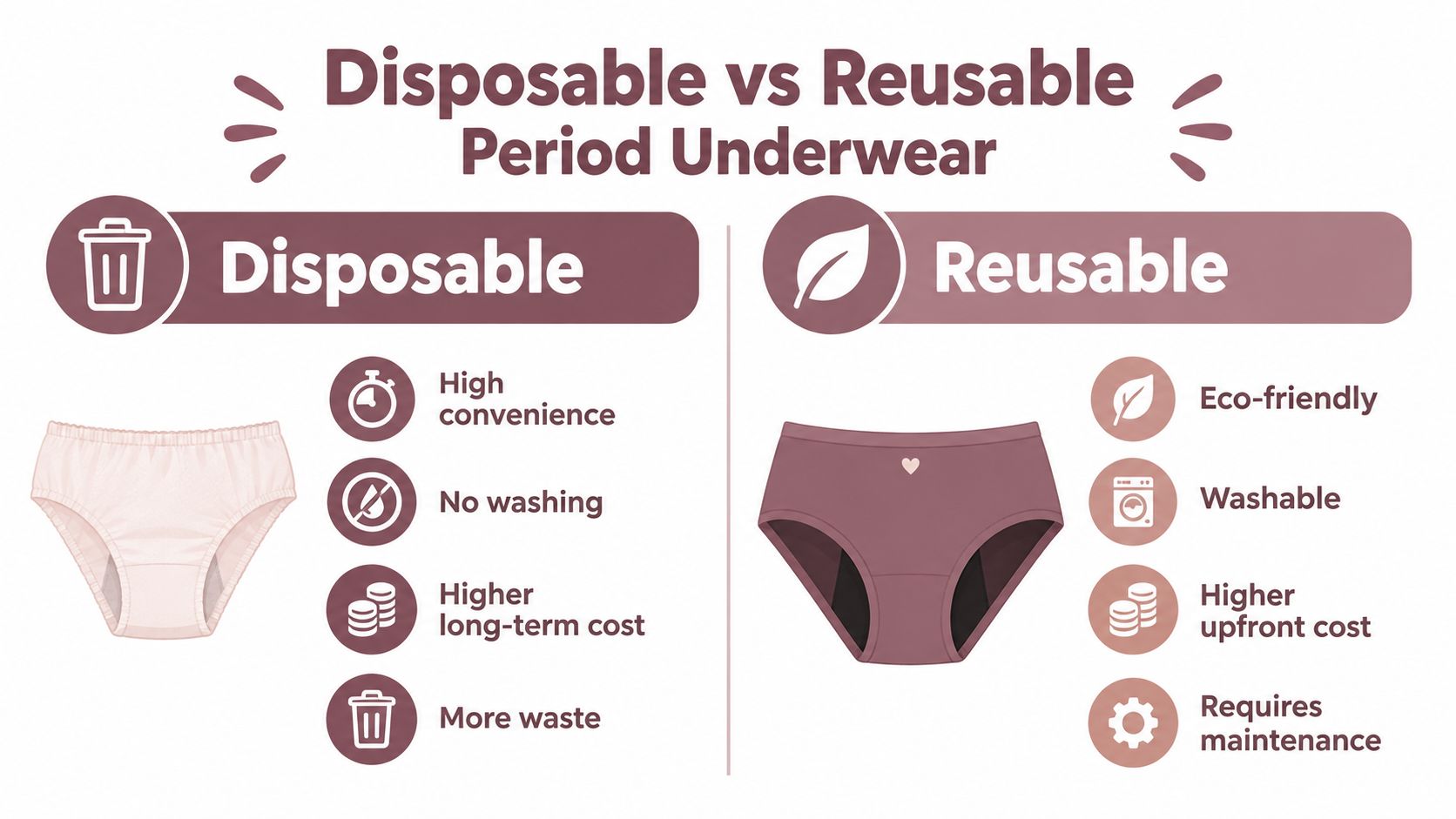
Environmental priorities may shift the balance toward reusable underwear, while access, health needs, and daily demands may make disposables more realistic. A choice that works at home may fail during a trip. Evaluate the routine you can maintain, not the one that looks most virtuous on paper.
The Environmental Impact of Menstrual Waste
Disposability has a real environmental cost. A 2025 BBC Future report estimates that about 20 billion disposable menstrual products are discarded each year in the United States, creating roughly 240,000 tonnes of solid waste. Europe uses about 49 billion single-use period products annually, according to the same report, which places everyday menstrual care within a substantial waste stream. Read the BBC Future report on sustainable period products for the full context.
Conventional pads also contain significant plastic. The report notes that pads can contain up to 90% plastic, with each pad contributing about 2 g of non-biodegradable plastic to the environment. Decomposition estimates range from 500 to 800 years, so the disposal decision extends far beyond the few hours a product is worn.
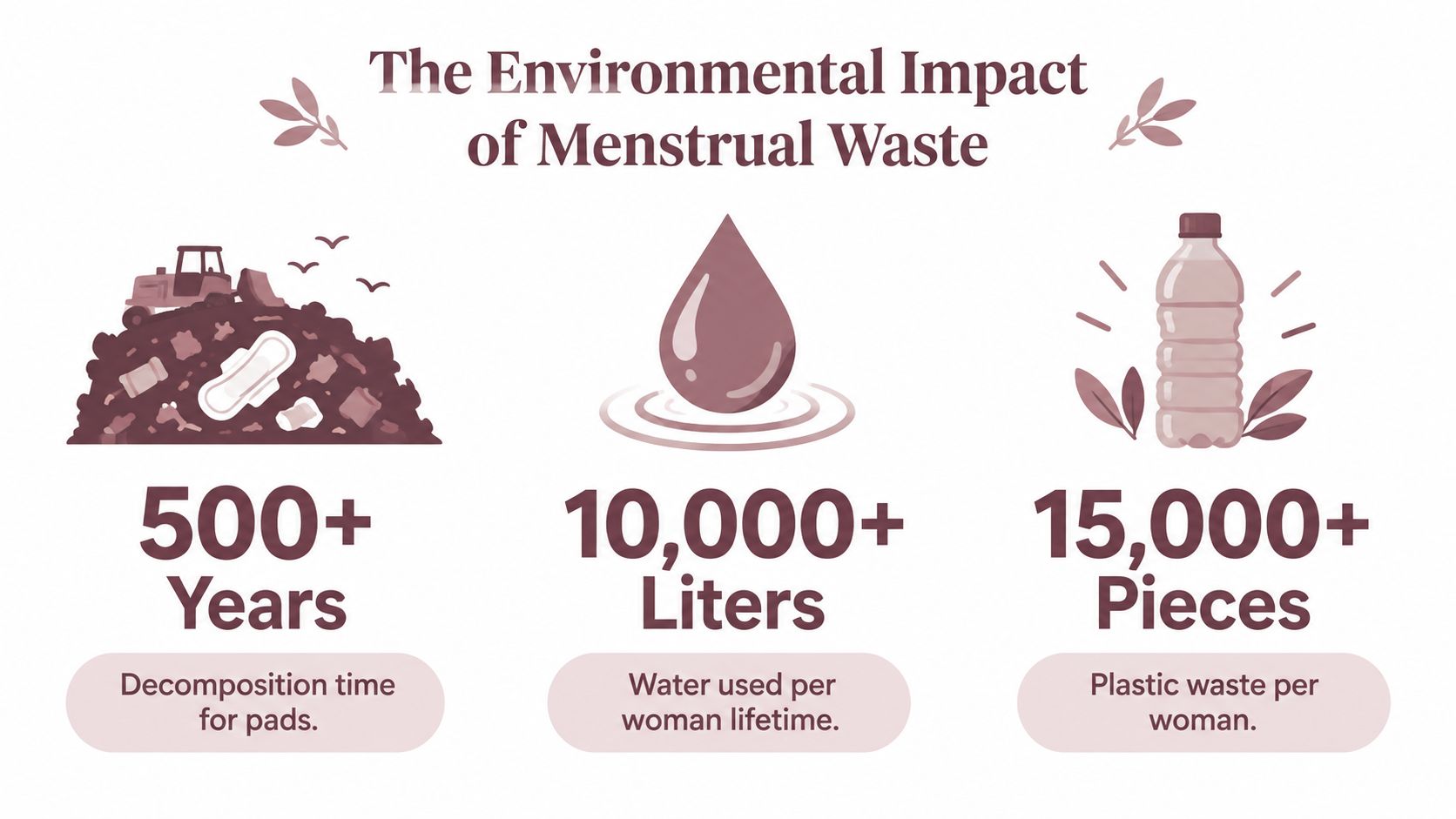
Disposable period panties may distribute absorbent material differently from a pad, but they remain single-use products. Their underwear-like design doesn't make them biodegradable, recyclable, or impact-free. Disposal should follow local waste guidance, and products shouldn't be flushed.
Where period underwear fits
A life-cycle assessment across three countries ranked period underwear second-best environmentally after the menstrual cup, ahead of reusable pads and far ahead of single-use pads and tampons, as reported by BBC Future. That ranking places period underwear in a middle category. It can be a lower-waste alternative to conventional single-use products when it's reusable, but a disposable garment does not receive the same benefit merely because it uses an underwear shape.
Waste planning also includes what happens after use. If you're clearing out old reusable garments or other textiles, look for textile recyclers around Chicago rather than assuming every fabric item belongs in curbside recycling. Menstrual products themselves may not be accepted through textile programs, so check the specific instructions before dropping anything off.
Sustainability decisions work best when they include the whole lifecycle: raw materials, manufacturing, washing, transport, use, and disposal. If you need a disposable option for a particular trip or health-related circumstance, using it selectively can reduce the number of disposable products in that situation without pretending the product has no environmental footprint. Momotaro Apotheca also discusses its commitment to sustainability as part of broader personal-care choices.
Health Considerations and Material Safety
“Disposable” describes the use pattern, not the safety profile. A product can be convenient and still cause friction, trap heat, irritate sensitive skin, or expose you to materials you'd prefer to avoid. People with vulvar sensitivity, recurring irritation, or a history of contact reactions need to assess the product's composition as carefully as its absorbency.
Conventional disposable menstrual products may include plastic components and superabsorbent polymers. Period underwear is less standardized than long-established pads and tampons, and an NIH-linked paper from 2023 noted that menstrual-specific underwear is marketed as having tampon-equivalent absorbency even though regulations don't specify underwear content or capacity. That gap makes transparent labeling especially important.
Read beyond the front of the package
Look for:
- A complete materials list: “Soft” or “natural-feeling” doesn't identify the fibers, adhesives, polymers, or barrier layers.
- Fragrance-free construction: Fragrance can be an avoidable irritant for sensitive external skin.
- Dye and finish information: Ask the manufacturer what touches the vulva and whether treatments are used.
- Relevant testing: Dermatological or irritation testing can provide useful context, but it doesn't guarantee that your skin will tolerate the product.
- Clear certification details: A named, meaningful certification is more useful than an unexplained “clean” or “non-toxic” claim.
Chemical exposure deserves a measured response. Independent reporting and research have raised concerns about chemical exposure, irritation, and possible toxic shock syndrome risk across some disposable menstrual products. A 2025 materials-safety screening found fluorine signals in about one-third of reusable period underwear products, which shows why “reusable” doesn't automatically mean chemically safer. The broader lesson is to ask which materials and finishes are present in either product type, rather than assuming one category has a universal safety advantage. Background on this issue is also discussed in evidence about period panties as a safe alternative.
For sensitive skin: Stop using a product if you develop burning, itching, rash, swelling, or worsening discomfort. Persistent or severe symptoms deserve assessment by a qualified clinician, because irritation can resemble an infection.
Disposable period panties aren't designed for internal use, so toxic shock syndrome concerns differ from those associated with inserted products. Still, prolonged dampness, friction, and occlusion can aggravate external skin. Change based on saturation and comfort, and don't use a product that repeatedly triggers symptoms just because its marketing sounds reassuring.
Sizing, Care, and Usage Guidelines
A good fit starts with the manufacturer's size chart, not your usual clothing size. Measure where the brand instructs, then consider the leg openings and waistband separately. If the waistband digs in or the leg elastic leaves painful marks, the garment may be too small. If you feel gaps around the thighs or the absorbent panel doesn't stay close to your body, it may be too large or the cut may not suit you.
Wear the garment with the absorbent panel centered. Check that the back coverage sits where you need it, especially if you're sleeping or sitting for long periods. A correct fit can reduce shifting, but it can't compensate for a product whose capacity doesn't match your bleeding pattern.
Know when to change
Several industry and practical-use sources describe typical change intervals of around 12 hours, but that isn't a target you need to reach. Flow intensity, activity, heat, and skin comfort can shorten the useful wear window. Change sooner if you notice:
- Wetness against the skin, especially if it doesn't improve after the product settles.
- Odor, which can indicate that the garment has been worn too long or is saturated.
- Visible leakage, a clear sign that protection has failed.
- Rubbing or irritation, even if the absorbent core isn't full.
Pack unused garments in a clean, dry pouch. Carry disposal bags so you can wrap the used product before placing it in a bin, and never flush it. For reusable underwear, set aside a predictable laundry routine. If home washing is difficult, a service that lets you schedule a wash and fold can reduce the maintenance burden, although you should still follow the garment's care instructions.
Test a new product on a lower-stakes day before relying on it for a flight, overnight event, or heavy-flow day. Your own skin response and leakage pattern are more useful than a generic promise of all-day protection.
When to Choose Disposable Period Panties
Disposable period panties make the most sense when laundry access, privacy, or convenience matters more than minimizing single-use waste. Travel is the obvious example. You can pack clean pairs, change in a bathroom, and dispose of the used garment without rinsing or carrying wet fabric. The same logic applies to long workdays, conferences, camping, and overnight stays.
They can also help during postpartum recovery or other periods when bending, washing, or managing a complicated routine feels like too much. However, postpartum bleeding can be different from a regular period, and anyone recovering after birth should follow their clinician's advice about product choice, hygiene, and symptoms that need medical attention.
Match the product to the day
Choose disposable underwear when:
- You can't wash reliably: Travel, shared accommodation, or a disrupted home routine may justify the convenience.
- You want full coverage at night: The panty shape can feel more secure than a pad that shifts as you sleep.
- You need a backup plan: Keep a pair available for unexpected bleeding, work emergencies, or a long journey.
- Your skin tolerates the materials: Review the ingredient and material information first, especially if you're prone to irritation.
- Your flow fits the capacity: Don't use a low-capacity product as your only protection during rapid or heavy bleeding.
Choose reusable underwear, pads, tampons, discs, or a combination instead when you need a different capacity, want to reduce waste, or can't tolerate the disposable garment's materials. A menstrual disc, for example, measured far higher in the cited laboratory comparison than period underwear, but internal products aren't suitable or comfortable for everyone. Product choice should follow your body, access needs, and comfort, not a category battle.
The most useful period routine may be mixed. Reusable underwear can cover predictable days at home, while a disposable pair stays in your travel kit. Pads or another product can provide a faster change when your flow is unpredictable. If you keep leaking despite correct sizing and timely changes, move to a product with a better-documented capacity or speak with a healthcare professional about unusually heavy bleeding.
Momotaro Apotheca offers certified organic, cruelty-free vulvovaginal care products and routines for concerns including irritation, dryness, BV, yeast infections, and urinary discomfort. Visit Momotaro Apotheca to review its educational resources and choose care that complements, rather than replaces, thoughtful menstrual-product selection.


