


Plant Based Feminine Care: Evidence, Safety and Routines
The most popular advice about plant based feminine care is also the least useful: choose natural ingredients and assume they'll be gentler. A plant extract can soothe external skin in one formulation and irritate sensitive tissue in another. Natural describes an ingredient's origin, not its safety or ability to treat an infection.
A better approach starts with the job you need done. Refreshing sweaty outer skin, easing friction during sex, and treating unusual discharge are different tasks. Choosing safely means separating comfort care from medical treatment, then deciding when to stop experimenting.
Table of Contents
- Plant Based Feminine Care at a Glance
- Which Botanicals Have Real Evidence
- Why Vaginal pH Decides What Helps
- Label Checks Before You Buy
- Red Flags That Mean Stop Self-Care
- How to Introduce a New Product Safely
- Choose a Routine for Your Situation
Plant Based Feminine Care at a Glance
Plant based feminine care covers products with very different purposes. Some touch ordinary external skin. Others contact the vaginal lining or are swallowed, which changes the questions you need to ask before using them.
The vulva is the external genital area, while the vagina is the internal canal. A product intended for the outer pelvic area isn't automatically suitable for the vaginal opening, inner vulvar tissue, or inside the vagina.
Plant-based product types compared
The evidence descriptions below apply to the intended use, not to every product in a category. A comfort product's ingredient list doesn't establish that it can treat the cause of discomfort.
| Product type | Typical use | Evidence level | Main risk |
|---|---|---|---|
| External wash or cleanser | Cleaning the outer vulva | Limited for added comfort beyond gentle cleansing | Fragrance and harsh surfactants can irritate or dry skin |
| Hydrosol or micromist | Refreshing outer skin and the pelvic area | Limited, comfort only | Alcohol, fragrance, or botanical sensitivity |
| Plant oil or balm | External dryness and barrier support | Formulation-specific support for comfort | Occlusion or irritation; oils can weaken latex condoms |
| Water-based lubricant | Reducing sex-related friction | Comfort use, not infection treatment | An unsuitable formula can sting sensitive tissue |
| Intravaginal herbal product | Application inside the vagina | Limited and botanical-specific | Irritation and disruption of the vaginal environment |
| Probiotic or ingestible | Intended support for gut or vaginal flora | Product- and strain-specific | Assuming it treats an active infection |
For a concrete label-reading exercise, Supplemynts Inc.’s listing for a plant-based vaginal gel with vitamin E gives you a product to evaluate by route, ingredients, and intended purpose. The product name alone doesn't establish suitability for your symptoms or prove infection-treatment benefits.
Don't treat every ingredient warning as interchangeable, either. A preservative, essential oil, and probiotic strain serve different functions and need different scrutiny.
Practical rule: The closer a product gets to the inside of the vagina, the more its formulation, tissue tolerability, and clinical evidence matter.
If a product causes burning or changes your symptoms, stop using it rather than interpreting the reaction as cleansing or adjustment.
Which Botanicals Have Real Evidence
A randomized study indexed by PubMed evaluated 210 women with diagnosed vaginitis using plant-extract vaginal formulations and found that postmenopausal participants tolerated the St. John's wort-based and five-herb formulations better than the tea-tree-oil formulation. That's a useful comparison of specific formulations, not proof that every product containing those plants is safe or effective.
The distinction matters because manufacturers can change the extract, concentration, delivery vehicle, and accompanying ingredients. A result from a formulated vaginal preparation doesn't transfer automatically to a homemade mixture or a bottle of essential oil.
Separate activity from usefulness
Judge botanical claims through separate questions. Laboratory activity asks whether an ingredient affects microbes under controlled conditions. Human trial evidence asks what happened when people used a particular preparation. Tolerability asks whether those people could use it without unacceptable irritation.
An ingredient can look promising in a laboratory and still sting real tissue. Likewise, a comfortable formulation hasn't necessarily been shown to clear an infection.
Before choosing herbs, ask a pharmacist or clinician about medication interactions. St. John's wort can interact with prescription medicines, including hormonal contraception, particularly when taken orally; don't assume a different route removes the need for review. Possible estrogenic activity in some botanicals is another reason to check first.
Chamomile, calendula, and yarrow belong to the daisy family, Asteraceae, which also includes ragweed. A known sensitivity to that family is a reason to avoid experimenting with these ingredients on sensitive genital skin.
Botanicals ranked by evidence and tolerability
This comparison separates traditional uses from what the clinical findings can actually support.
| Botanical | Traditional use | What the evidence shows | Tolerability notes |
|---|---|---|---|
| St. John's wort | Vaginal discomfort | Its studied formulation was better tolerated than tea tree oil among postmenopausal participants | Medication review is important; trial tolerability isn't universal safety |
| Chamomile | Soothing irritated skin | Included in combination preparations; individual benefit wasn't isolated | Daisy-family allergy risk |
| Calendula | Skin soothing | Included in multi-herb formulations; standalone benefit wasn't established | Daisy-family allergy risk |
| Yarrow | Inflammation and skin care | Included in combination preparations; individual benefit wasn't isolated | Daisy-family allergy risk |
| Shepherd's purse | Traditional uterine and bleeding uses | Included in multi-herb preparations, not established as a standalone treatment | Avoid during pregnancy without clinician review |
| Tea tree oil | Antimicrobial use | Laboratory activity doesn't establish clinical suitability; its trial formulation was less well tolerated in the relevant subgroup | Irritation and contact sensitivity; never apply undiluted |
| Garlic | Folk antifungal use | Convincing clinical support for vaginal self-treatment isn't established | Can burn mucosal tissue; don't insert it |
| Aloe vera | Moisture and skin soothing | Skin use doesn't establish vaginal benefit | Sensitivity remains possible; check the complete formula |
A combination trial also can't tell you which plant produced a benefit. The base formulation or the interaction among ingredients may matter.
Look for evidence about the finished product and intended route. A botanical name on a label is a starting point for questions, not enough support for a claim to clear yeast, bacterial vaginosis, or another infection. Persistent or atypical symptoms need evaluation even when a product feels soothing.
Why Vaginal pH Decides What Helps
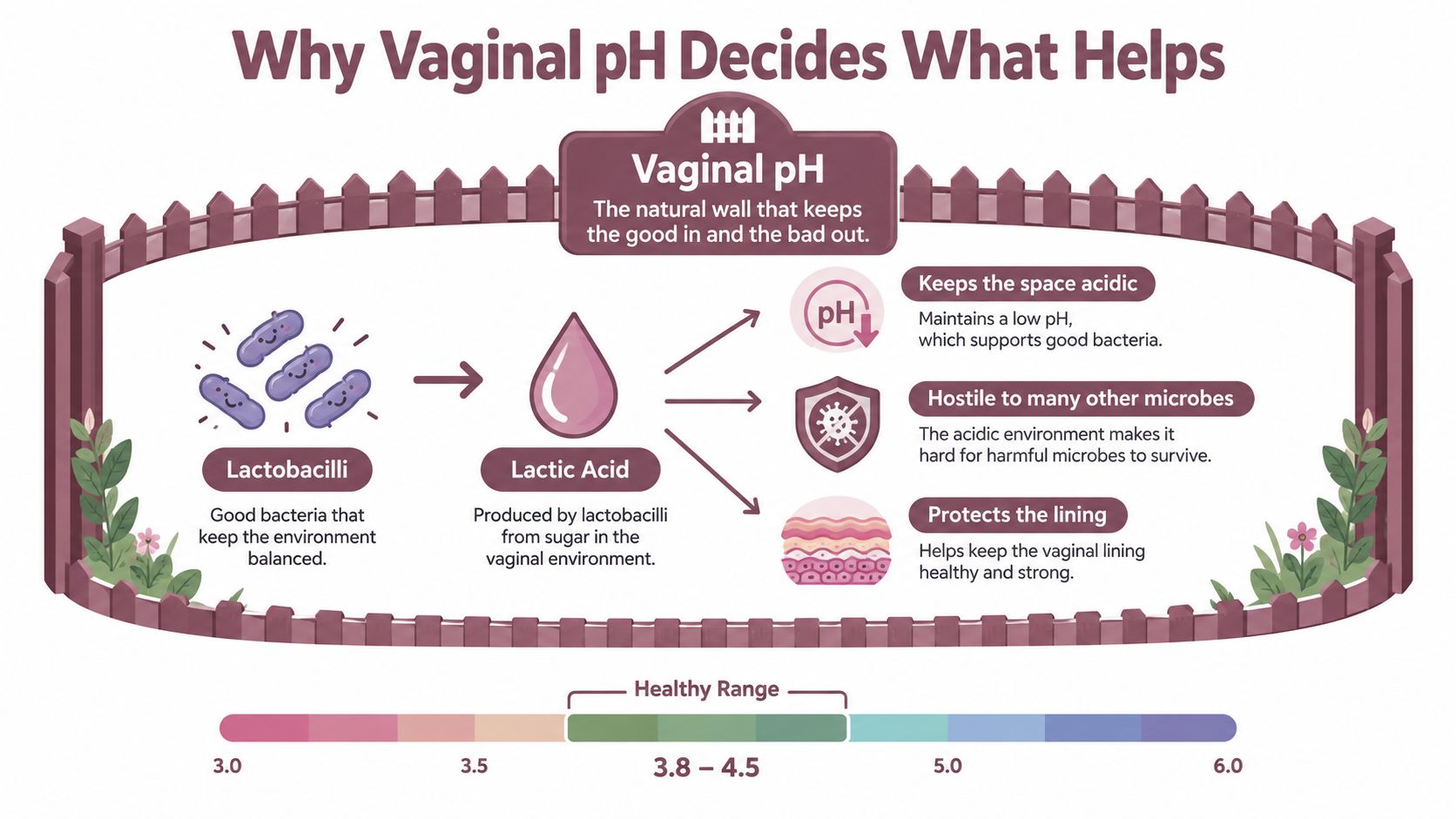
Think of the vaginal environment as a walled garden whose residents help maintain suitable conditions. Lactobacilli use available glycogen-derived substrates to produce lactic acid, supporting an acidic environment that discourages many competing organisms and helps protect the lining.
The clinical review in the International Urogynecology Journal describes a typical reproductive-age vaginal pH below 4.5, often approximately 3.8–4.2, while bacterial vaginosis can involve loss of Lactobacillus dominance and a rise above 4.5. These values describe an ecological pattern, not a home diagnosis.
The illustration shows how the bacteria, acid, and protective environment connect.
Compatibility means more than acidity
Semen and menstrual blood can temporarily affect vaginal pH. Soaps, detergents, and unsuitable lubricants can also interfere with comfort or the local environment, while sweat mainly changes conditions on external skin rather than proving an internal pH problem.
Product choice therefore requires more than an acidic number. Osmolality, the concentration of dissolved particles, affects how a formulation interacts with water in tissue. Preservative effects and the potential to disturb beneficial organisms matter too.
An oil-based balm may not have a meaningful pH measurement in the same way a water-based gel does. That's why a manufacturer should explain what was measured, rather than merely printing a reassuring phrase on the package.
For cleanser-specific questions, the guide to pH balance washes offers a useful starting point for distinguishing external cleansing from internal treatment.
This accompanying video provides another way to approach the topic.
Acidifying isn't the same as curing. Lactic-acid products haven't been established as reliable ways to cure bacterial vaginosis or restore the microbiome. Suspected BV needs appropriate diagnosis and evidence-based treatment.
For any rebalance claim, ask: What pH is listed, where was it measured, and what outcome is the product intended to achieve? If those answers aren't available, don't infer clinical benefit from the wording.
Label Checks Before You Buy
Read the back of the package before relying on the front. Botanical illustrations, organic language, and medical-sounding endorsements don't tell you whether the finished product suits your tissue or symptoms.
A useful label should make the route, ingredients, and intended purpose understandable without guesswork. Use these checks before opening a product.
Read for suitability, not reassurance
- Route: Confirm whether the product is intended for external skin or intravaginal use, because permission to use it on the body doesn't establish suitability for the vaginal lining.
- Stated pH: Look for the finished formula's pH and measurement context, remembering that a water-free oil may not have a meaningful conventional pH value.
- Botanical identity: Seek the plant name, extract type, and concentration where available, because a vague reference to tea tree doesn't explain the exposure.
- Potential irritants: Review fragrance, essential oils, and alcohol carefully, especially if you've reacted to scented or botanical products before.
- Preservatives and free-from claims: Compare claims about sulfates, parabens, and phthalates with the ingredient list, without assuming that every preservative is harmful or every preservative-free formula is safer.
- Condom compatibility: Look for explicit latex compatibility when sex is involved, because oil-based products can weaken latex and water-based labeling alone doesn't answer every compatibility question.
- Certification meaning: Use the explanation of what certified organic means to distinguish farming and processing standards from evidence of clinical benefit.
- Claim wording: Separate statements about soothing or moisturizing from claims to treat, cure, or prevent infection, which require a different level of evidence.
- Named approval: Treat an unnamed doctor-approved endorsement as weak support unless the manufacturer identifies the reviewer, assessment, or relevant clinical study.
Ask when the label is incomplete
Missing information isn't an invitation to experiment. Ask the manufacturer whether the product is intended for your exact application site and whether it has been assessed as a finished formulation.
Bring the ingredient list to a pharmacist or clinician if you take prescription medicines, have significant allergies, or have a diagnosed vulvar condition. The label is often the only information available before sensitive tissue is exposed, so uncertainty should narrow your choices, not encourage a larger trial.
Red Flags That Mean Stop Self-Care
Itching doesn't automatically mean yeast, and odor doesn't establish bacterial vaginosis. Burning, discharge, and irritation can accompany infections, urinary problems, dermatitis, or conditions such as lichen sclerosus, and the appropriate responses aren't interchangeable.
A clinical commentary in Climacteric describes limited or inconsistent evidence for many over-the-counter herbal products and warns that tea tree oil, garlic, vaginal steaming, and detox products may irritate tissue or delay diagnosis. It also recommends professional review of medication interactions and possible estrogenic activity.
Decide which kind of help you need
A mild external comfort problem with an obvious trigger, such as irritating clothing, may justify removing the trigger and simplifying care. New internal discomfort, unusual discharge, urinary symptoms, or repeated episodes call for assessment rather than another botanical experiment.
Urgent symptoms take priority over product selection. Use the following situations as stop rules, not as a way to diagnose yourself.
| Symptom or situation | Why it matters | Next step |
|---|---|---|
| Fever, chills, or pelvic pain | Can signal a spreading infection or another urgent problem | Seek same-day medical care |
| Sores, ulcers, or blisters | Can indicate herpes or another condition requiring examination | Arrange prompt assessment and testing before applying products |
| Bleeding between periods or after sex | Needs evaluation rather than symptom masking | Book a clinician visit; seek urgent care if bleeding is heavy or you feel unwell |
| Pregnancy or trying to conceive | Botanical suitability and reproductive safety need individual review | Check with a clinician before use |
| Thick white or shiny vulvar patches | Can be mistaken for yeast but may reflect a skin condition | Arrange a clinician examination |
| Symptoms that don't improve during a brief self-care trial | Continuing products can delay the correct diagnosis | Stop experimenting and arrange assessment |
Pregnancy deserves particular caution because an ingredient's traditional use doesn't establish reproductive safety. New symptoms during pregnancy should prompt contact with your maternity clinician rather than an intravaginal herbal trial.
Repeated symptoms also deserve testing. Temporary relief followed by another episode doesn't confirm that the original self-diagnosis was correct.
A natural label should never give you permission to tolerate worsening symptoms.
For mild external irritation without warning signs, guidance on how to soothe vaginal irritation can help you simplify care while deciding whether an examination is needed. Comfort measures should make that decision easier, not postpone it.
Set a reassessment point before starting. If you're not clearly improving, or symptoms return, the next step is clinical review rather than a longer shopping list.
How to Introduce a New Product Safely
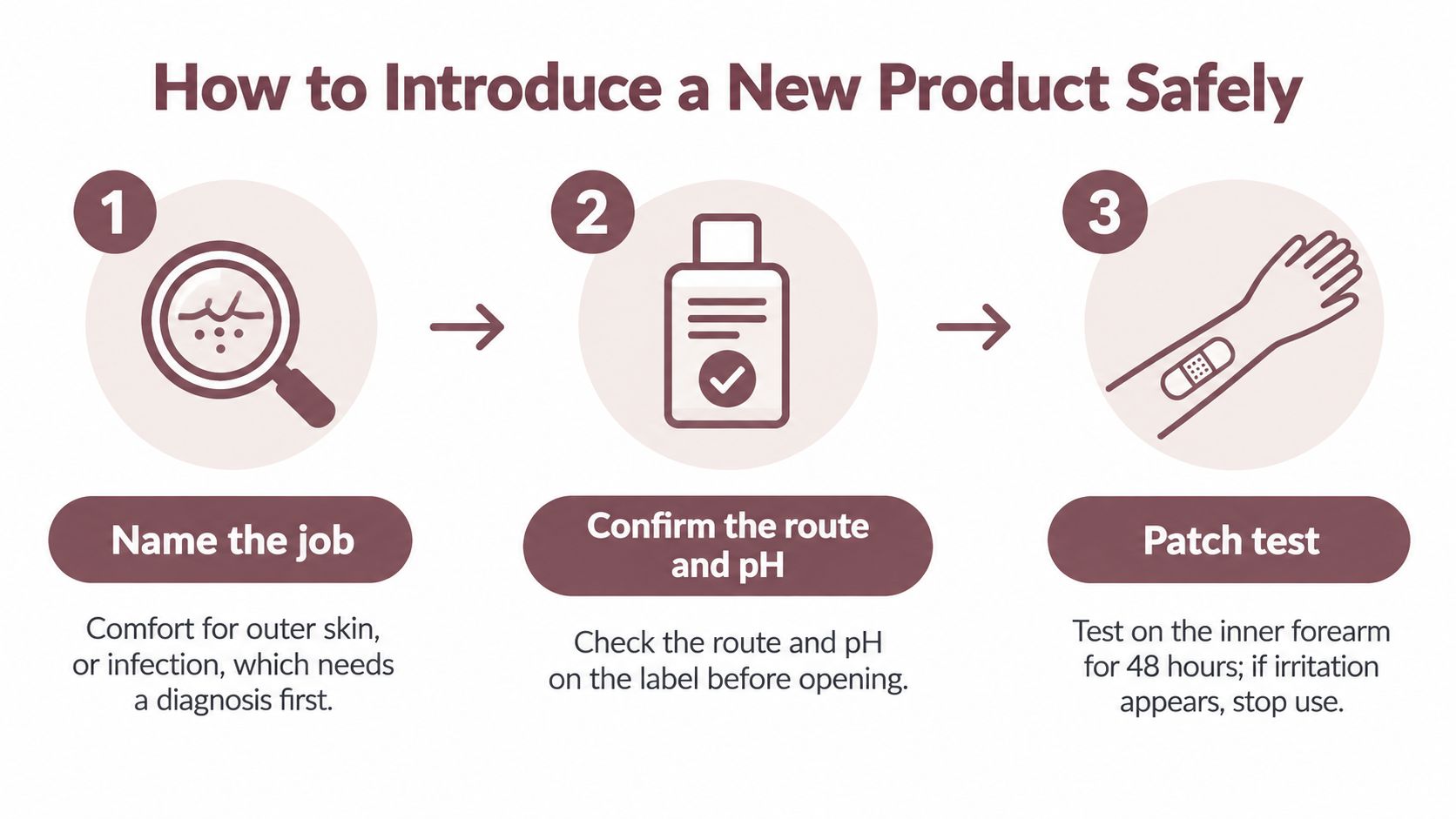
A cautious introduction can help identify a product reaction, but it can't prove vaginal safety or exclude infection. Use this process only for mild external comfort needs without warning signs, and follow any individualized advice from your clinician.
The visual summarizes the starting decisions before anything touches sensitive tissue.
Keep the trial small and interpretable
- Name the job before choosing the product. Write down whether you're addressing external dryness, rubbing, or another clearly defined comfort concern. If you're trying to treat a suspected infection, get a diagnosis instead of using this process as a substitute.
- Confirm the application site and formulation information. Read the route, warnings, ingredients, and relevant pH information before opening. If the label doesn't clearly permit your intended use, ask the manufacturer or choose something else.
- Check tolerance away from genital skin first. For a suitable external product, test a small amount on intact forearm skin according to manufacturer or clinician advice before cautiously trying a tiny amount on the intended outer skin. A clear forearm test doesn't guarantee vulvar tolerance, and this isn't a method for testing intravaginal products.
- Change only one product at a time. Don't introduce a new wash, balm, and lubricant together. Keeping the rest of your routine stable makes it easier to identify what helped or triggered a reaction.
- Keep a simple daily record. Note the product, application site, and whether itching, burning, discharge, or discomfort is better, unchanged, or worse. That record gives a clinician more useful information than a general recollection that several products didn't work.
- Stop promptly if a reaction develops. Rinse external skin gently with plain lukewarm water if you develop persistent stinging, swelling, or a rash, and seek advice for changed odor or discharge. Don't douche or insert water to remove an internal product.
- Reassess rather than automatically continuing. If comfort isn't clearly improving, stop the trial and arrange a clinician visit. Worsening symptoms or warning signs override any planned reassessment date.
Brief tingling doesn't always establish an allergy, but it isn't a sign that a product is working either. There's no need to push through discomfort on sensitive tissue.
Keep your notes: Bring the package and symptom record to an appointment so the clinician can assess both your symptoms and possible product exposure.
Choose a Routine for Your Situation
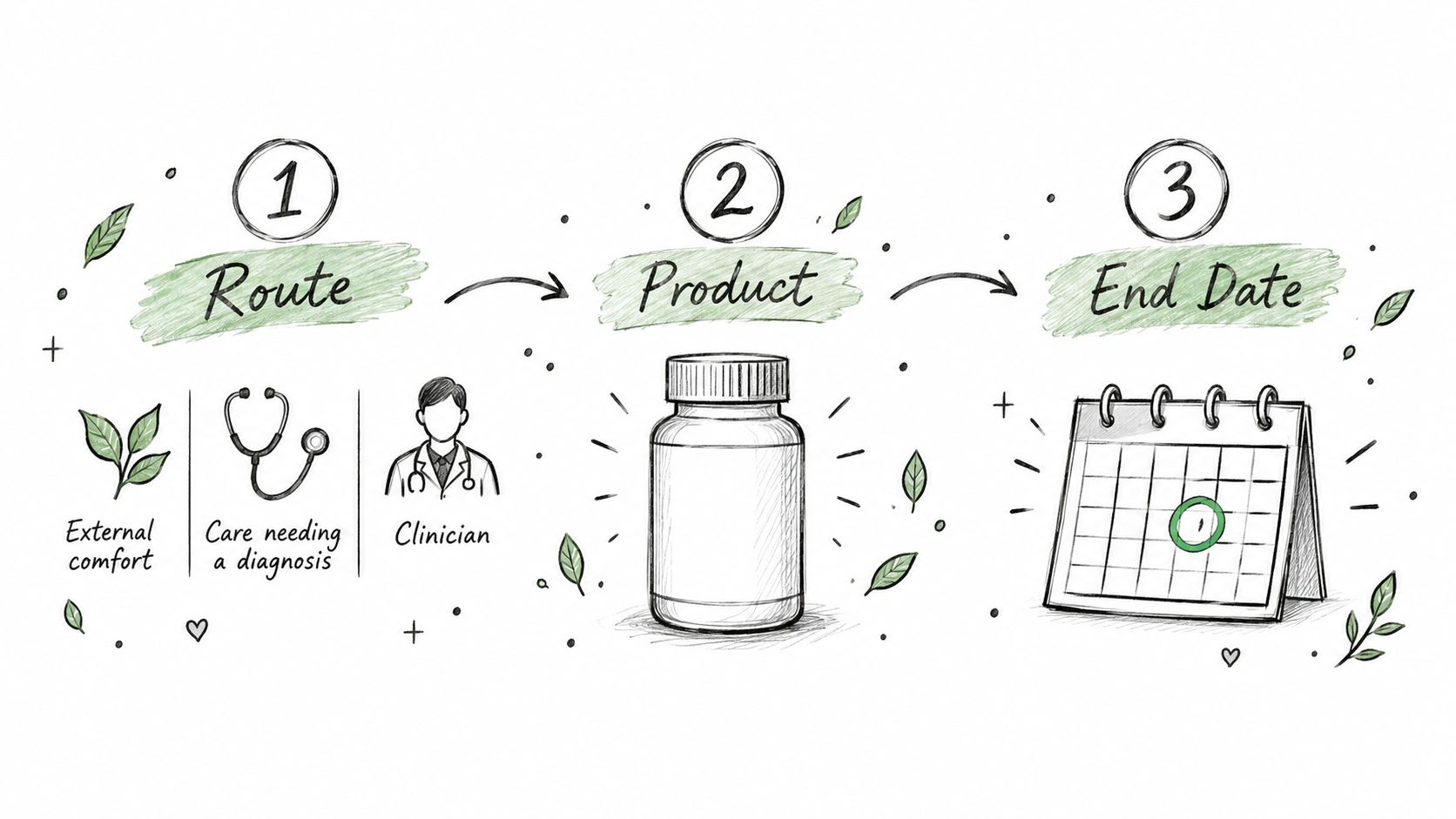
Choose the route first, then the product, then the point when self-care ends. That order prevents a familiar mistake: buying something soothing before deciding whether the symptoms need testing.
The decision process should stay simple enough to use when you're uncomfortable.
Plant-based routine by situation
| Situation | Plant-based approach | Clinician check if |
|---|---|---|
| Everyday sensitivity or post-workout sweat | Plain water or a tolerated fragrance-free external cleanser; optional external refresher | Irritation persists, worsens, or includes unusual odor or discharge |
| Dryness or itching during perimenopause | A tolerated fragrance-free balm on external skin | Dryness persists, sex hurts, or tissue appears fragile |
| Friction or irritation after sex | An appropriate water-based lubricant; gentle external cleansing only if wanted | Burning, unusual discharge, or bleeding occurs |
| Recurrent yeast- or BV-type symptoms | Minimal external comfort care while arranging diagnosis | Symptoms recur, even if previous products briefly helped |
| Postpartum healing | Gentle external care using only clinician-approved products | There's a wound concern, heavy bleeding, or fever |
| Diagnosed lichen sclerosus | Only adjunct products approved by your dermatologist or gynecologist | Skin texture, color, pain, or symptoms change |
For external dryness, Soothe & Restore Salve is an organic coconut- and jojoba-oil balm positioned for comfort and moisture-barrier support. Treat it as an external comfort option, not an infection treatment, and account for latex incompatibility when using oils around sex.
A lightweight outer-skin refresher serves a different purpose from a lubricant. For sex-related friction, look for a water-based formula with explicit pH and condom-compatibility information rather than substituting a wash, mist, or balm.
Match persistent symptoms to professional care
Perimenopausal dryness may need more than an external product. ProMD Health's explanation of systemic versus local HRT can help you prepare questions about treatment options, but suitability requires an individual clinical discussion.
Postpartum tissue and diagnosed skin disease also need individualized limits. Don't apply a new balm to healing wounds or replace prescribed lichen sclerosus treatment with botanical care.
For mild symptoms without warning signs, start with a single appropriate comfort product and record the response. No clear improvement means reassess, not add more products. Any red flag moves you out of a self-care routine and into medical assessment.
Momotaro Apotheca offers plant-based external comfort products and educational resources for dryness, irritation, and vulvovaginal wellness. Visit Momotaro Apotheca to review ingredients and intended uses, then choose only what fits your symptoms, application site, and clinician's advice.


