


Probiotic Feminine Wash: What It Does (and Doesn't) Do
You're in the shower, you notice a product labeled probiotic feminine wash, and the claim sounds reassuring enough to matter. It promises gentler care, microbiome support, and a cleaner feeling without the harshness that makes some intimate washes sting or dry the skin.
The problem is that the phrase itself bundles together two very different ideas. The science of the vaginal microbiome is real, but a wash is still a rinse-off cleanser, not a treatment that stays behind and rebuilds anything on its own.
Table of Contents
- What Probiotic Feminine Wash Claims to Do
- The Vaginal Microbiome Explained
- Why Probiotics in a Rinse-Off Wash Are Not a Simple Fix
- How to Choose a Gentle, pH-Conscious Feminine Wash
- When Probiotic Feminine Wash May Help and When It Won't
- The Bigger Picture for Vulvovaginal Wellness
- Frequently Asked Questions About Probiotic Feminine Wash
What Probiotic Feminine Wash Claims to Do
A probiotic feminine wash usually enters the cart with a simple promise, it's supposed to cleanse the external vulvar area while being kinder to the body's natural balance. The wording often suggests support for pH, odor control, comfort, and microbiome health, which is why it sounds more specialized than a standard body wash.
That pitch sits inside a larger market shift. The broader feminine hygiene market is large and still expanding, with one industry report valuing it at USD 33.20 billion in 2025 and projecting USD 43.74 billion by 2031, while another placed it at USD 45.56 billion in 2025 and projected USD 85.81 billion by 2036. Natural and organic feminine hygiene products were also reported as growing at a 7.6% CAGR, which helps explain why probiotic-positioned products keep showing up in intimate care aisles. Mordor Intelligence's feminine hygiene market overview
What the label usually means
In practice, “probiotic” can mean a few different things. Some formulas use live bacteria, some use probiotic-derived ingredients, and some lean on postbiotics, which are the byproducts or metabolites associated with probiotic organisms.
Practical rule: if the product rinses off, judge it first as a cleanser, not as a microbiome therapy.
That distinction matters because a wash and a treatment do different jobs. A wash can be made gentle, acidic, and skin-friendly. It still doesn't behave like a product that remains in place long enough to change the internal vaginal environment in a durable way.
The Vaginal Microbiome Explained
The vaginal ecosystem is more like a balanced garden than a sterile room. A 2009 NIH review noted that the human vagina can host microbes from a pool of more than 50 species. The same review also helps place Lactobacillus within that larger community, rather than treating the microbiome as a single-organism system. NIH review on vaginal microbiology

Why Lactobacillus gets so much attention
Lactobacillus helps maintain an acidic environment, which can make it harder for unwanted organisms to overgrow. You can read more in our guide to probiotic benefits on the vaginal microbiome. That biological role explains the appeal of probiotic-labeled products, but it does not prove that a rinse-off cleanser will rebuild or maintain the internal microbiome.
The vagina largely cleans itself. The vulva is external skin, so it calls for gentle washing, not scrubbing or heavily fragranced products. Clinical guidance places normal vaginal pH around 4.0 to 4.5. Vulvar pH falls between skin pH, about 4.7, and vaginal pH, so a cleanser formulated within an acidic range may be less disruptive to the surrounding environment. Clinical guidance on vulvar care and pH
A pH-conscious wash may therefore differ from a standard cleanser in formulation, but the difference is not automatically a microbiome treatment.
Clean the outside gently. Leave the inside alone unless a clinician has told you otherwise.
A healthy vaginal ecosystem is not maintained by pursuing absolute cleanliness. It is supported by leaving the internal system undisturbed and treating the external skin with care.
Why Probiotics in a Rinse-Off Wash Are Not a Simple Fix
A probiotic feminine wash can sound like a shortcut, but the body doesn't work that neatly. A rinse-off cleanser touches the vulva briefly, then goes down the drain, so it has limited opportunity to alter internal vaginal flora in a lasting way.
That doesn't make the category useless. It just means the product's effect depends heavily on formulation, pH, and whether the active ingredient is live, inactive, or postbiotic. The review literature is still mixed, with some evidence suggesting probiotic use may improve vaginal health in prevention settings, while evidence for commercially available probiotics in treating or preventing vulvovaginal candidosis remains inconclusive. Review literature on vaginal probiotics
The live-probiotic problem
Live strains sound appealing, but they raise practical questions about stability and dose. If a product is sitting on a shelf, exposed to heat changes, or built as a wash that leaves quickly, the strain may not behave the same way it would in a controlled research setting.
That's part of why the field has started looking toward postbiotic formulas. A 2025 preprint described a customized feminine hygiene wash using Lactobacillus-derived postbiotics aimed at UTI prevention, which reflects a move away from live organisms and toward more stable topical actives. The shift makes sense from a formulation standpoint, even if the consumer-facing claims still outrun the evidence.
How to Choose a Gentle, pH-Conscious Feminine Wash
Start with the simplest filter, external use only. If a product blurs the line between internal and external care, skip it. Your goal is to clean the vulva gently, not to flush, scrub, or “reset” the vagina.
The next filter is pH. A wash designed to sit near the acidic range is less likely to disrupt protective bacteria or leave the skin feeling stripped. The controlled 28-day assessment of a lactic-acid gel wash at pH 4.2 found no significant change in vulvar skin pH over time and no significant loss of natural vulvar microbiome species richness or diversity for bacteria or fungi, which is a useful benchmark for what a careful external formula can look like. Controlled assessment of a low-pH external wash
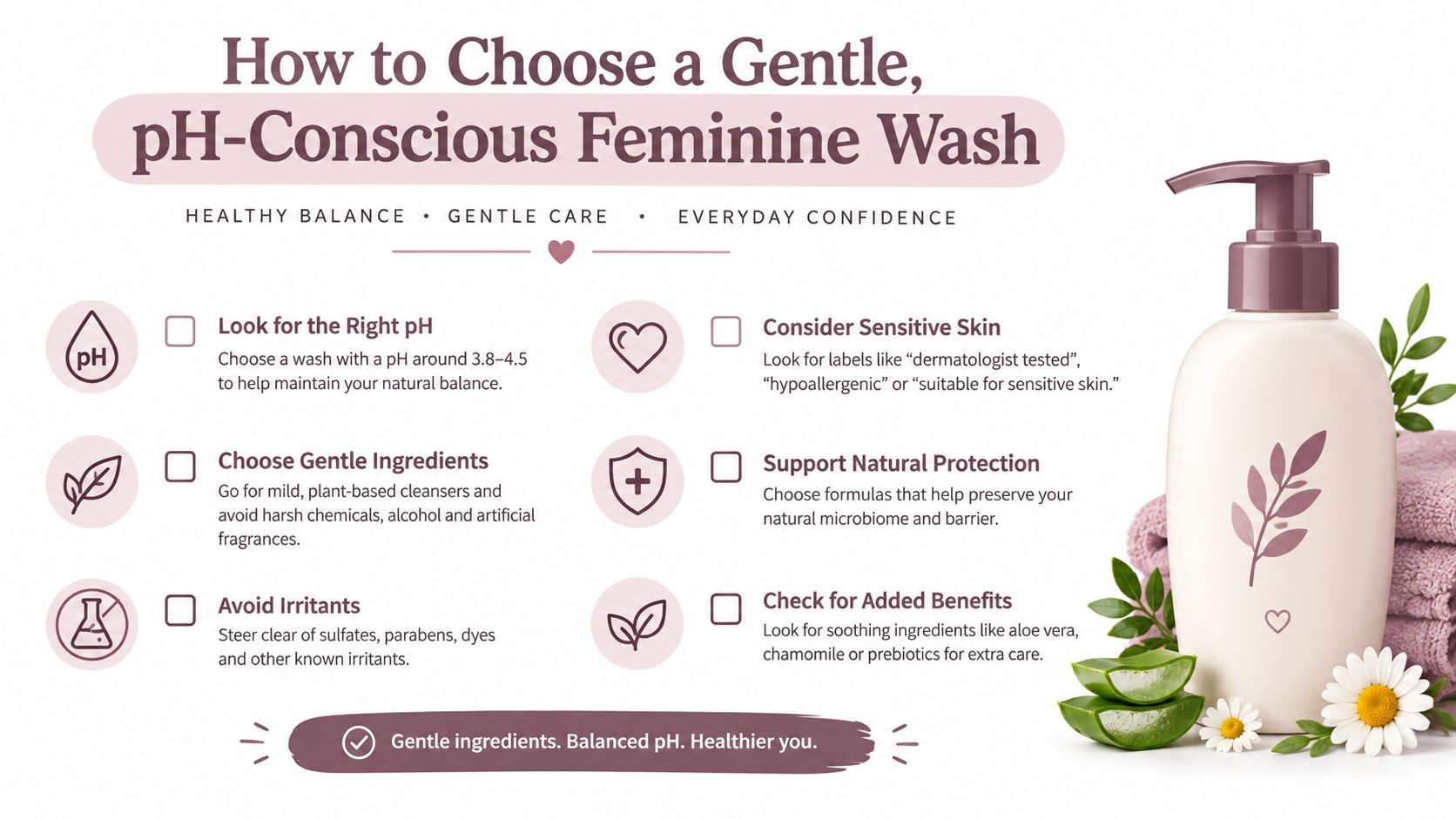
What to look for on the label
- Fragrance-free formulas: Fragrance is a common irritant, especially on thin vulvar skin.
- Sensitive-skin positioning: That usually signals simpler surfactants and fewer decorative additives.
- Acidic or pH-conscious design: This better matches the area's natural environment.
- Clear external-use instructions: If the label is vague, that's a problem.
- Modest cleansing claims: “Supports comfort” is more credible than “restores the microbiome.”
A useful comparison is to think about intimate care the same way you think about gut support. You don't buy a bloating supplement because it promises magic, you pick it because the ingredient list, use case, and tolerance profile fit your body. If you want a related consumer example, the best gut supplements for bloating page shows how people often evaluate support products by function rather than hype.
For people who need a more structured routine around urinary and vulvovaginal comfort, Address & Restore | Urinary Tract Focus combines a urinary tract support supplement, a probiotic, and an external salve in one preventive-style regimen.
If you're comparing products, the internal reference on pH Balance Wash is a useful reminder that mildness beats novelty. The safest cleanser is often the one you hardly notice.
When Probiotic Feminine Wash May Help and When It Won't
For everyday use, a gentle probiotic feminine wash may be reasonable if your main goal is comfort, not treatment. People often want a milder alternative to harsh soap, especially after sweating, during warm weather, or when their skin gets irritated easily.
The strongest signal for benefit is not universal. A pilot trial found Lactobacillus-containing feminine products showed more improvement in postmenopausal women than in premenopausal participants, which fits what clinicians already see: dryness, high pH, and microbiome instability are more common around menopause. PLOS One review on subgroup differences and feminine probiotics
What it won't do
It won't reliably treat a yeast infection, bacterial vaginosis, or a urinary tract infection. It also won't replace medical care when symptoms are recurrent, severe, or changing.
That's where consumers get misled. A probiotic wash may feel soothing, but soothing isn't the same as curing. Reviews in 2024 and 2025 continue to show interest in topical and vaginal probiotics, while also stressing that strain choice, delivery method, and outcomes vary too much for a one-size-fits-all recommendation.
If you're asking whether a probiotic wash is appropriate after sex, during perimenopause, postpartum, or with recurrent BV or yeast symptoms, the honest answer is that the evidence is still uneven. The internal guide on vaginal probiotics, BV, and yeast is helpful precisely because it keeps that uncertainty visible instead of pretending every probiotic claim has the same weight.
The Bigger Picture for Vulvovaginal Wellness
A probiotic feminine wash is one tool, not a whole plan. The bigger picture still includes gentle hygiene, avoiding irritants, paying attention to body changes, and getting checked when symptoms don't settle down.
That matters because the most useful care is often the least dramatic. If a product helps you clean externally without stinging, dryness, or over-washing, that's a legitimate win. If it promises to fix infections or “balance” you instantly, that's where caution should kick in.
For readers who want a broader, plain-language resource on intimate health habits, the silenced guide to women's wellness can be a useful companion. The key is to keep your expectations realistic and your standards high.
Frequently Asked Questions About Probiotic Feminine Wash
Is probiotic feminine wash safe for daily use?
It can be, if it's a mild external cleanser, fragrance-free, and used as directed. Daily use should still stay gentle, because over-washing can irritate vulvar skin.
Can it prevent infections?
Not reliably. Some probiotic-focused products may support comfort or pH-conscious care, but they're not proven replacements for medical prevention or treatment.
Is it different from a regular gentle cleanser?
Sometimes only a little. If a standard cleanser is already mild, fragrance-free, and pH-conscious, the probiotic label may add more marketing than measurable difference.
Is it appropriate after sex or during perimenopause?
It may be a reasonable external-care option if your skin tolerates it, especially during times when dryness or sensitivity are common. If symptoms are recurrent or painful, get evaluated instead of experimenting indefinitely.
What if I keep getting irritation, odor, or discharge changes?
Don't keep cycling through washes. Persistent symptoms deserve a clinician's assessment, because the problem may be infection, dermatitis, hormone-related dryness, or something else entirely.
If you want a routine that's built around gentle, external, pH-conscious care, visit Momotaro Apotheca to explore vulvovaginal wellness products and educational resources that match this topic. Their formulations are designed for people who want support without harsh ingredients, and their product guides can help you choose care that fits your body instead of fighting it.


