


Urinary Tract Yeast Infections Explained
Burning when you pee can make you pause outside the bathroom, wondering whether the problem is a bladder infection, a vaginal yeast infection, or something more unusual. Add itching, urgency, discharge, or pelvic discomfort, and the symptoms can blur together quickly. Even people who know their bodies well can find this overlap confusing.
The phrase urinary tract yeast infection adds another layer of uncertainty. Candida yeast can appear in urine, but that result doesn't automatically mean yeast is infecting the bladder or kidneys. For someone living in the community who suddenly feels urinary burning, a bacterial UTI or irritated vulvar tissue is often a more plausible explanation than yeast growing in the urinary tract.
This guide separates the three possibilities without shame or guesswork. You'll learn what candiduria means, why it appears more often in hospitals, how clinicians distinguish colonization from infection, what testing involves, and why antifungal treatment isn't appropriate for every positive urine culture. For broader everyday guidance, you can also review this resource on urinary tract health.
Table of Contents
- Introduction
- What Candiduria Really Means
- UTI vs Yeast Infection vs Candiduria
- Who Gets Urinary Yeast Infections
- How Clinicians Diagnose Yeast in the Urinary Tract
- Treatment Options for Urinary Tract Yeast Infections
- When to See a Doctor and Everyday Preventive Habits
Introduction
Suppose you wake with a sharp sting as urine passes, then need to go again shortly afterward. You notice some itching at the entrance to the vagina, but you aren't sure whether it started before or after the burning. A quick search brings up bacterial UTIs, vaginal yeast, Candida in urine, antibiotics, probiotics, and alarming stories about kidney infections. Instead of clarity, you have a longer list of possibilities.
That confusion is understandable because the urinary opening and vulvar tissues sit close together. Urine touching inflamed external skin can burn, even when the bladder is healthy. Meanwhile, a bladder infection can cause urgency and frequency without causing vaginal itching or discharge. Symptoms can overlap, but the treatments don't.
There are three situations worth keeping separate:
- A bacterial UTI, usually involving the bladder or urethra.
- A vulvovaginal yeast infection, where irritated external tissue makes urination sting.
- Candiduria, meaning Candida is detected in urine, which may be contamination, harmless colonization, or a genuine urinary infection.
The third category is the one most often misunderstood. Yeast in a urine sample is a laboratory finding, not a complete diagnosis. Clinicians have to ask whether the sample was collected carefully, whether a catheter is present, whether symptoms fit, and whether the person has medical factors that raise concern for deeper disease.
You don't need to diagnose yourself from one symptom. You do need a way to understand what your body may be signaling and when testing matters. By the end, you'll have a practical framework for separating urinary symptoms from vaginal irritation and recognizing when Candida in urine deserves medical attention.
What Candiduria Really Means
A urine culture that grows Candida answers one narrow question. Yeast was detected in the sample. It does not show, on its own, whether Candida is merely present, whether it entered the specimen during collection, or whether it is truly causing disease in the bladder or kidneys.
The flour-on-the-counter comparison helps here. Flour tells you something is there, but not what happened around it. Maybe someone was baking. Maybe a bag leaked. Maybe it has been sitting there unnoticed. Candida in urine works the same way. The finding is real, but the meaning depends on context.
A finding with several possible explanations
One possibility is contamination. A clean-catch urine sample still passes near skin and genital tissue, where yeast may be present. Another possibility is colonization, which means Candida is present in the urinary tract without invading tissue or causing harm. This is especially common when a catheter is involved, because catheters give organisms a surface where they can persist.
True infection is a different category. Candida can cause cystitis, which affects the bladder, or pyelonephritis, which involves the kidneys. In uncommon situations, urinary Candida may appear along with infection elsewhere in the body. Those situations call for a different level of concern and evaluation than an isolated lab finding.
Remember: A positive culture starts a conversation, not a prescription.
This distinction matters because colonization and infection can look identical on a report. The lab may list Candida either way. Clinicians sort out the difference by putting the result next to the rest of the picture: symptoms, how the urine was collected, whether a catheter is present, whether repeat testing shows the same result, and whether there are medical factors that make urinary Candida more concerning.
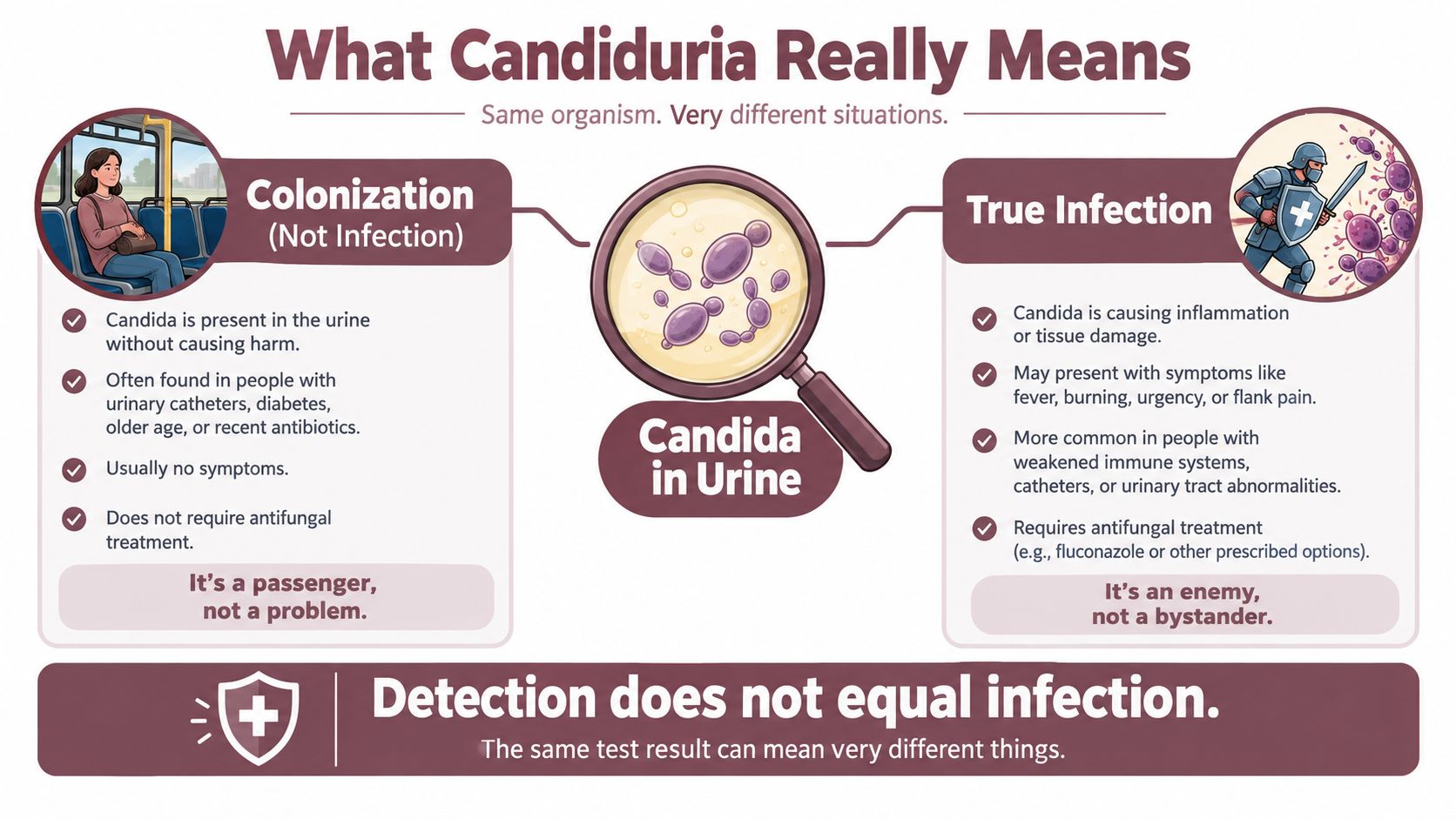
For healthy adults outside high-risk medical settings, Candida in urine is unusual rather than routine. That point matters because many people with urinary burning assume any mention of yeast must explain their symptoms. Often, the explanation turns out to be somewhere else: a bacterial UTI, irritated vulvar tissue, or vaginal yeast causing burning when urine touches inflamed skin.
So the useful question is more specific than “Was Candida found?” The better question is whether the whole clinical picture shows Candida causing urinary tract disease.
UTI vs Yeast Infection vs Candiduria
The most practical way to approach urinary burning is to compare where the discomfort starts and what accompanies it. A bacterial UTI usually creates symptoms from inside the urinary tract, especially urgency, frequency, and bladder discomfort. A vulvovaginal yeast infection affects the vulva and vagina, where itching, soreness, redness, and discharge are more prominent.
The classic confuser is external burning. If the vulvar skin is inflamed, urine passing over it can sting sharply. That sensation may feel like a UTI even though the bladder isn't infected. A person can also have more than one issue at the same time, which is why symptoms alone can't always settle the question.
| Feature | Bacterial UTI | Vulvovaginal Yeast | Urinary Candidiasis, Candiduria |
|---|---|---|---|
| Main location | Urethra or bladder | Vulva and vagina | Bladder or upper urinary tract when true infection is present |
| Typical sensation | Internal burning, urgency, frequency, bladder pressure | External itching, soreness, redness, burning when urine touches skin | May cause urinary burning, urgency, or bladder symptoms, but can also be asymptomatic |
| Discharge | Usually not a defining feature | Discharge may be thick and abnormal | Vaginal discharge doesn't diagnose urinary candidiasis |
| Common context | Bacterial entry into the urinary tract | Disruption of the vaginal environment or local irritation | Catheter use, diabetes, recent antimicrobials, hospitalization, or critical illness |
| What confirms it | Clinical assessment and urine testing when appropriate | Examination and vaginal testing when needed | Repeat urine testing plus symptoms and risk-factor assessment |
A positive urine culture showing Candida doesn't automatically explain vaginal symptoms. Conversely, vaginal itching and external burning don't prove that yeast is in the bladder. If you're trying to understand the broader picture of supplements for bladder and urinary concerns, keep that distinction in mind: supportive products aren't substitutes for identifying the source of pain.
Pay attention to the pattern:
- More suggestive of vulvovaginal irritation: prominent external itching, redness, soreness, or thick discharge, especially without urinary frequency.
- More suggestive of a bladder problem: internal burning, urgency, frequent small trips to the bathroom, or suprapubic discomfort.
- More concerning for upper-tract involvement: fever, flank pain, vomiting, or feeling systemically unwell.
These are clues, not a self-diagnosis. A useful comparison of UTI vs yeast symptoms can help you organize what you're noticing, but urine and vaginal testing may still be needed.
Who Gets Urinary Yeast Infections
You feel burning when you pee, search your symptoms, and land on the word "yeast." It sounds straightforward, but yeast found in urine usually shows up in a very specific context: medical vulnerability and healthcare exposure.
In practice, candiduria tends to cluster around indwelling urinary catheters, diabetes mellitus, recent antimicrobial therapy, prolonged hospitalization, and critical illness. That pattern matters because it helps explain the overlap zone that confuses so many people. Yeast in the bladder or urinary tract is not the same question as vaginal yeast irritation, and it is not the leading explanation for a healthy person with sudden urinary burning.
The outpatient versus inpatient gap makes that clearer. In a 10-year Hungarian clinical-center study covering 2008–2017, candiduria appeared in 0.11–0.75% of positive outpatient samples, compared with 3.49–10.63% of positive inpatient samples, a statistically significant difference. In the same study, Candida albicans was the leading species, representing 65.22% of outpatient isolates and 59.64% of inpatient isolates, while Candida glabrata contributed roughly 20–30% (Hungarian candiduria epidemiology study).
Hospital settings change the odds for practical reasons. A catheter works a bit like a surface yeast can stick to and linger on. Antibiotics can disturb the usual microbial balance. Diabetes, severe illness, and long hospital stays add more opportunities for Candida to show up in urine, sometimes as colonization rather than a true infection. Colonization versus infection is like a guest versus a break-in. Presence alone does not tell you how much trouble it is causing.

For a healthy person at home with new urinary burning, this is usually reassuring. A bacterial UTI or irritated vulvovaginal tissue is often a more plausible starting point than Candida infection in the bladder. If you're also noticing broader Candida overgrowth symptoms, keep the body-site distinction in mind. Yeast around the vulva or vagina, yeast reported on a urine test, and invasive urinary Candida disease are separate clinical questions.
How Clinicians Diagnose Yeast in the Urinary Tract
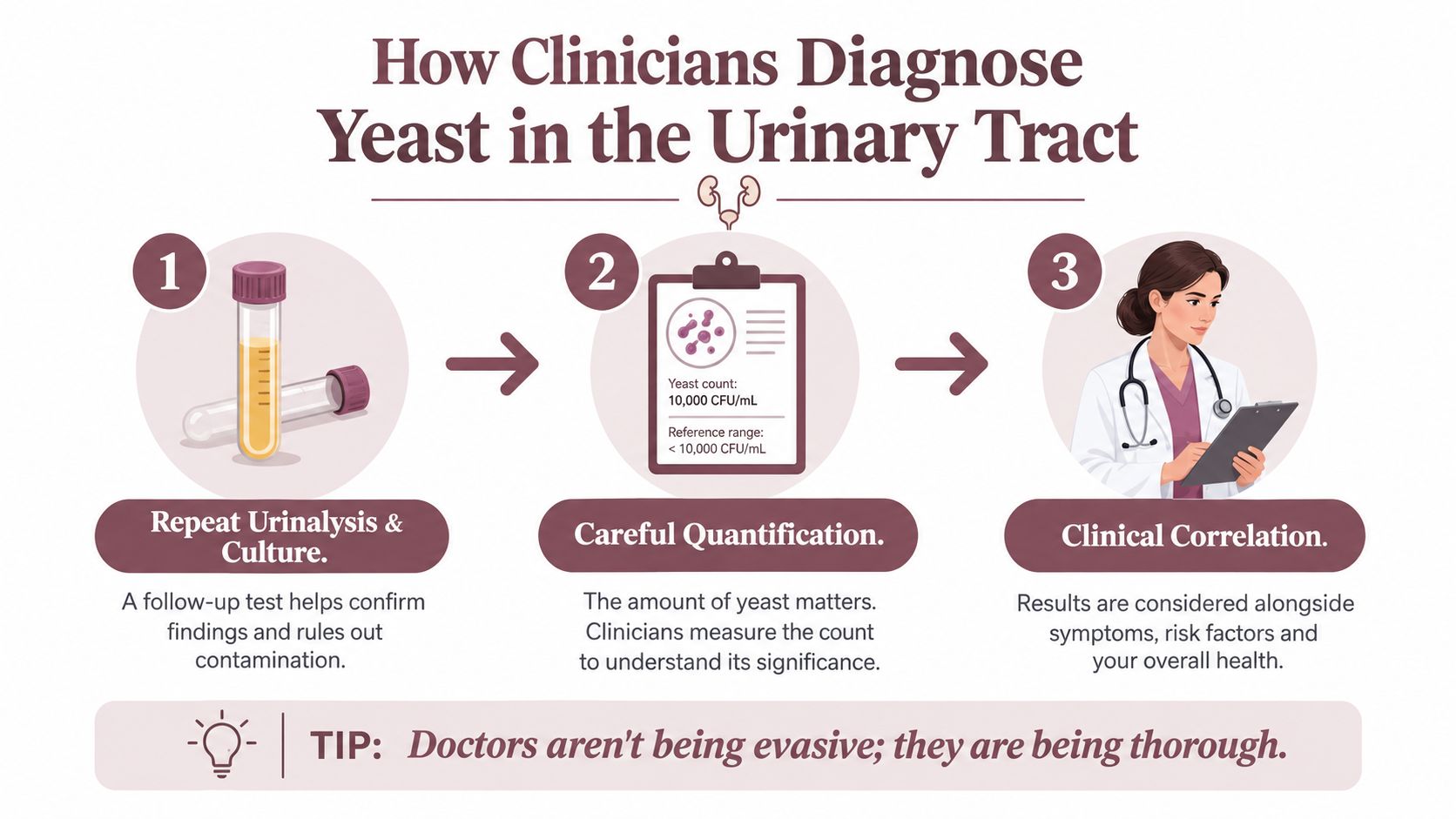
Diagnosis usually begins by checking whether the urine result is trustworthy. When contamination is plausible, the recommended first step is to repeat urinalysis and culture using a carefully collected clean-catch midstream specimen. This gives the clinician a better chance of learning whether Candida is consistently present in urine rather than appearing because of collection problems.
A clean-catch sample involves cleaning the area as instructed, beginning to urinate, and collecting the middle portion in the sterile container. Follow the instructions provided by the testing site, because collection details matter. If a catheter is present, the clinical team may use a different method rather than asking the patient to collect a standard sample.
Three questions shape the interpretation
First, is Candida present? Repeat testing can help distinguish contamination from a repeated finding. A single result deserves context, especially if symptoms don't match.
Second, are there signs of inflammation or infection? Pyuria, meaning white blood cells in urine, can support inflammation. It can't reliably separate harmless colonization from true infection, particularly when a catheter or another urinary problem is present.
Third, does the person look and feel ill? Clinicians weigh dysuria, frequency, urgency, suprapubic discomfort, fever, and flank pain alongside catheter status, diabetes, recent antibiotic exposure, urinary obstruction, and immunosuppression. They may consider imaging when kidney involvement or obstruction is a concern.
The need for this careful process becomes clearer in hospitalized populations. A multi-institutional evaluation of 305 hospitalized candiduria cases found that nearly 80% were asymptomatic (multi-institutional candiduria evaluation). In the same study, 43% of patients with asymptomatic candiduria weren't managed in accordance with contemporary Infectious Diseases Society of America recommendations. Those findings illustrate why an automatic “positive culture equals antifungal” response can expose patients to treatment without addressing the actual problem.
Doctors aren't being evasive when they ask for another sample or review your catheter history. They're trying to identify whether yeast is a bystander, a surface colonizer, a bladder pathogen, or a sign of something more serious.
Treatment Options for Urinary Tract Yeast Infections
Treatment depends on whether infection is present, where it is located, and which Candida species is involved. Asymptomatic candiduria often doesn't call for an antifungal. Removing or replacing an indwelling urinary catheter when feasible, and addressing urinary obstruction or other predisposing factors, may be more important than prescribing medication.
That can feel counterintuitive. People often assume that eliminating every organism found on a culture is the safest approach. In candiduria, the safer approach is to determine whether the organism is causing disease before exposing someone to an antifungal.
When antifungal medication is appropriate
For symptomatic Candida cystitis caused by a fluconazole-susceptible isolate, the Infectious Diseases Society of America recommends oral fluconazole 200 mg once daily for 14 days (IDSA candidiasis guideline). Suspected pyelonephritis generally requires 200–400 mg once daily for 14 days, clinical assessment for obstruction, and sometimes imaging. These are prescription decisions based on culture, symptoms, kidney involvement, and the person's medical situation.
Species can change the plan. Candida glabrata and Candida krusei may be resistant to fluconazole and could require specialist-directed alternatives such as amphotericin B deoxycholate or flucytosine. Echinocandins are generally unreliable for lower-tract infection because urinary drug concentrations are limited.
Over-the-counter vaginal yeast creams belong to a different treatment category. They may be appropriate for a confirmed or familiar vulvovaginal yeast infection, but they don't treat Candida residing in the urinary tract. Applying a topical product externally won't address bladder or kidney infection, just as taking a urinary remedy won't necessarily calm inflamed vulvar skin.
Seek prompt medical evaluation for fever, flank pain, vomiting, hypotension, pregnancy, immunosuppression, or persistent candiduria. These circumstances raise the stakes and make self-treatment particularly risky. The aim isn't to frighten you. It's to match the treatment to the site and severity of the problem.
When to See a Doctor and Everyday Preventive Habits
Use your symptom pattern as a starting point, not a final verdict.
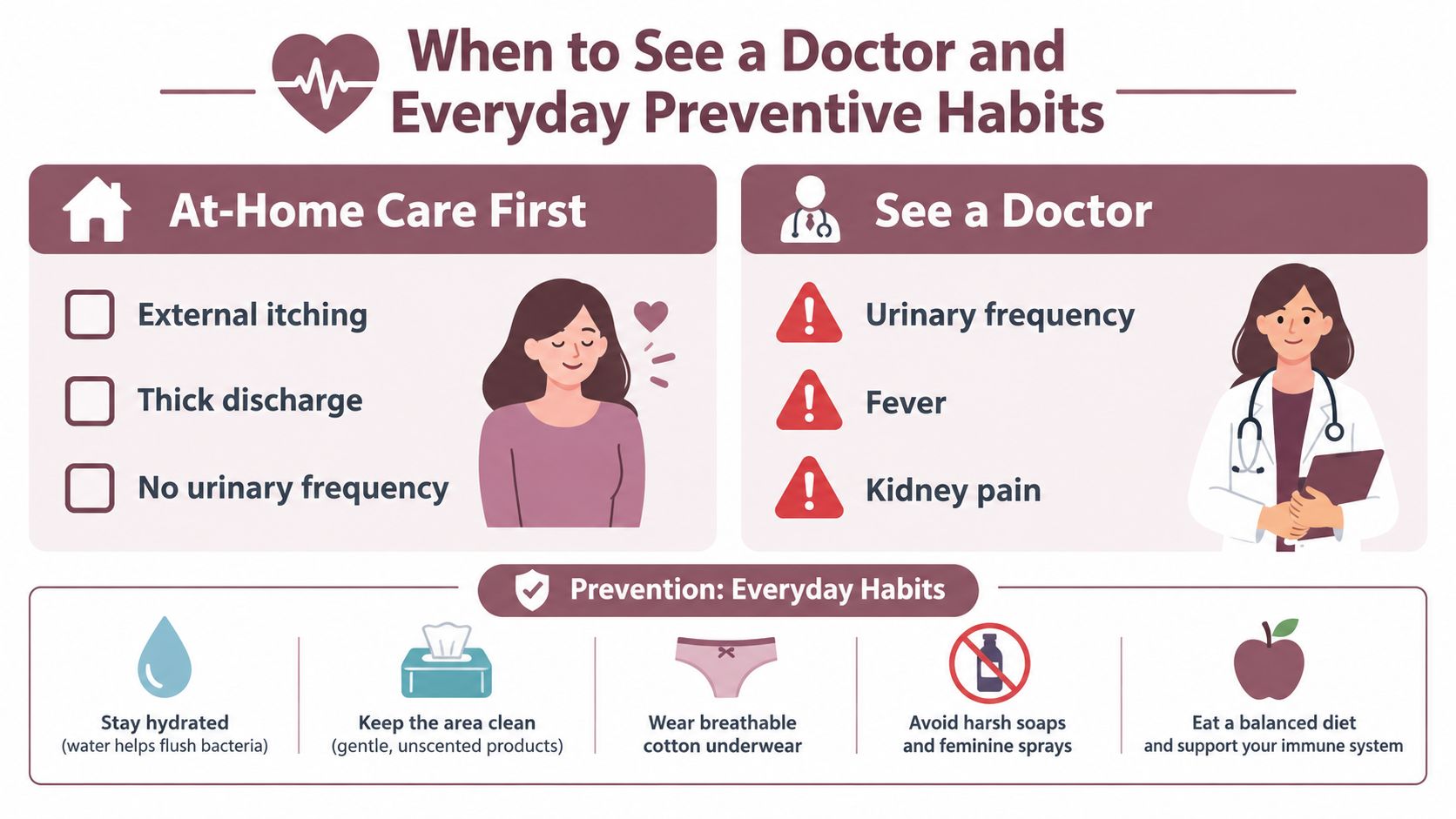
- External itching or irritation: If itching, redness, soreness, or thick discharge dominate and you don't have urinary frequency, ask whether the problem may be vulvovaginal rather than bladder-related.
- Internal urinary symptoms: Burning that feels internal, urgency, or frequent urination is a reason to contact a clinician about urine testing, especially if symptoms persist or recur.
- Same-day medical care: Fever, flank or kidney-area pain, vomiting, pregnancy, immunosuppression, or feeling acutely unwell deserves prompt evaluation.
Gentle care can reduce irritation. Avoid harsh soaps, douching, fragranced products, and anything that repeatedly stings sensitive tissue. If you tend to develop UTIs after sex, urinating afterward may be a useful routine. For practical guidance on reducing UTI risk in aged care, prevention plans should also account for mobility, continence support, hydration routines, and access to timely clinical care.
Plant-based urinary support products or soothing salves may fit into a comfort and prevention routine, but they aren't antifungal treatment for candiduria and shouldn't delay testing when symptoms point to a urinary infection. Body literacy plus prompt, appropriate testing beats guessing.
Momotaro Apotheca offers plant-based, pH-conscious vulvovaginal care for irritation, yeast-related discomfort, and urinary tract support, including soothing salves and curated wellness routines. Visit Momotaro Apotheca to explore gentle options that can complement, but not replace, appropriate medical care.


