


Vaginal Health Products: A Practical Guide to Choosing
“Keep it pH-balanced” sounds like a complete plan for vaginal health. It isn't. A wash, an external balm, a vaginal moisturizer, a probiotic, a menstrual cup, and a prescription infection treatment do different jobs, and treating them as interchangeable can lead to irritation or delay the care a symptom needs.
A more useful starting point is to ask where a product goes, what it's meant to do, and whether it's intended to soothe discomfort or treat a diagnosed condition. That distinction makes it easier to choose thoughtfully without turning ordinary body care into a search for something to “fix.”
Table of Contents
- Why Vaginal Health Products Are Not One Category
- The Five Main Product Categories Explained
- Ingredients That Actually Matter
- Matching Products to Specific Conditions
- The Limits of Microbiome and Probiotic Claims
- Building a Routine That Actually Works
- When to Stop Self-Care and Seek a Clinician
Why Vaginal Health Products Are Not One Category
“Vaginal health products” is an umbrella label, not a product type. It can cover external cosmetics, comfort-focused topicals, supplements, menstrual products, devices, and medicines. A salve applied to the vulva isn't the same as a vaginal suppository, and neither is a substitute for an antibiotic or antifungal when a clinician determines one is needed.
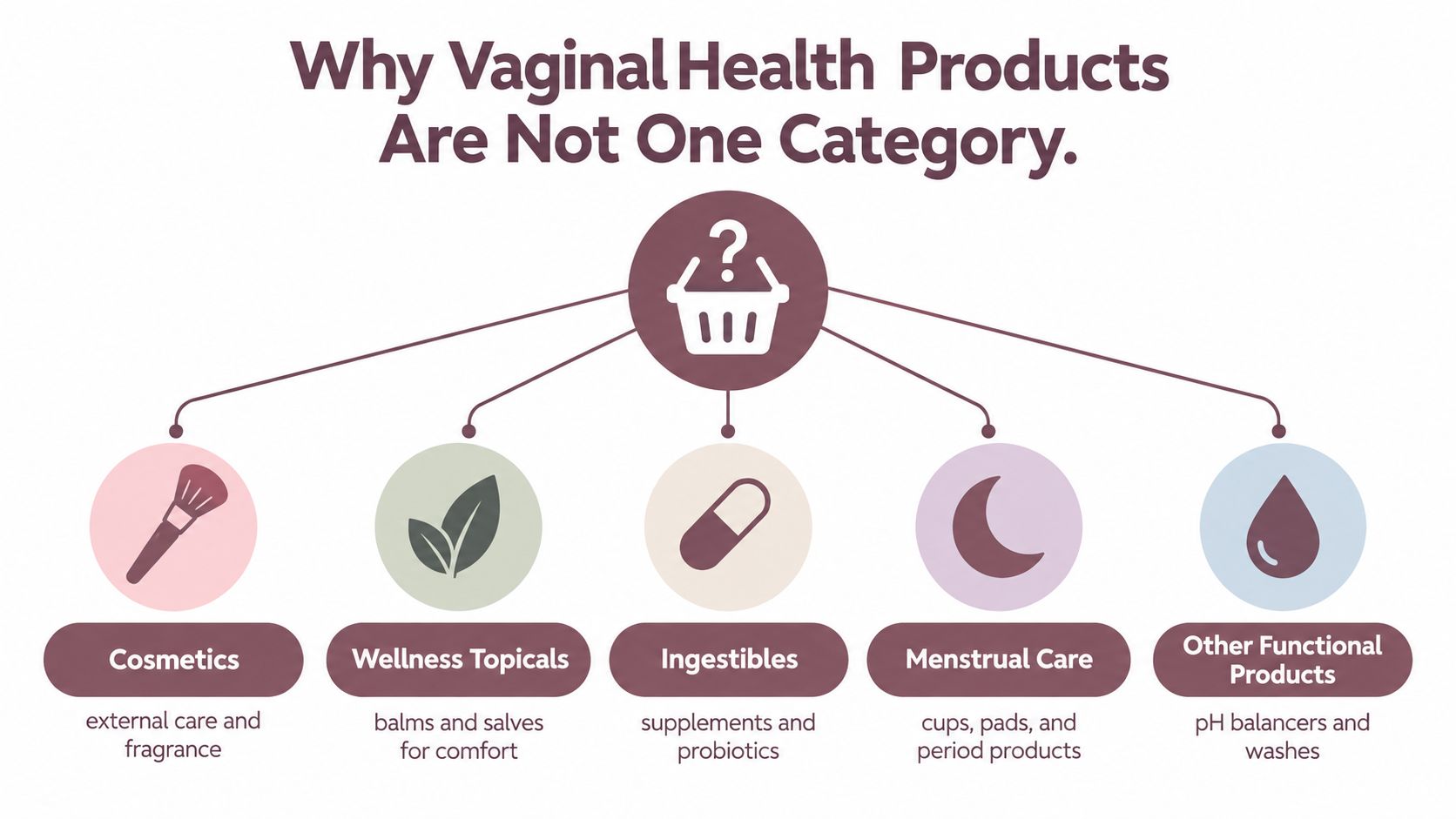
Location matters. The vulva is the external genital area; the vagina is the internal canal. A product designed for external skin may not be suitable for internal use. Read the directions rather than assuming that a product marketed for “intimate care” belongs everywhere.
Regulation also depends on the product. In the United States, the FDA regulates tampons, menstrual pads, menstrual cups, and douching apparatuses as medical devices, while douching solutions, sprays, wipes, and powders are generally regulated as cosmetics. That's one reason labels and claims can differ across the shelf. A wellness claim doesn't mean a product diagnoses or treats an infection.
The need for careful distinctions isn't theoretical. The World Health Organization says a recent systematic review estimated bacterial vaginosis (BV) prevalence among women of reproductive age at approximately 23%–29% worldwide. BV can occur without noticeable symptoms, and prevalence varies with population and setting, so symptom-based product choices can't tell the whole story. The WHO describes BV as a disruption of normal vaginal bacterial balance and advises medical evaluation when symptoms persist or cause concern. The WHO overview of bacterial vaginosis offers useful context on why comfort care and clinical assessment shouldn't be blurred.
Stigma has also made vague promises easier to sell. If a product's purpose or route is unclear, pause before buying. For readers encountering claims about appearance or tightening alongside wellness language, this cosmetic vaginal tightening guide can help distinguish elective procedures from everyday vulvovaginal care.
The Five Main Product Categories Explained
A helpful way to sort products is to think about where they act and what job they can reasonably do. A topical is like a skin-care product for the vulva. An internal moisturizer is closer to ongoing tissue comfort care. A prescription medication, by contrast, is meant to treat a diagnosed condition.
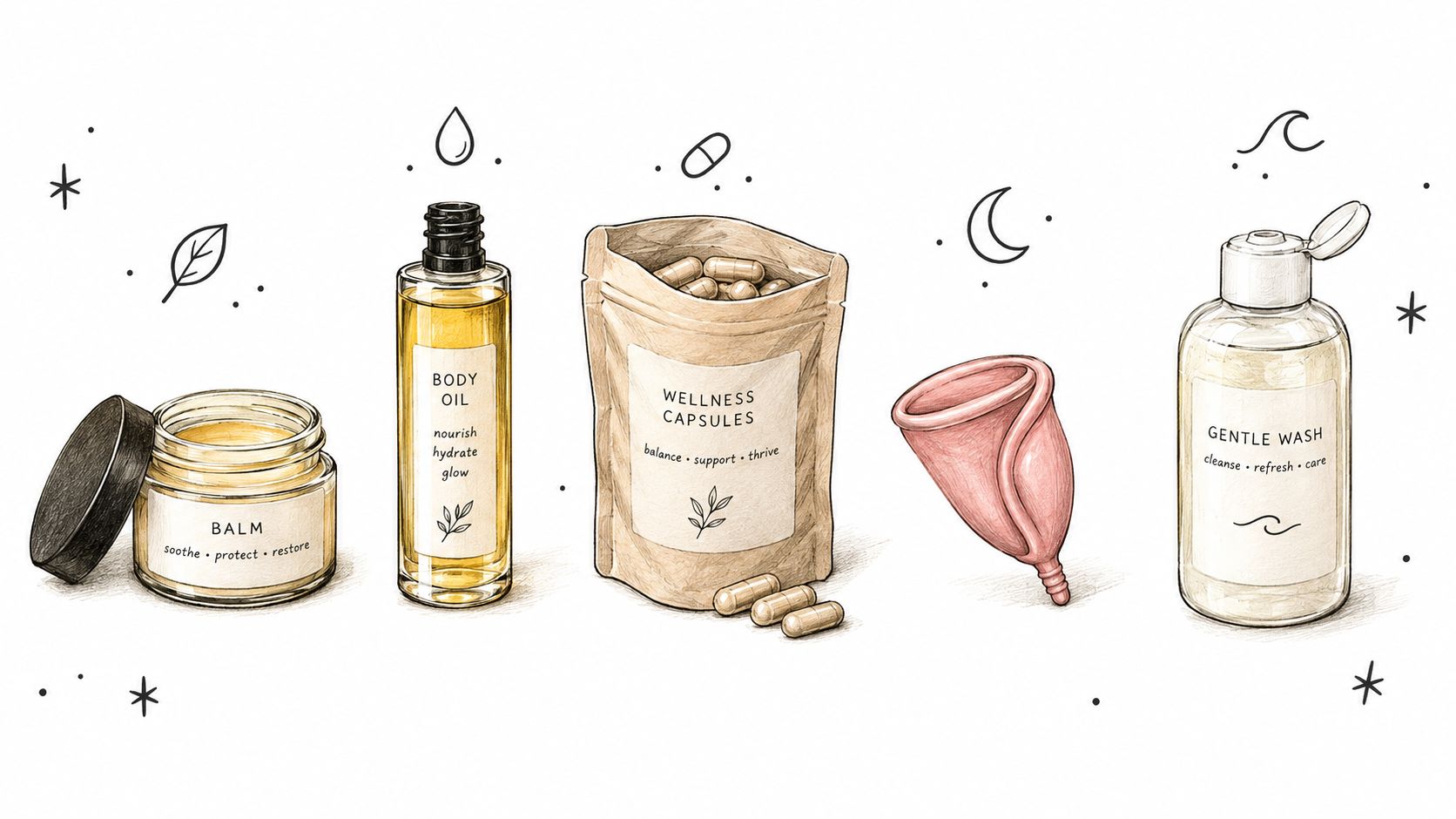
Five buckets, five different jobs
External topicals include balms, salves, and oils intended for vulvar skin. They may support comfort when skin feels dry or irritated by friction, but they aren't internal treatments and don't cure BV or yeast infections. Check whether the label says external use only.
Vaginal moisturizers are designed for repeated use to ease ongoing internal dryness. That's different from a lubricant, which reduces friction during sexual activity. A moisturizer is used as directed on its product label; lubricant is used when needed for sex. Neither should be presented as reversing hormone-related changes to vaginal tissue.
Cleansers and mists sit close to the boundary between cosmetic care and wellness marketing. A gentle external wash may suit someone who prefers one, but the vagina itself doesn't need to be washed internally. A product described as “pH-balanced” still needs clear directions and a specific purpose. This guide to choosing a pH balance wash can help readers assess what a wash is intended to do.
Ingestibles include probiotics and other supplements. Their effects depend on what's in them, how they're used, and the health concern involved. They aren't interchangeable with topical products or prescription treatments, and a supplement label doesn't establish that a product can treat an infection.
Menstrual care and functional products include pads, tampons, cups, douching devices, and products marketed as pH balancers. These have different routes, purposes, and safety instructions. Menstrual products manage bleeding; a cup doesn't treat an infection. A pH-related claim alone doesn't prove that a product will restore the microbiome.
Practical rule: Choose by the need, then check the route. “For vulvar skin” and “for vaginal use” aren't interchangeable directions.
Some readers also encounter device-based procedures while searching for vaginal wellness. Information about ThermiVa and vaginal health provides context for distinguishing a procedure from a topical or internal product. Whatever the category, the label should make the intended use, application site, and limits clear.
Ingredients That Actually Matter
The most useful ingredient question isn't whether a formula sounds “natural.” It's whether the product suits its route and purpose without unnecessarily disrupting sensitive tissue or the vaginal environment.
A healthy vaginal microbiome is typically Lactobacillus-dominant, with a pH of approximately 3.5–4.5. Lactobacillus bacteria produce lactic acid and other factors that help inhibit competing organisms. With BV, lactobacilli decline as the microbiome shifts toward a mixed bacterial imbalance, and vaginal pH generally rises. Research on vaginal pH and the microbiome helps explain why aggressive cleansing isn't a reliable way to support balance.
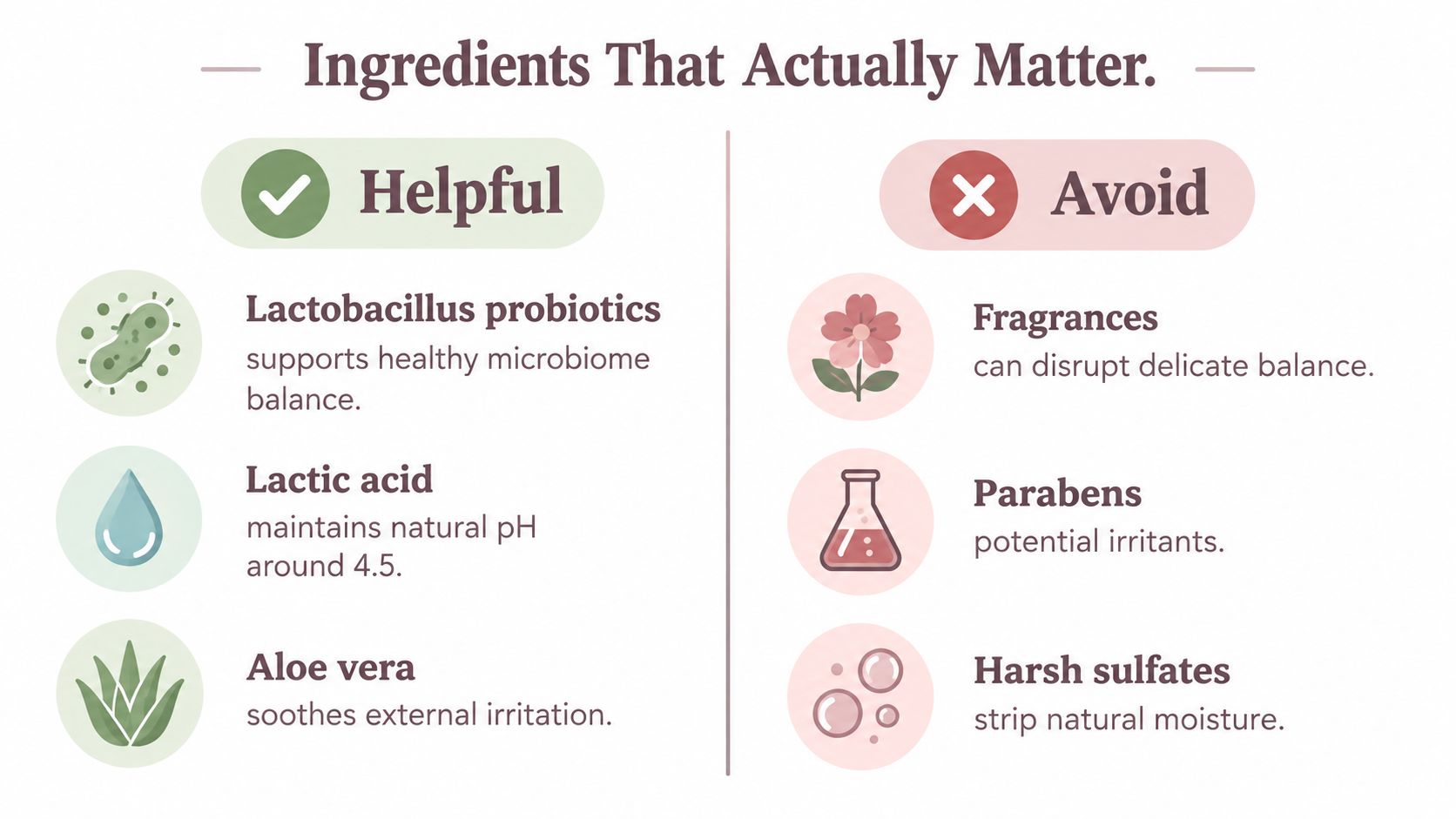
Read the label by route and purpose
For an external product, look for directions that clearly identify vulvar use, plus an ingredient list you can review for known personal sensitivities. Fragrance and harsh cleansing agents may irritate sensitive skin. Some guidance on lubricants advises avoiding ingredients such as glycerin, parabens, nonoxynol-9, propylene glycol, benzocaine, and chlorhexidine gluconate. That doesn't mean every person reacts to each ingredient, but it does make transparency and individual response important.
“Natural” isn't a safety certification. Plant oils and botanical extracts can still irritate some people, and a product's effect depends on the ingredient, its formulation, the amount used, and where it's applied. Don't assume that coconut oil, jojoba oil, calendula, echinacea, goldenseal, or a hydrosol is suitable for internal use just because it's plant-derived. Follow the product directions and stop using it if irritation develops.
Douching deserves particular caution. It can disturb protective flora rather than improve vaginal health, and the WHO identifies vaginal cleansing and douching among BV risk factors. A spray or wash that promises to eliminate natural odor may also encourage unnecessary internal cleansing. The vagina doesn't need an internal wash to be clean.
When considering a moisturizer or lubricant, check whether it's meant for internal or external use, whether it contains fragrance or other ingredients that have irritated you before, and whether it's compatible with condoms or devices. Water-based lubricants are commonly chosen for easier cleanup and compatibility, though they may not last as long as silicone-based options. Oil-based lubricants may irritate tissue and can reduce latex-condom effectiveness, so the label's compatibility instructions matter.
Matching Products to Specific Conditions
A product choice should follow the symptom, not the category's marketing. External irritation and internal infection aren't the same problem, even when they produce overlapping discomfort. If symptoms are persistent or recurrent, a clinician can help identify the cause rather than leaving you to guess from a product label.
| Symptom or condition | Best-fit product family | Role in care |
|---|---|---|
| Vulvar dryness or friction | External barrier balm or salve | May support external comfort; it doesn't treat an internal infection. |
| Ongoing vaginal dryness | Vaginal moisturizer | Intended for repeated internal moisture support; seek care if symptoms persist or are painful. |
| Friction during sex | Lubricant | Reduces friction during sexual activity; check ingredients and condom compatibility. |
| Odor or unusual discharge | Clinical evaluation | Can identify whether BV or another condition is present; a comfort product can't diagnose the cause. |
| Itching or suspected yeast infection | Clinical evaluation when symptoms are new, recurrent, or unclear | External soothing care may ease discomfort but doesn't confirm or eradicate infection. |
| Urinary discomfort after sex | Clinician-guided urinary health plan | Supplements may be considered as support, not as a way to diagnose or treat a UTI. |
| Sensitive vulvar skin, including postpartum sensitivity | Simple, fragrance-free external care | Keep the routine minimal and coordinate with a clinician if symptoms persist. |
Think in terms of support, not substitution
With suspected BV or yeast, a balm may soothe external skin, but it doesn't replace testing or indicated treatment. Odor, discharge, itching, and urinary discomfort can overlap across different conditions. This comparison of BV, UTIs, and yeast infections can help clarify why the symptom alone may not tell you which problem you have.
For dryness associated with perimenopause or menopause, separate external vulvar comfort from internal vaginal moisture. A balm applied externally isn't a vaginal moisturizer, and neither necessarily addresses the tissue changes associated with declining estrogen. Clinical guidance recommends moisturizers and/or lubricants for genitourinary syndrome of menopause, while persistent symptoms may call for a discussion about clinician-directed options. Painful sex that doesn't improve deserves attention rather than repeated product swaps.
For urinary discomfort, probiotics or supplements may be part of a broader conversation about support, but they shouldn't be treated as stand-alone UTI care. A UTI needs appropriate assessment, especially if symptoms persist, recur, or worsen.
A product can help with comfort while still being the wrong tool for the underlying cause.
The Limits of Microbiome and Probiotic Claims
“Supports balance” can sound like a treatment promise without saying exactly what's being treated. Probiotic evidence is indication-specific, so a product that may be relevant to one concern shouldn't be assumed to prevent or resolve another.
A 2025 review found possible benefit for recurrent BV when probiotics are used with or after antibiotics, but probiotics don't appear effective for preventing recurrent vulvovaginal candidiasis. The same review described a 76% reduction in recurrent UTIs only within a multi-component, non-antibiotic bundle that also included D-mannose and cranberry. That finding can't be attributed to probiotics alone. The 2025 review of probiotics and recurrent vulvovaginal and urinary conditions is a reminder to look at the actual indication and combination being studied.
Claims should match the evidence
The American Society for Microbiology has also reported that small clinical trials of vaginal microbes haven't shown effectiveness sufficient for FDA clearance or dependable treatment claims. In practice, that means a “microbiome support” label shouldn't be read as proof that a product treats BV, yeast, or urinary infections.
Supplements also require their own scrutiny. Check the strains and ingredients, the intended use, directions, and warnings. Ask a clinician or pharmacist about possible interactions or whether a supplement is appropriate for you, especially if you're pregnant, breastfeeding, taking medication, or managing a medical condition. A reassuring ingredient list doesn't establish clinical effectiveness.
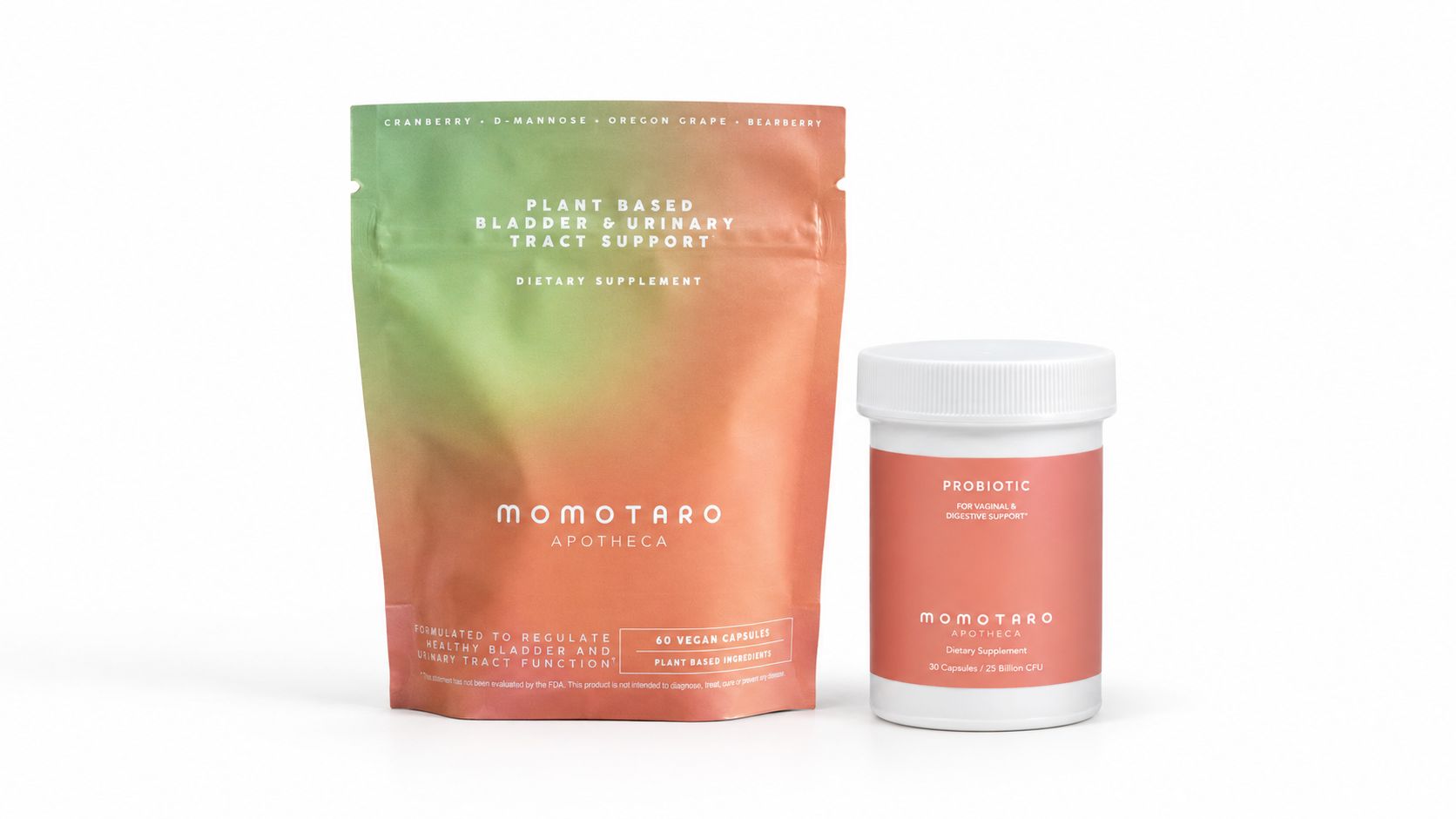
For example, the Bladder & Belly Kit combines a probiotic with a urinary-support supplement containing D-mannose and cranberry. Its product information describes it as a wellness product and states that it isn't intended to diagnose, treat, cure, or prevent disease. That distinction matters: a combination product can't be assumed to reproduce the results of a study or replace care for an active infection.
Use this test: If a claim says “treats,” “prevents,” or “cures,” look for evidence for that specific condition, product, and route. “Natural” doesn't fill in missing evidence.
Persistent, recurrent, painful, or unusual symptoms call for diagnosis, not another round of trial and error. A supportive product may have a role alongside appropriate care, but it can't identify a pathogen or determine which treatment is indicated. This explainer on whether probiotics can help with BV can help readers approach microbiome claims with that distinction in mind.
Building a Routine That Actually Works
A useful routine is usually small, specific, and easy to reassess. Start with the body area and symptom you're addressing, then choose only the product type that matches. Adding several new products at once makes it harder to know what helped or caused irritation.
Start with the simplest sequence
For everyday sensitivity, use water to clean the external area as needed and avoid adding fragranced products. If a clinician has ruled out an underlying issue and you want extra comfort, try one external product according to its label. Stop if the skin stings, burns, or becomes more irritated.
After sex, focus on comfort rather than trying to “reset” the vagina. If friction is a concern, use a lubricant that suits your needs and is compatible with condoms or devices. Clean the external vulva gently; skip douching and avoid putting a balm or wash inside unless its label explicitly says it's for vaginal use.
For ongoing internal dryness, use a vaginal moisturizer as directed, and choose a lubricant for sexual activity when friction is a separate concern. An external barrier product may support vulvar comfort, but it has a different job from either one. If pain or irritation doesn't improve, reassess with a clinician instead of layering on more products.
Postpartum recovery calls for minimalism. Follow your care team's advice, keep products gentle and external unless a clinician recommends otherwise, and avoid experimenting with internal products while healing or managing new symptoms.
Introduce one change at a time
Give each new product a clear purpose: cleanse externally, moisturize the intended tissue, reduce friction, or support a specific comfort need. Read use instructions before application, particularly for internal products, and keep track of any reaction so you can stop the item that seems to trigger it.
Clothing and laundry choices can also affect comfort for people whose vulvar skin is easily irritated. This practical guide to washing underwear without ruining its fit can help with garment care, but it doesn't replace product-label directions or medical advice when symptoms persist.
When to Stop Self-Care and Seek a Clinician
Book a medical appointment for persistent or unusual odor, abnormal discharge, pelvic pain, fever, bleeding outside a normal period, recurring symptoms, or pain during sex that doesn't improve. Symptoms that continue for about two months also warrant evaluation; don't wait that long if symptoms are severe, unusual, or worsening. During pregnancy, ask a clinician about concerning symptoms promptly.
A clinician can test for specific causes, assess whether an STI needs to be ruled out, prescribe an antifungal or antibiotic when appropriate, and discuss hormone-based care for menopause-related symptoms. A wellness product can support comfort, but it can't perform those tasks.
Before buying, ask yourself: What symptom is this for? Where is it meant to be used? Does it claim comfort support or treatment? What will I do if symptoms continue? If you can't answer those questions, pause the purchase and seek clearer guidance.
Momotaro Apotheca offers non-prescription vulvovaginal care, including external balms, oils, ingestibles, and routines organized around concerns such as dryness, irritation, and urinary discomfort. Explore the products and educational resources at Momotaro Apotheca, and choose only what fits your needs and the product's stated use.


