


Vaginal Itching Cream: What to Use and Skip
The most common advice for vaginal itching is also the easiest to get wrong: buy a yeast cream and see what happens. Itching is a sensation, not a diagnosis. An antifungal can treat yeast, but it won't treat every condition that makes your vulva or vagina itch.
You don't need to scrub harder, smell different, or feel embarrassed. You need to identify where the irritation is, consider what's causing it, and separate temporary comfort from treatment.
Table of Contents
- Which Vaginal Itching Cream Fits This Itch
- How Antifungal Creams Clear a Yeast Itch
- Ingredients That Calm Skin Instead of Feeding the Itch
- When an Itching Cream Is the Wrong First Step
- Why Antifungal Cream Fails in Perimenopause
- A Short Care Routine That Does Not Mask the Cause
- Choose Comfort Care or Book the Exam
Which Vaginal Itching Cream Fits This Itch
| Symptom pattern | More likely cause | Cream role | Do not rely on cream alone |
|---|---|---|---|
| Itch plus thick white discharge, without a strong fishy odor | Uncomplicated yeast infection, also called VVC | A labeled short-course topical azole when yeast is reasonably established | Pregnancy, diabetes, recurrent or severe symptoms, or no relief after treatment |
| Thin gray discharge and fishy odor, with milder itch | Bacterial vaginosis | Antifungal cream doesn't treat BV | Odor-predominant symptoms need assessment and different treatment |
| Itch or burning after a new soap, pad, detergent, or lubricant, with little discharge change | Irritant or contact dermatitis | Stop the trigger; consider a plain external barrier | Adding fragrance, essential oils, or an antifungal just in case |
| Dryness, burning, irritation, and painful sex around menopause | Genitourinary syndrome of menopause | A vaginal moisturizer or vulvar protectant may provide comfort | Repeated antifungal courses that keep failing |
| Sores, bleeding, pelvic pain, fever, or a first episode | Several causes are possible; an examination is appropriate | External comfort only when suitable for the affected skin | Self-diagnosis or waiting for a cream to work |
These patterns are clues, not a home diagnostic test. Infections can overlap, and discharge doesn't always follow a textbook description.
The vulva is the external genital area, including the labia and skin around the vaginal opening. The vagina is the internal canal. That distinction matters because an external skin protectant and an intravaginal medicine have different jobs.
When yeast is a reasonable possibility
Yeast often causes substantial itching, soreness, and thick, white discharge that may resemble cottage cheese. A strong fishy odor points away from a straightforward yeast explanation, although its absence doesn't confirm yeast.
For uncomplicated VVC, the Centers for Disease Control and Prevention lists one-, three-, and seven-day topical azole regimens and reports symptom relief and negative cultures in approximately 80%–90% of patients who complete azole treatment.
That's a real treatment effect, not just a soothing sensation. But the result applies to appropriately treated yeast infection, not to everyone who buys vaginal itching cream.
A familiar pattern after a previously confirmed infection can help guide a decision. Familiarity isn't certainty, especially when the symptoms change or return.
When another explanation fits better
An odor-dominant episode deserves assessment for BV rather than another antifungal. BV involves a different microbial problem and needs a different treatment.
External burning after switching laundry detergent or trying a new lubricant suggests skin irritation. Say the itching started after scented liners became part of your daily routine: removing that exposure is more useful than layering medicine over it.
Dryness and painful sex during the menopause transition suggest a tissue-health question, not automatically an infection. And sores, bleeding, pelvic pain, or fever shouldn't become an experiment with pharmacy products.
Practical rule: Choose cause-directed treatment for the condition and comfort care for the irritated skin. Sometimes you need both, but they aren't interchangeable.
How Antifungal Creams Clear a Yeast Itch
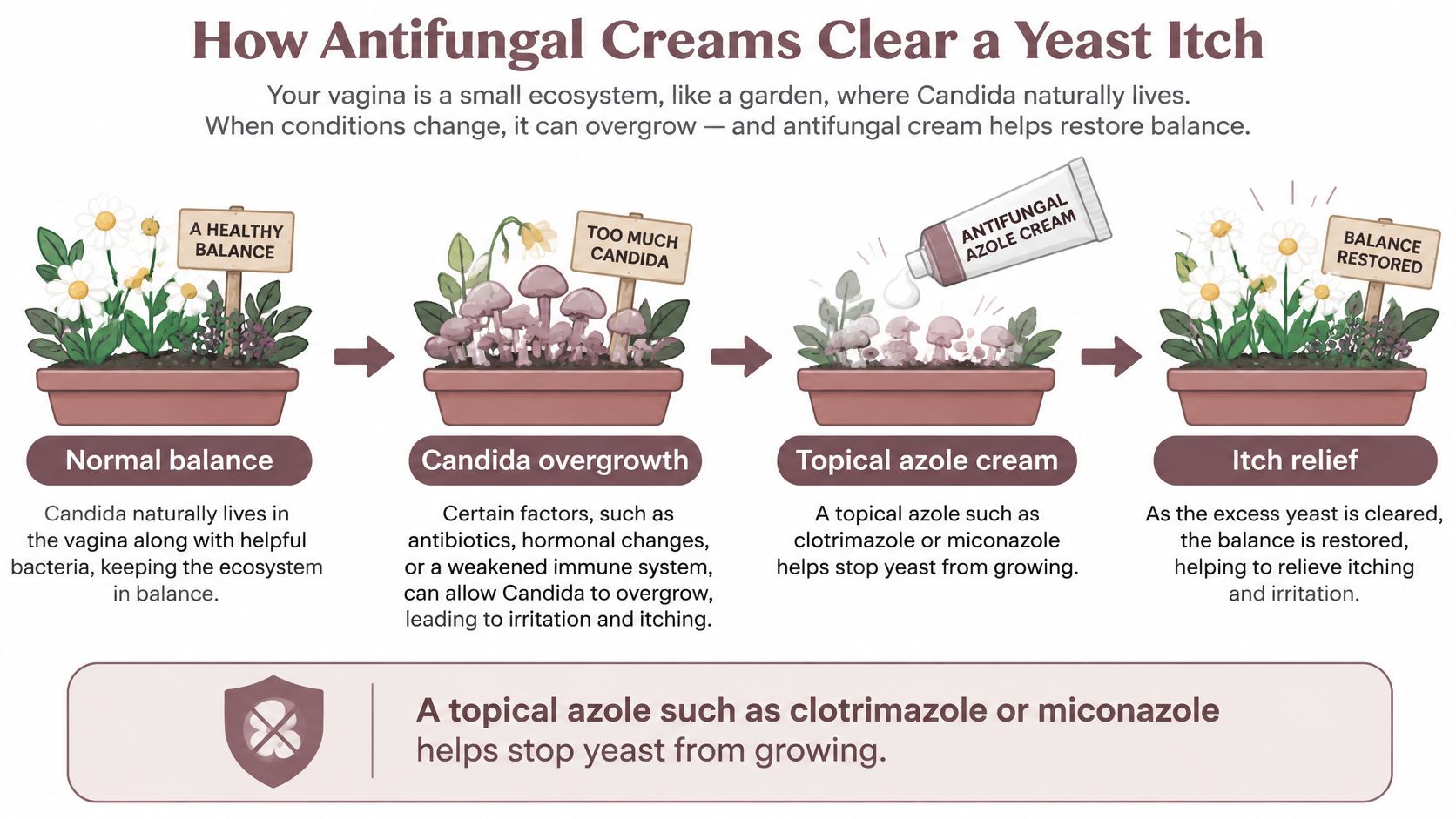
Think of the vagina as a small garden rather than a surface that needs sterilizing. Candida can live there without causing trouble. When it overgrows, the surrounding tissue may become inflamed and itchy.
A topical azole, such as clotrimazole or miconazole, interferes with the fungal cell membrane. That helps stop yeast from growing so inflammation caused by the overgrowth can settle.
The illustration shows the basic sequence from balance to overgrowth and treatment.
Match the medicine to the course
The active ingredient, concentration, and treatment duration work together. A shorter course isn't a longer course with doses removed; manufacturers formulate products for their labeled schedules.
Don't borrow the timing from another package. Read whether yours is an intravaginal treatment, an external cream, or a combination pack, then use each component for its intended purpose.
An external antifungal may help yeast-related irritation on vulvar skin, but applying it outside doesn't automatically complete treatment for an internal vaginal infection. Conversely, an insert isn't a general-purpose ointment for raw external skin.
Keep these distinctions clear:
- Treatment schedule: Complete the labeled or prescribed course rather than stopping when you feel better.
- Expected response: Less itching can mean inflammation is settling, but it doesn't prove that the original diagnosis was right.
- Worsening irritation: Significant new burning, swelling, or a rash after application deserves advice from a pharmacist or clinician rather than repeated dosing through a possible reaction.
Pregnancy changes the treatment decision
Treatment-duration evidence in pregnancy shouldn't be used to rank every over-the-counter product for everyone. It does show why choosing the shortest package without considering your circumstances can be a mistake.
A Cochrane review of topical treatment for vaginal candidiasis in pregnancy found that seven-day courses cured more than 90% of women, while four-day courses cured approximately half of cases.
If you're pregnant, contact your maternity clinician before self-treating. A symptom that feels familiar can still need confirmation, and pregnancy affects which medicines are appropriate.
Recurrent infections, severe swelling, diabetes, immune suppression, and less typical Candida species also need an individualized plan. The answer may involve testing, a longer course, or a different medicine rather than another identical tube.
Antifungal cream doesn't treat bacterial infection or replace estrogen-related tissue support. Use it for its actual target, and don't shorten a prescribed course just because comfort returns before treatment ends.
Ingredients That Calm Skin Instead of Feeding the Itch
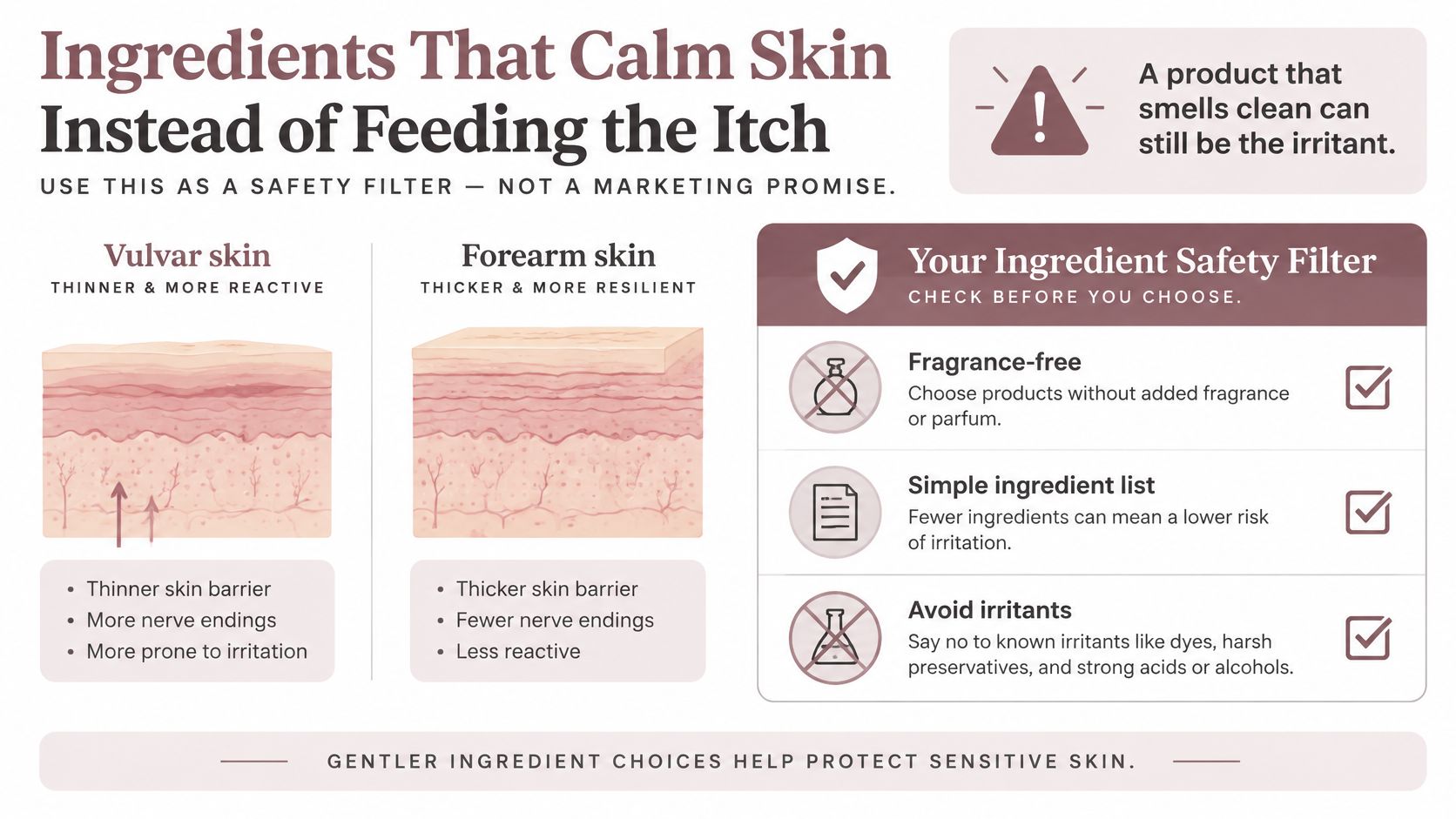
Treat the label as a safety filter, not a promise on the front of the box. A product can smell clean, look botanical, and still irritate vulvar skin.
Start with the intended site, then the active ingredient, then the base and additives. Those checks tell you more than words such as gentle or natural.
What to read on an itching cream label
| Label item | Why it matters | Prefer | Skip or question |
|---|---|---|---|
| Site of use | Vulva and vagina are different surfaces | External-only products for external skin; intravaginal products only for an appropriate internal treatment | Using a vaginal insert on broken external skin without guidance |
| Active ingredient | Azoles target Candida, not bacteria or low estrogen | Clotrimazole or miconazole when treating yeast | An antifungal when the main clue is fishy odor |
| Base | Some oil-based formulas weaken latex | Product-specific compatibility instructions and alternative contraception when indicated | Assuming a latex condom or diaphragm remains reliable |
| Fragrance and botanicals | Continued exposure can sustain dermatitis | Fragrance-free formulas without ingredients you react to | Perfume, essential oils, or unclear botanical blends |
| Preservatives and solvents | Some additives can sting or trigger sensitivity | Simple formulas; consider alcohol-free options if alcohol irritates you | Treating paraben-free, sulfate-free, or phthalate-free claims as proof of safety |
| Pregnancy callout | Pregnancy changes treatment selection | Clinician-directed topical azole treatment | Oral fluconazole or a self-selected treatment course |
For pregnancy, CDC candidiasis guidance recommends only topical azoles applied for seven days and advises against oral fluconazole. Pregnancy-specific advice belongs beside the medicine choice, not buried beneath marketing language.
For condoms and diaphragms, check the exact product's warning. Oil-based treatment can compromise latex, and the label may specify precautions that extend beyond application; ask a pharmacist if the timing is unclear.
This visual highlights the basic ingredient-screening habit.
Keep comfort care simple
For irritated external skin, removing the offending product matters more than finding an elaborate replacement. A thin layer of plain petroleum jelly can reduce contact with friction and moisture, while a cool compress can ease discomfort.
Fragrance-free doesn't mean allergy-proof, and organic certification doesn't guarantee that your skin will tolerate every ingredient. Essential oils and botanical extracts can cause reactions too; pH-conscious labeling doesn't establish that a product treats infection.
One comfort-care option is Momotaro Apotheca's Soothe & Restore Salve, an organic balm containing coconut and jojoba oils, designed for dryness, itching, and irritation. Consider it barrier-oriented comfort care, not treatment for BV, an STI, or confirmed Candida overgrowth, and assess its ingredients and latex compatibility before use.
The useful label habit is straightforward: right site, right active ingredient, tolerable base.
When an Itching Cream Is the Wrong First Step
Equating itch with yeast can send you through repeated treatments while the actual condition goes untreated. A cream that briefly reduces friction may feel helpful even when the underlying problem hasn't changed.
Relief is not a diagnosis.
A 2025 clinical report on vulvovaginal candidiasis warns that self-diagnosis and self-treatment can cause misdiagnosis, incomplete resolution, and inadequate treatment. The practical consequence is simple: don't interpret another unsuccessful tube as a reason to keep buying the same medicine.
What an examination can change
A clinician can look for skin changes, assess discharge, and select appropriate testing. Bring the packaging or photographs of products you've used, including washes and lubricants, because an ingredient exposure may matter as much as the medicine.
BV and several STIs can produce irritation but won't clear with clotrimazole. Contact dermatitis may continue if each attempted remedy adds another irritating ingredient.
Lichen sclerosus is another reason persistent external itch deserves attention. It can cause skin changes and scarring, so repeatedly covering the symptom with a balm isn't adequate management.
Lack of discharge doesn't make persistent itching harmless. The guide to an itchy vulva without discharge can help you describe an external pattern, but it shouldn't substitute for examining skin that stays irritated.
Know when to stop experimenting
Arrange clinical assessment when any of these apply:
- A first episode: You haven't previously had the cause confirmed.
- A returning pattern: Symptoms recur after treatment or keep interrupting daily life.
- Changed discharge or odor: The presentation isn't the same as a previously diagnosed infection.
- Visible changes: Sores, bleeding, white patches, cracks, or changes in vulvar shape need examination.
- Pain or urinary symptoms: Pelvic pain, painful urination, or urinary urgency may need different testing.
- Pregnancy or medical complexity: Tell the clinician about pregnancy, diabetes, immune suppression, and current medicines.
- Treatment failure: Itching remains after a full labeled course, or application makes things worse.
Fever with pelvic pain, severe pain, or feeling acutely unwell calls for prompt medical care rather than a routine appointment. Don't wait for a comfort routine to finish.
While waiting for assessment, a tolerated external barrier may be reasonable on intact irritated skin. Stop anything that stings or worsens the rash, and tell the clinician what you applied before any examination or swab.
Why Antifungal Cream Fails in Perimenopause
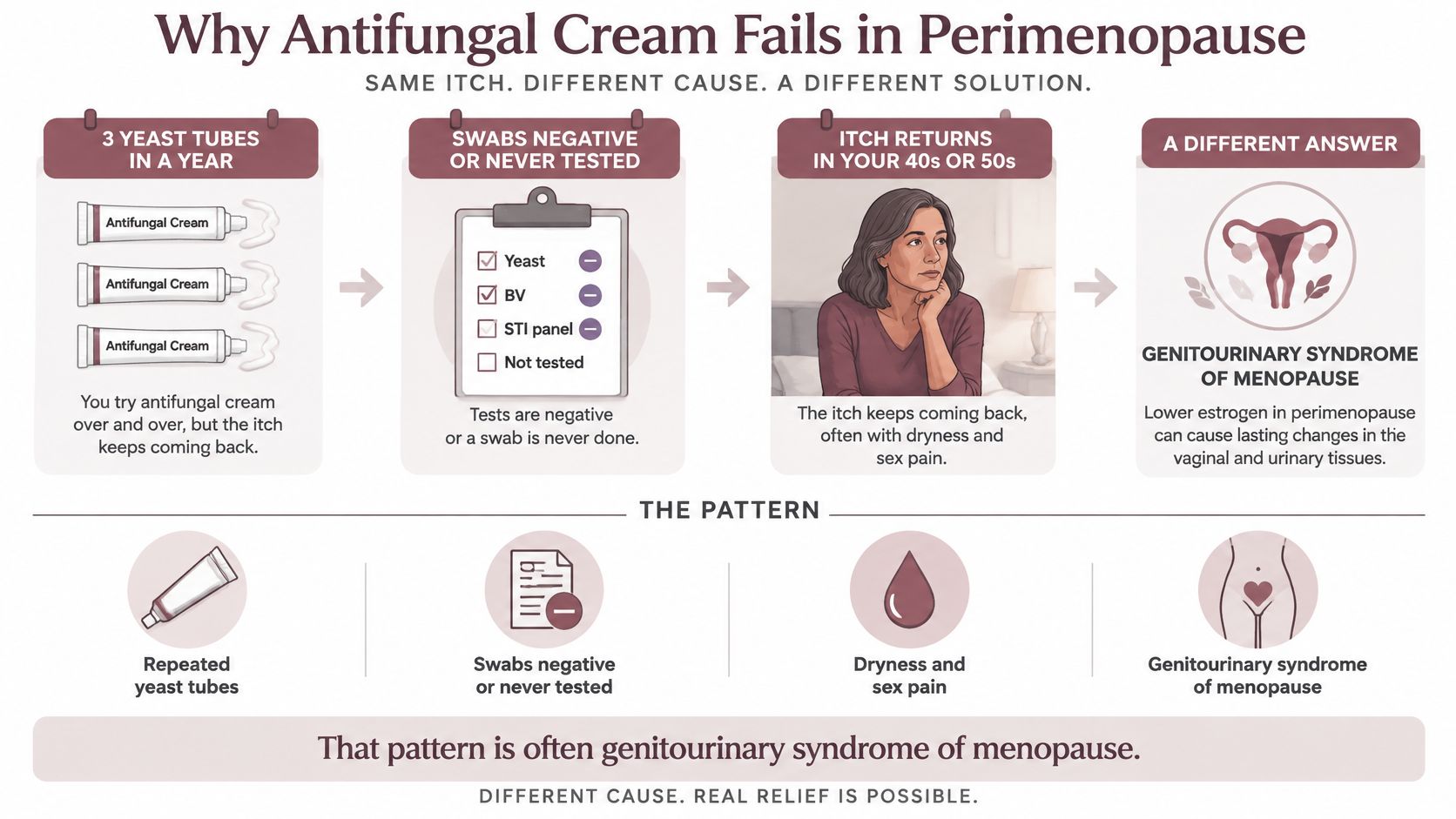
Say you've tried repeated yeast treatments during the menopause transition. Swabs were negative, or nobody tested, and the itching returns alongside dryness and painful sex.
That pattern calls for an assessment of tissue health rather than an assumption that the fungus needs a stronger cream. Lower estrogen can contribute to genitourinary syndrome of menopause, often shortened to GSM, but infection and skin disease can coexist.
The visual below illustrates this commonly confused pattern.
Different products do different jobs
The 2025 AUA/SUFU/AUGS guideline on genitourinary syndrome of menopause identifies local low-dose vaginal estrogen as having the strongest evidence base, while emphasizing assessment for other causes and coexisting disease.
That doesn't mean everyone needs estrogen. It means a balm shouldn't be presented as equivalent to treatment directed at estrogen-related tissue changes.
| Product type | Used for | Acts on | Not a substitute for |
|---|---|---|---|
| Occasional lubricant | Reducing friction during sex | Surface friction | Ongoing moisture between encounters |
| Vaginal moisturizer | Regular use to support hydration | Tissue hydration | Discussing local estrogen when appropriate for confirmed estrogen-related changes |
| Topical vulvar protectant or balm | Shielding external skin from clothing, sweat, and friction | External skin comfort, potentially on the same day | Treatment of estrogen-related tissue changes |
| Local low-dose vaginal estrogen | Treating GSM when appropriate | Estrogen-related tissue changes | Clinical assessment and individualized prescribing |
Moisturizers and local estrogen aren't necessarily competing choices. A clinician may recommend more than one approach according to your symptoms, preferences, and medical history.
Change the question you bring to care
Instead of asking which yeast cream is strongest, ask whether dryness, friction, and hormonal changes explain the pattern. An examination can also check for dermatitis, lichen sclerosus, infection, or concerning lesions.
For broader context, Pause Medical's guide to how perimenopause affects your body can help you connect genital symptoms with other changes. The more focused guide to vaginal itching during menopause can help you organize questions about local discomfort.
This video offers another format for exploring the topic.
Don't keep repeating antifungals after negative testing without discussing the results. Ask what the test ruled out, what still needs checking, and which treatment matches the tissue changes found.
A Short Care Routine That Does Not Mask the Cause
Keep comfort care boring and consistent while you arrange any needed testing. Changing several products at once makes it harder to tell what helped or triggered a reaction.
Reduce exposure and friction
- Pause scented products. Set aside fragranced washes, wipes, douches, and newly introduced lubricants. Wash the external vulva gently with lukewarm water; if you use cleanser, choose a bland unscented one that doesn't sting, and never wash inside the vagina.
- Change what rubs. Choose breathable underwear and loosen clothing that presses against sore skin. Change out of damp exercise clothes so sweat and friction don't add to the irritation.
- Cool before coating. Apply a cool compress wrapped in soft fabric, not ice directly against skin. If tolerated, follow with a thin external barrier such as plain petroleum jelly; don't pack barrier ointment into the vagina.
- Keep treatment separate from soothing. If yeast has been established and an azole is appropriate, complete its labeled or prescribed schedule. Don't add extra antifungal doses just because the skin still feels tender.
Protect the skin without delaying care
- Check barrier-method compatibility. If the medicine or ointment can damage latex, follow its instructions for alternative contraception and compatible barrier protection. Non-latex doesn't automatically mean oil-compatible, so check that product too.
- Pause activities that sting. Penetration, tampons, and toys can aggravate inflamed tissue. Resume when comfortable, and use a simple compatible lubricant if friction remains a problem; don't push through pain to test whether you're better.
- Keep a symptom note. Record where it itches, discharge changes, odor, urinary burning, product exposure, and menstrual or menopause-related changes. Include medicine names and how long you used them so the appointment starts with specifics.
Stop rule: A comfort routine is something you can use while arranging care, not a waiting period you must complete before asking for help.
Avoid scratching when possible, but don't turn that advice into another reason to blame yourself. Itching can be intense; press gently through clothing or use a cool compress rather than repeatedly rubbing already inflamed skin.
If symptoms persist, worsen, or meet any warning signs, arrange assessment. Don't spend another round of trial and error trying to make an undiagnosed problem fit a product.
Choose Comfort Care or Book the Exam
The useful decision isn't which vaginal itching cream has the most reassuring packaging. It's whether you have enough information to choose a treatment safely.
When reasonable self-care fits
A labeled topical azole may be reasonable when symptoms match a previously confirmed uncomplicated yeast infection, you're not pregnant, and no warning signs or complicating conditions apply. Even then, be prepared to seek care if the course doesn't resolve the symptoms.
For clearly external irritation after a new product, stop that exposure and use a tolerated plain barrier if needed. Improvement after removing the trigger is useful information, but ongoing or recurrent symptoms still deserve evaluation.
When to book the examination
Choose an appointment when the cause is uncertain, symptoms recur, or treatment hasn't worked. Pregnancy, skin changes, unusual discharge, and urinary symptoms also change the decision; severe pain, fever, or acute illness call for more urgent care.
Use this clinic script, filling in your details:
- Location: The itching is on my vulva, inside my vagina, or both.
- Treatment history: I've used these creams and medicines for these lengths of time, with this response.
- Pattern: Sex, soap, menstrual changes, or menopause symptoms seem to change the discomfort in these ways.
Bring your product list and use this guide to preparing for an OB-GYN appointment and questions to ask to plan the conversation.
Gentle, organic, and non-prescription never mean you can skip testing. The right outcome may be a medicine that matches the cause, an external comfort product, or no cream until someone examines the area.
Momotaro Apotheca offers non-prescription vulvovaginal comfort products and educational resources for concerns such as dryness and irritation. Visit Momotaro Apotheca to explore comfort-care options once the cause has been considered, and keep testing or prescribed treatment separate from your soothing routine.


