


What Does a Yeast Infection Smell Like? Truths 2026
A yeast infection typically has little to no smell, and about 90 to 95% of diagnosed patients have no vaginal odor. If there is a scent, it's usually mild and yeasty, like bread or beer, not fishy or foul.
That's often the moment people end up searching for answers. You notice itching, burning, or a change in discharge, then pause and wonder whether smell should help you figure out what's going on. It can help, but not in the way commonly assumed.
The most useful clue isn't usually a smell you do notice. It's the absence of a strong, fishy odor. That matters because many vaginal conditions can feel similar at first, while their odor patterns are very different. If your symptoms seem to match a yeast infection but there's a sharp or unpleasant odor, that points away from yeast and toward something else that may need different treatment.
Table of Contents
- Decoding Your Body's Signals
- The Signature Scent of a Yeast Infection
- Yeast Infection vs Other Vaginal Odors
- Understanding the Causes and Risk Factors
- When to See a Doctor for an Accurate Diagnosis
- Gentle Prevention and Supportive Self-Care
Decoding Your Body's Signals
A lot of people have had the same quiet thought in the bathroom mirror: something feels different, but I'm not sure what counts as normal. That uncertainty is common, and it doesn't mean you're overreacting. Vaginal scent, discharge, and irritation can shift for lots of reasons.
When people ask what does a yeast infection smell like, the clearest answer is simple. Usually, it doesn't have a noticeable smell at all. If you do notice one, it tends to be faint and slightly yeasty, more like bread dough than anything rotten or fishy.
Why this question gets confusing
The internet often reduces vaginal health to one-liners. Real life is messier. You can have itching without odor. You can have odor without much itching. And a normal vagina isn't scentless every hour of every day.
Practical rule: A mild natural scent can be normal. A sudden, strong, fishy, or foul odor is the kind of change that deserves closer attention.
That's why body literacy matters. The Axelrad Clinic's perspective makes a helpful point about listening to your body's patterns instead of waiting for symptoms to become extreme. Knowing your usual baseline helps you recognize when a change is worth checking.
If you want a broader look at what counts as typical, this guide to different vaginal scents and odors can help put yeast infection questions into context.
The clue most people miss
People often focus on finding the “right” smell. In practice, the more useful clue is often what's missing. A yeast infection usually brings itching, burning, redness, and thick white discharge, not a powerful odor.
That doesn't mean odor is irrelevant. It means odor works best as a sorting tool. No strong smell points one way. A fishy or foul smell points another.
The Signature Scent of a Yeast Infection
You notice itching, burning, and a change in discharge, so your brain goes straight to one question: shouldn't an infection have a strong smell?
Usually, no. With a yeast infection, the “signature scent” is often the absence of a strong odor. That detail matters because it helps separate yeast from other conditions that can look similar at first.

What the smell is usually like
If there is a scent, it is often faint and slightly yeasty, similar to bread dough or beer. The smell usually stays subtle enough that many people notice texture and irritation first.
That's why discharge and skin symptoms often give clearer clues than odor. A classic yeast pattern includes thick, white, clumpy discharge along with itching, burning, redness, or swelling. If you want a side-by-side breakdown of those patterns, this guide on comparing common vaginal health issues like BV, UTIs, and yeast infections can help.
Why the lack of odor matters
A yeast infection is usually caused by an overgrowth of Candida, which is a fungus. Bacterial vaginosis involves a different kind of imbalance. Bacteria linked with BV can produce compounds that create the classic fishy smell. Yeast usually does not.
A strong fishy odor is a clue worth taking seriously because it points away from the usual yeast pattern. That does not mean self-diagnosis becomes easy. It means smell works best as one piece of the puzzle, not the whole answer.
The mistake people often make
A lot of people assume “itching plus discharge” automatically means yeast. That shortcut can lead to the wrong treatment, especially if the odor is strong, foul, or suddenly different from your normal baseline.
Here's the simpler way to read the signal:
- Little to no odor: More consistent with yeast
- Faint bread-like or yeasty scent: Can still fit yeast
- Strong fishy or unpleasant odor: Less consistent with yeast and more suggestive of another cause
- Intense symptoms with no expected odor: Still worth checking, because several vaginal conditions can overlap
In other words, the missing smell can be as informative as a smell that is present. Your body is not being vague. It is giving a pattern, and yeast usually sounds more like irritation than odor.
Yeast Infection vs Other Vaginal Odors
The easiest way to understand odor is by comparison. Several common vaginal conditions overlap in discomfort, discharge changes, and irritation. Their smell patterns differ more clearly.
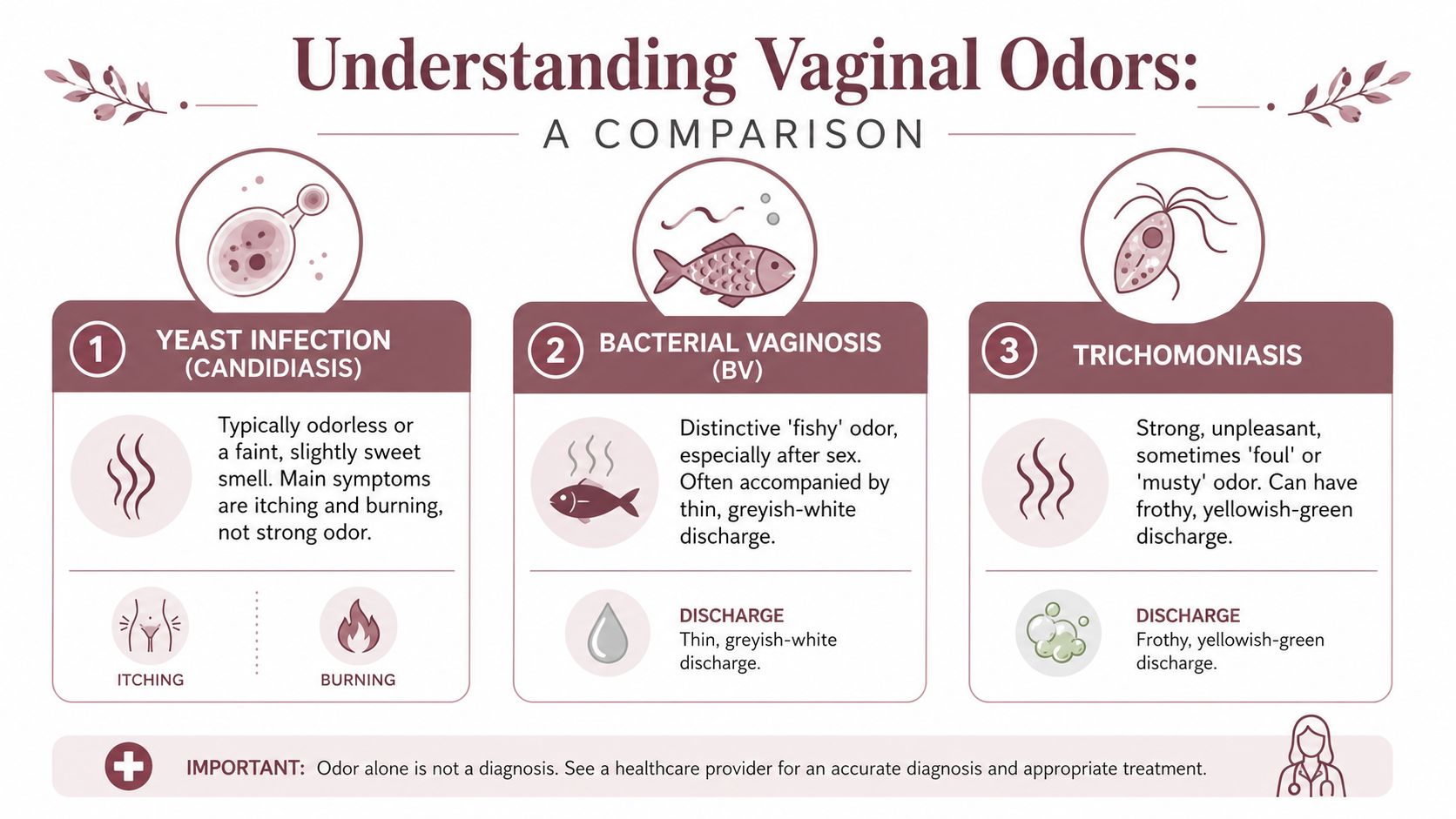
A clinical overview notes that yeast infections account for 20 to 25% of vulvovaginal complaints, while bacterial vaginosis affects up to 30% of women. That same source explains that yeast is distinguished by a lack of significant odor, BV is nearly always linked to a pronounced fishy odor, and a sweet or sickly smell may indicate trichomoniasis in this OB-GYN guide on feminine odor.
Symptom comparison
| Symptom | Yeast Infection (Candidiasis) | Bacterial Vaginosis (BV) | Trichomoniasis |
|---|---|---|---|
| Typical smell | Little to no odor, sometimes faintly yeasty | Strong fishy odor | Sweet, sickly, or otherwise unpleasant odor |
| Discharge | Thick, white, lumpy | Often thin, grayish-white | Often greenish |
| Itching or burning | Common | Can happen | Can happen |
| Best odor clue | Usually not strong | Often more noticeable after sex | Unpleasant smell with colored discharge |
A simple way to sort the clues
Think of odor as a traffic signal.
- No strong smell: Yeast becomes more likely, especially if discharge is thick and white.
- Fishy smell: BV moves to the top of the list.
- Sweet, sickly, or odd odor with greenish discharge: Trichomoniasis should be considered.
This side-by-side guide on BV, UTIs, and yeast infection differences is also useful if you're trying to separate symptoms that can blur together.
If the odor is the loudest symptom, yeast is often not the best fit.
Where self-diagnosis goes wrong
People often assume all vaginal infections smell bad. They don't. Others assume that if there's no odor, there's no infection. That's not right either.
Yeast is the classic example. It can cause significant discomfort without a strong smell. BV often does the opposite. The scent is the standout feature, even when irritation is milder.
Understanding the Causes and Risk Factors
A yeast infection usually starts with a shift in balance, not a cleanliness problem or a sign that you did something wrong.

Your vagina works like a small ecosystem. Helpful bacteria and naturally present yeast share the same space, and under normal conditions they keep each other in check. A yeast infection happens when yeast, often Candida albicans, gets the upper hand. That can happen after antibiotics, during hormonal changes, or during times when the immune system is under more strain.
That pattern also helps explain one of the easiest points to miss. Yeast overgrowth can cause a lot of itching, burning, and thick discharge without producing the strong fishy smell people often expect from “an infection.” The missing odor is not proof that nothing is wrong. It is one clue that the problem may be yeast rather than a bacterial cause.
Common triggers that can tip the balance
Some triggers are short-lived. Others show up in repeatable patterns over time.
- Antibiotics: These can lower the number of protective bacteria that usually help keep yeast under control.
- Hormonal shifts: Menstrual cycle changes, pregnancy, and other hormone changes can affect moisture, acidity, and the overall vaginal environment.
- Immune changes: Stress, illness, and other immune disruptions can make it easier for yeast to multiply.
- Heat and moisture: Tight, non-breathable clothing or staying in damp workout clothes can create conditions yeast likes better.
- Higher blood sugar: For some people, higher blood sugar can make recurrent yeast issues more likely.
Hormones deserve a closer look because they can blur the picture. Lower estrogen can contribute to dryness, irritation, and tissue sensitivity, which may feel similar to an infection at first. If that sounds familiar, this guide to Common indicators of low estrogen can help connect symptoms that seem unrelated on the surface.
Why the odor often stays mild
Bacteria linked to BV are more likely to create the compounds behind that noticeable fishy smell. Yeast usually does not. So the body can feel very irritated while the scent stays faint or unchanged.
That detail matters because it lowers the chance of mixing up yeast with BV, but it does not remove the need for caution. If symptoms do not fit the usual yeast pattern, keep an open mind. Bodies do not always read like a textbook.
For a quick visual explanation of the broader biology, this video helps:
The key takeaway is simple. Yeast infections grow out of an internal imbalance, and the lack of a strong odor is often part of that pattern.
When to See a Doctor for an Accurate Diagnosis
The “no smell means yeast” shortcut can help, but it can also mislead.
Some people have itching and thick discharge without a fishy odor and still aren't sure what they're dealing with. Others treat themselves for BV or yeast based on smell alone and end up stuck in the wrong treatment cycle. That's one reason proper testing matters.
Why absence of odor isn't a guarantee
A newer review reports that 32% of patients with odorless fungal overgrowth initially misdiagnose and treat for BV with antibiotics, which can worsen symptoms by reducing protective lactobacilli. The same source notes that yeast infections maintain a pH below 4.5, while BV causes a pH above 4.5, making pH testing a useful clue in this discussion of discharge, smell, and when to test.
No fishy odor does not rule out infection. It only tells you that BV may be less likely.
Signs it's time to get checked
See a clinician if any of these apply:
- Your symptoms keep returning: Recurrent irritation deserves confirmation, not repeat guessing.
- The discharge looks unusual for you: Thick white discharge fits yeast, but greenish or otherwise unexpected color needs evaluation.
- The odor is strong or suddenly different: Fishy, foul, or striking changes should be assessed.
- Over-the-counter treatment didn't help: If symptoms stay the same, the original diagnosis may have been wrong.
A visit is usually straightforward. A clinician may ask about symptoms, examine discharge, check vaginal pH, or take a swab. Those simple steps can separate yeast from BV, trichomoniasis, or another cause much more accurately than smell alone.
Gentle Prevention and Supportive Self-Care
Prevention usually works best when it's gentle. The goal isn't to sterilize the vulva or chase away every scent. The goal is to protect the environment that keeps irritation and overgrowth less likely.

One comparison found that a strong, foul-smelling, or fishy odor is a hallmark of BV, while yeast infections show an absence of vaginal odor in approximately 90 to 95% of diagnosed patients, according to Everlywell's review of BV versus yeast infection differences. That's one reason harsh odor-covering products often create more confusion than relief.
Everyday habits that support balance
Small routine changes often help more than aggressive cleansing.
- Choose breathable fabrics: Cotton underwear and dry clothing reduce the warm, damp conditions that can encourage imbalance.
- Skip fragranced washes and douches: These can irritate tissue and disrupt your natural chemistry.
- Change out of wet clothes promptly: Staying in sweaty underwear or swimsuits for long stretches can make irritation worse.
Supportive care during irritation
Self-care should feel calming, not harsh. Stick with products that are fragrance-free and designed for sensitive skin. If recurring yeast symptoms are part of your experience, this overview of solutions for frequent thrush offers a useful way to think about patterns and triggers over time.
Some people also explore microbiome support while working on prevention habits. If you're curious, this breakdown of vaginal probiotics for BV and yeast can help you weigh that option more realistically.
Your vagina doesn't need to smell like perfume to be healthy. It needs a stable, low-irritation environment.
The key message is simple. A mild or absent odor can be normal, and it can also fit a yeast infection. Strong, fishy, or foul odor usually points elsewhere. If your body feels off, listen to the full pattern, not just the scent.
If you want gentle, pH-conscious vulvovaginal support, Momotaro Apotheca offers certified organic care for common concerns like irritation, dryness, and recurring discomfort, including options such as the Soothe & Restore Salve and curated wellness kits.
Drafted with Outrank tool


