


Can Probiotics Help with BV? Evidence and Practical Guide
You finish a course of metronidazole, the odor fades, and you start to trust your body again. Then, weeks later, the familiar discharge or smell returns. Searching for answers often leads to probiotics, with promises about restoring “good bacteria” and preventing another episode.
So, can probiotics help with BV? The most accurate answer is yes, possibly, especially for recurrence prevention after standard treatment, but the answer depends heavily on the strain, dose, route, timing, and study design. Probiotics aren't a proven replacement for diagnosis or antibiotics, and a product labeled for vaginal health isn't automatically supported by BV research.
Table of Contents
- The Recurring BV Question
- What BV Actually Is and Why It Returns
- What the Reviews Actually Conclude
- Strain, Dose, and Route Matter More Than the Label
- Oral Versus Vaginal Probiotics
- How to Use Probiotics With Standard BV Treatment
- Safety, Limits, and When to See a Clinician
- A Honest Bottom Line on Probiotics and BV
The Recurring BV Question
A recurring episode can make you question everything. Was the antibiotic course long enough? Did sex trigger it? Did a new soap or period disrupt your pH? Or did the treatment fail?
That uncertainty is why probiotics sound appealing. They seem to offer a way to rebuild the vaginal microbiome after antibiotics have treated the immediate bacterial overgrowth. But the word “probiotic” covers many different microorganisms, formulations, and delivery methods. A capsule with unnamed Lactobacillus species isn't interchangeable with a vaginal product studied in people with recurrent BV.
The evidence is also less tidy than product marketing suggests. Some research points to lower recurrence among probiotic users, while major reviews and public health guidance remain cautious about using probiotics to treat active BV or reliably improve antibiotic treatment. Those conclusions aren't necessarily contradictory. They may reflect different strains, different treatment schedules, different outcome measures, and different standards for recommending a therapy.
The practical answer: Treat suspected active BV as a medical condition first. Consider a specific probiotic only as optional supportive care, particularly when recurrence prevention is the goal.
This guide won't promise a natural cure or tell you that every probiotic is useless. It will help you separate a plausible biological mechanism from a proven clinical outcome, read a product label with more precision, and recognize when recurring symptoms need testing rather than another supplement.
What BV Actually Is and Why It Returns
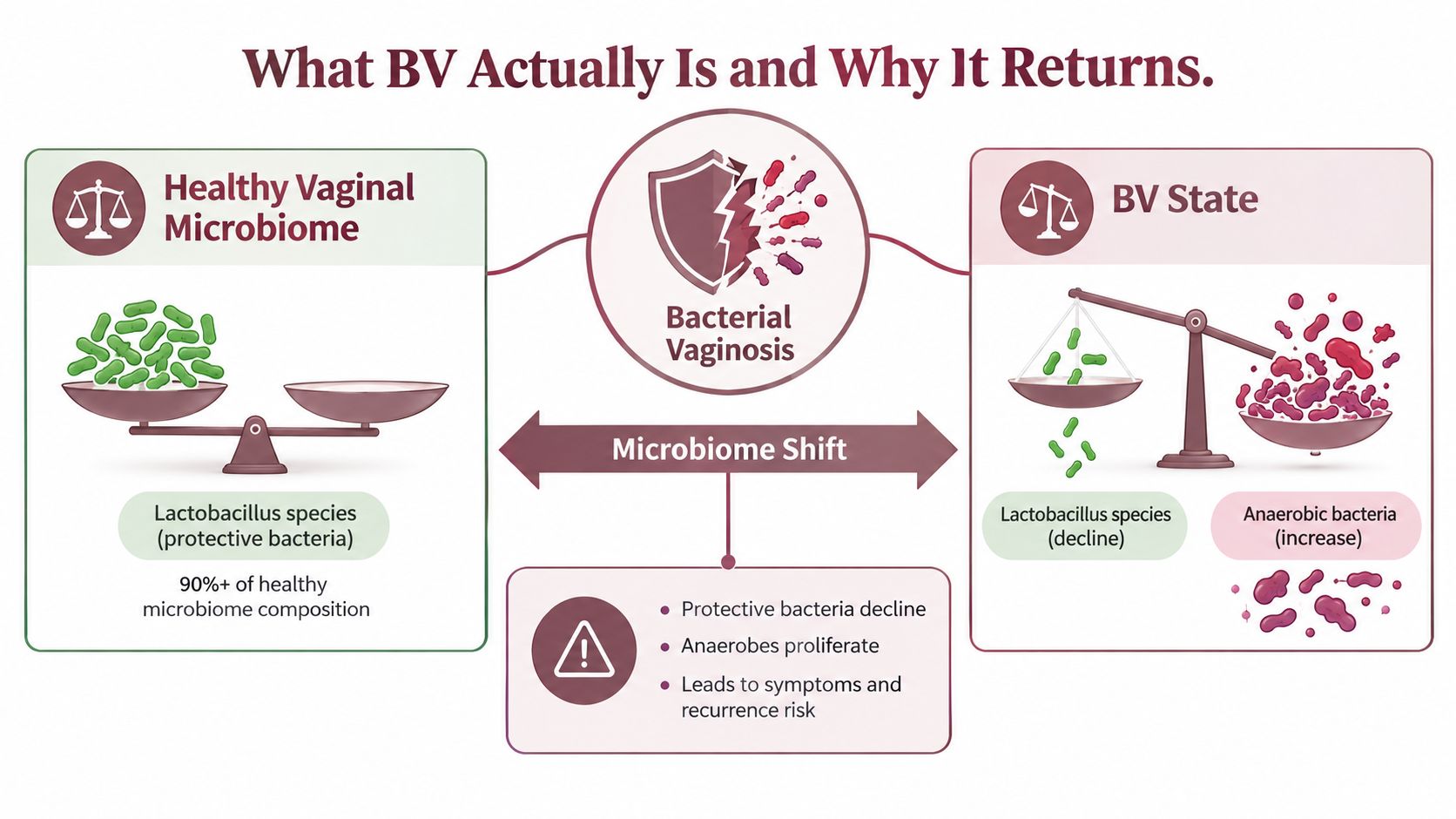
Bacterial vaginosis is a shift in the vaginal microbiome. Protective Lactobacillus species become less dominant, while a collection of anaerobic bacteria becomes more prominent. That change can raise vaginal pH and contribute to thin discharge, odor, irritation, or no noticeable symptoms at all.
A useful analogy is a garden. Lactobacillus species help occupy space and create an environment that is less favorable to some BV-associated organisms. When that protective community thins out, other organisms can expand into the available space. Antibiotics can reduce the overgrowth, but they don't guarantee that the original microbial community will rebuild in the same way afterward.
This is why symptom relief and microbiome recovery aren't identical. The odor may improve before the vaginal ecosystem has stabilized. If protective bacteria don't re-establish, the conditions that allowed BV to develop may return.
Why antibiotics and probiotics play different roles
Antibiotics target the active episode. Probiotics, when they help, are intended to support the microbial environment afterward or alongside treatment. That distinction matters because a supplement may influence the microbiome without eliminating the organisms responsible for current symptoms.
Selected Lactobacillus strains may produce lactic acid, compete with other bacteria for adhesion sites and nutrients, and support a lower-pH environment. Those mechanisms make probiotics biologically plausible, but plausibility isn't proof that a particular product prevents BV recurrence.
For readers who want a broader explanation of how vaginal ecology connects with hormones and whole-body health, Premiere Education offers a Premiere Education hormone harmony course. It shouldn't replace clinical care, but it can provide useful context for thinking about the body as an interacting ecosystem rather than a set of isolated symptoms.
Some people also consider multi-product wellness options such as the Complete Infection Defense Kit, which combines external care, a daily probiotic, urinary support, and a suppository product. Its catalog description states that it is intended to support vulvovaginal wellness, not diagnose, treat, cure, or prevent disease. A kit like this shouldn't delay testing or prescribed treatment when symptoms suggest active BV.
What the Reviews Actually Conclude
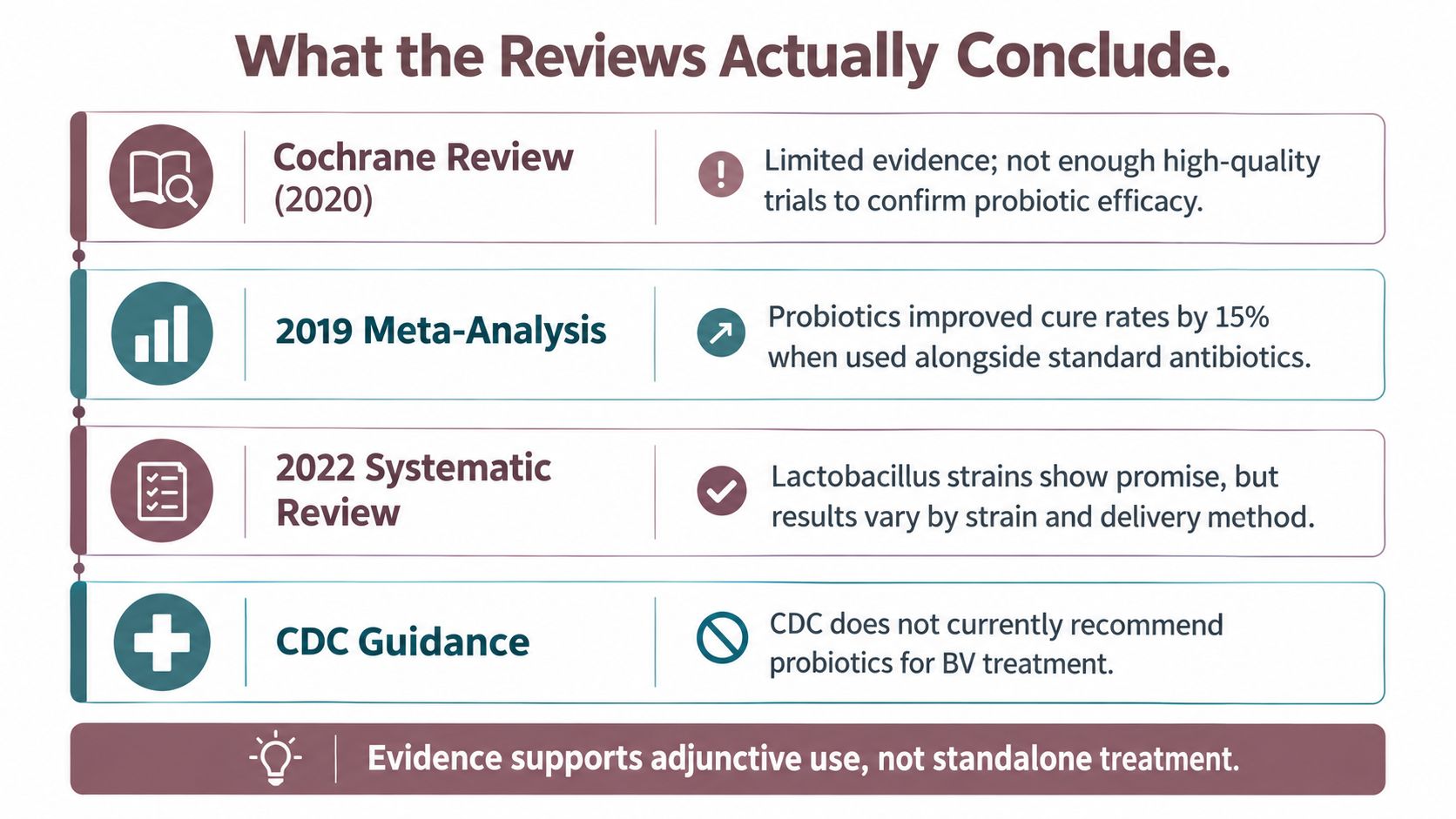
The research supports a qualified answer. Probiotics may help with recurrence prevention in some situations, but evidence does not show that every product treats active BV or can replace antibiotics.
A 2021 Cochrane review found insufficient evidence to determine whether probiotics outperform antibiotics or reliably improve antibiotic effectiveness. A 2019 meta-analysis included 13 randomized controlled trials with 1,258 participants. Its three placebo-controlled trials found a pooled cure risk ratio of 4.39, with a 95% confidence interval of 2.05 to 9.41. Differences among products and treatment protocols made that result difficult to apply to probiotics generally. The findings are summarized in the Cochrane evidence review on probiotics for bacterial vaginosis.
A later 2022 systematic review and meta-analysis examined 10 randomized controlled trials involving 1,234 participants. Probiotic users had a 45% lower relative risk of BV recurrence than control groups, with a risk ratio of 0.55, a 95% confidence interval of 0.33 to 0.91, and p=0.026. The analysis also reported an absolute risk reduction of 12.12% and an estimated number needed to treat of 8.25. These results indicate a recurrence signal, not a universal probiotic effect. The full analysis appears in this 2022 systematic review and meta-analysis.
Why the conclusions can differ
Studies may measure short-term cure, symptom relief, microbiome changes, or recurrence weeks after treatment. These outcomes are related but not interchangeable. A product that shifts bacterial composition may not deliver the same result as one tested for clinical cure.
For current symptoms, clinical assessment still matters. The bacterial vaginosis treatment guidance from the CDC states that studies of intravaginal Lactobacillus and other probiotic formulations do not support using them as a replacement for BV treatment or as a reliably established adjunct.
The practical reading is straightforward:
- Promising signal: Some products and protocols have been linked with lower recurrence or favorable microbiome outcomes.
- Unresolved treatment question: Reviews have not established probiotics as superior to antibiotics or as a dependable way to improve antibiotic effectiveness.
- Clinical standard: Suspected active or recurrent BV warrants evaluation and guideline-based care.
For an accessible discussion of strain selection and vaginal health research, GutRx research on vaginal health offers additional educational context. Product-specific evidence still matters more than the general claim that probiotics are beneficial.
Strain, Dose, and Route Matter More Than the Label
A probiotic doesn't work because the bottle says “women's health.” Its potential depends on the organism inside, the amount that remains viable, how it's delivered, and whether that exact formulation has been tested for a relevant BV outcome.
The label should identify the microorganism beyond the genus level when possible. Lactobacillus rhamnosus is not one uniform intervention, and a product containing one rhamnosus strain shouldn't inherit evidence from a different strain. The same caution applies to Lactobacillus crispatus, Lactobacillus reuteri, and multi-strain combinations.
A 2025 systematic review of 16 randomized controlled trials reported favorable findings for Lactobacillus rhamnosus TOM 22.8 at 10 billion colony-forming units per day for 10 days, including changes in Nugent score, vaginal pH, microbiota composition, and recurrence outcomes. That result supports the importance of a named strain and studied dose. It doesn't establish equivalent performance for an unrelated blend or a different dose. The review is indexed in this PubMed record on strain-specific probiotic evidence.
What to inspect on a product label
Look for these details before treating a probiotic claim as meaningful:
- Named strains: “Lactobacillus” alone provides less information than a complete strain designation.
- Viable dose through expiry: The amount listed at manufacture may not equal the amount remaining when you take the product.
- Administration route: Oral capsules and vaginal tablets have different biological pathways.
- Treatment timing: A study conducted after metronidazole doesn't automatically support use before diagnosis or instead of treatment.
- Relevant endpoint: Changes in pH or microbiota aren't identical to confirmed BV cure or recurrence prevention.
Colony-forming units matter, but the number alone isn't a quality verdict. A high count can't compensate for an unnamed strain, poor stability, an unsuitable route, or the absence of a BV-related clinical endpoint.
The product-specific evidence is why generic claims such as “supports feminine balance” deserve careful reading. For a separate consumer-oriented discussion of selection criteria, see this guide to the best probiotic for women, while keeping in mind that general vaginal wellness evidence isn't automatically evidence for treating BV.
Oral Versus Vaginal Probiotics
The route changes the biological question. A vaginal product delivers microorganisms near the tissue under study, while an oral capsule must pass through the digestive system before it could affect the vaginal environment.
The clearest recurrence example involves vaginal Lactobacillus crispatus CTV-05, known as Lactin-V. Among 228 women treated with vaginal metronidazole, recurrence at week 12 was 30% with Lactin-V compared with 45% with placebo, and successful colonization occurred in 79% of treated participants, as reported in the Lactin-V phase 2b trial (Cohen et al.). Those findings apply to that strain, dose, route, and treatment sequence. They do not show that every vaginal Lactobacillus product has the same effect.
Oral probiotics may be easier to take consistently, but they require evidence from oral, strain-specific studies. An oral product might influence the vaginal environment in some circumstances, yet oral use does not reliably establish vaginal colonization in every study. Evidence from a vaginal trial cannot be transferred to an oral supplement.
| Factor | Oral Probiotics | Vaginal Probiotics |
|---|---|---|
| Delivery | Passes through the digestive system before any possible vaginal effect | Places the product closer to vaginal tissue |
| Evidence question | Whether a named oral strain can influence vaginal outcomes | Whether a named vaginal strain can colonize and affect vaginal outcomes |
| Main limitation | Vaginal colonization is not guaranteed | Colonization, tolerability, and results vary by product |
| Practical consideration | Often easier to add to a daily routine | Requires comfort with vaginal administration and product instructions |
| What the label must show | Named strain, dose, stability, and oral BV evidence | Named strain, route, colonization data, and recurrence or microbiome outcomes |
Neither route wins automatically. A vaginal product without meaningful clinical evidence may offer less support than an oral product tested in a well-designed trial. An oral supplement also should not claim to reproduce findings from a vaginal formulation without direct evidence.
A probiotic wash is not a treatment for BV. Cleansing products may irritate sensitive tissue or alter the local environment, so review the ingredients and intended use carefully before choosing an intimate product, including this guide to probiotic feminine wash.
How to Use Probiotics With Standard BV Treatment
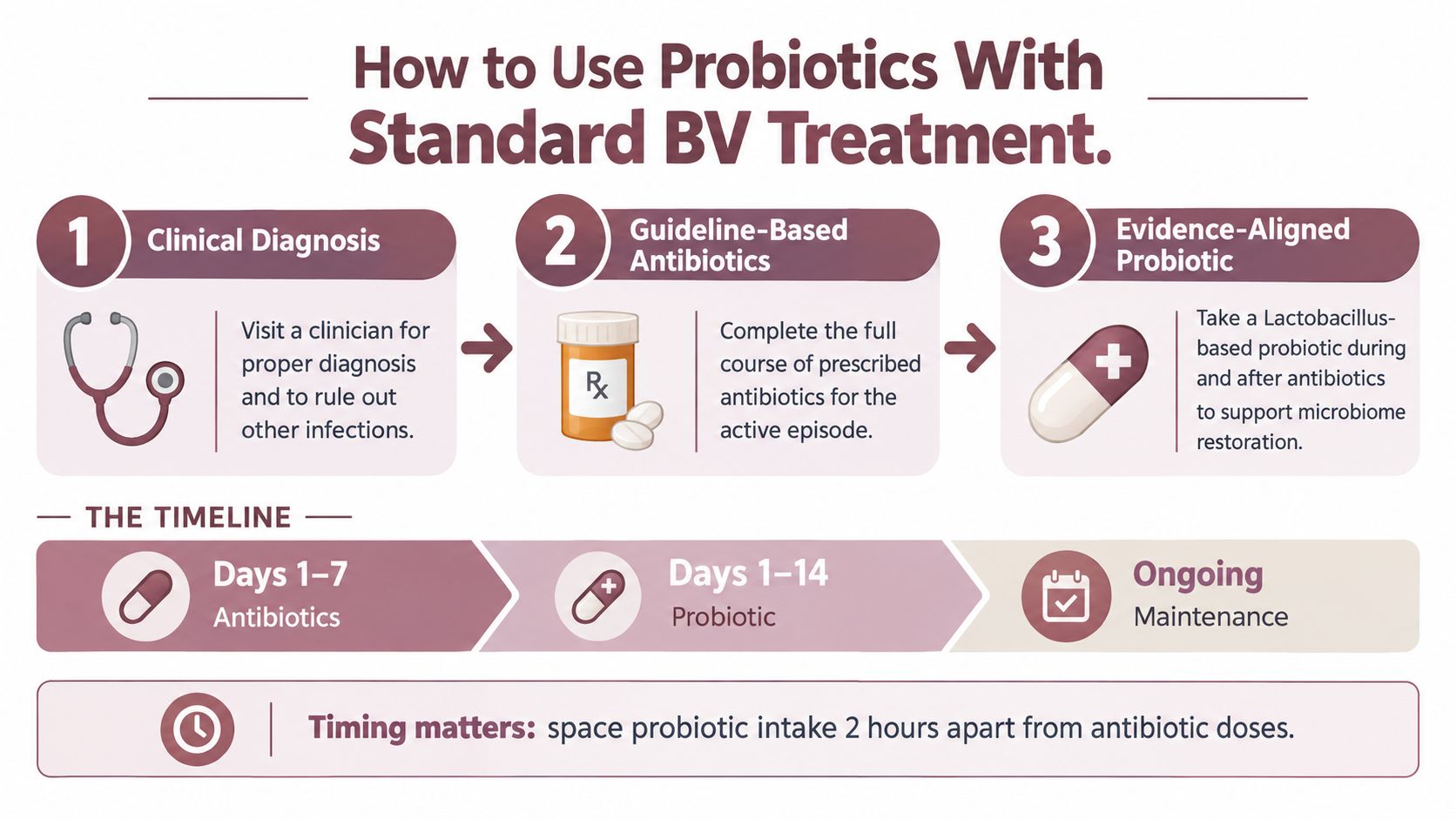
Start with the diagnosis. Odor and discharge can occur with BV, yet the same symptoms may come from yeast, trichomoniasis, aerobic vaginitis, irritation, or overlapping conditions. Treating the wrong cause with a probiotic can delay appropriate care.
Once a clinician confirms BV, follow the prescribed antimicrobial plan exactly. Complete the course even if symptoms improve, and do not substitute a probiotic for the prescription. A probiotic is optional support to discuss after the active episode has been treated, especially when recurrence is the concern.
A practical decision sequence
- Confirm the condition. Ask about testing when symptoms are new, severe, recurrent, or unlike earlier episodes. A familiar odor does not prove that the diagnosis is the same.
- Treat the active episode. Use the antibiotic prescribed for you and follow the clinician's instructions. Share the probiotic's product name, strain, route, and dose before adding it, since evidence applies to specific formulations rather than to probiotics as a category.
- Consider recurrence support. Look for a named strain and research relevant to BV, then track symptoms rather than assuming the label predicts results. Stop self-treatment if symptoms persist, worsen, or change.
Timing depends on the product and study protocol. Research has tested probiotics during antibiotic treatment, after treatment, and in sequences intended to support microbiome recovery. Many studied protocols begin after the antibiotic course ends. Ask your clinician whether to separate an oral probiotic from an antibiotic by two hours, and follow the product directions. The goal is to avoid treating every supplement as interchangeable.
The evidence remains a research signal, not a replacement for clinical treatment. As the CDC guidance discussed earlier states, probiotics are not a substitute for recommended antibiotics, and their role as routine adjunctive therapy is not firmly established. A product with a named strain, studied dose, route, and timing deserves more consideration than a generic claim that probiotics support vaginal health.
For recurrence planning, review this guide to preventing recurrent BV alongside a clinician-led plan. Avoid douching and harsh fragranced products, and use products intended for external tissue unless a healthcare professional directs otherwise.
Safety, Limits, and When to See a Clinician
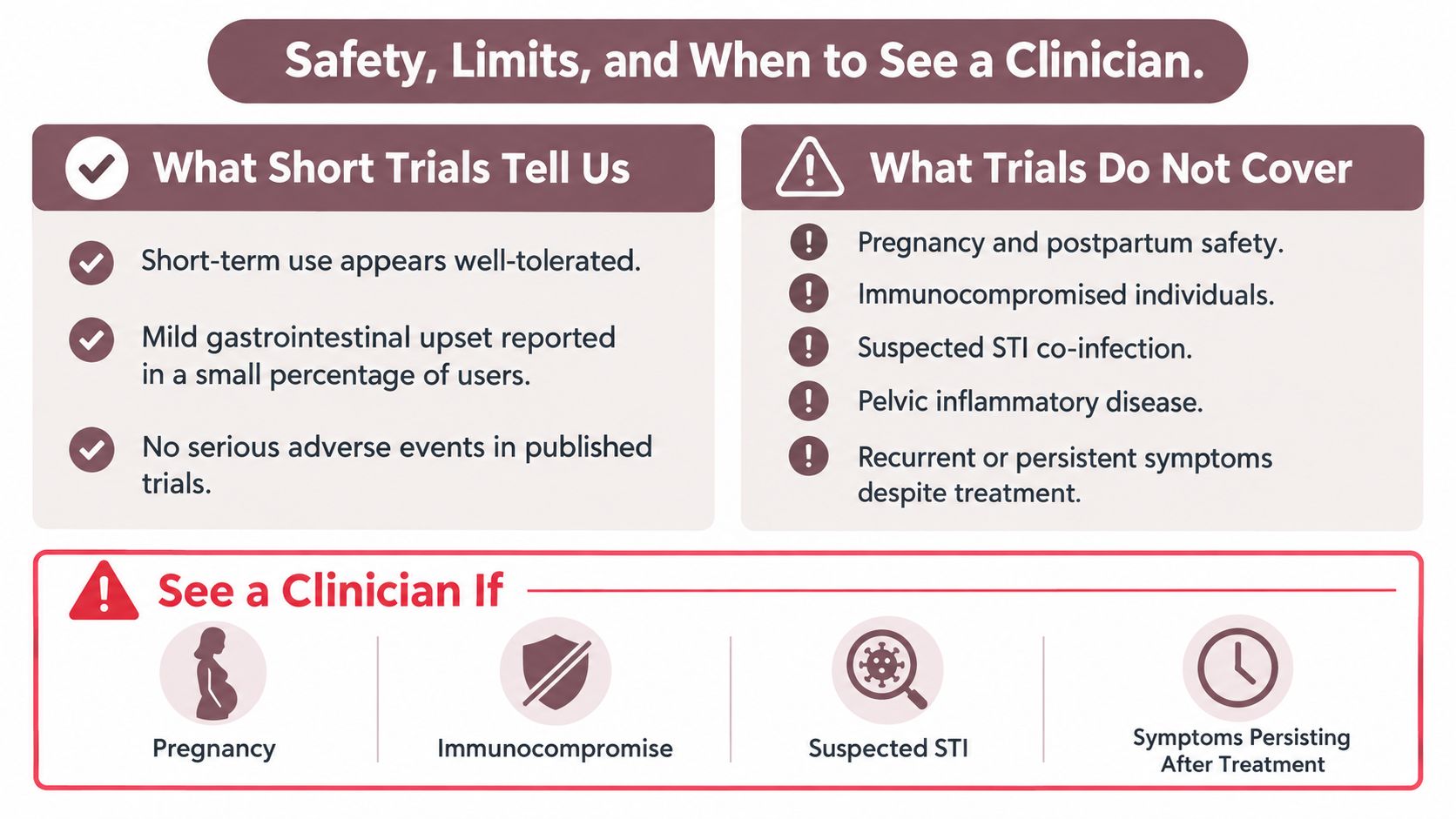
Short trials generally report few adverse effects, but that doesn't mean every person or situation has been adequately studied. Evidence is limited for pregnancy, postpartum care, immunocompromised people, and people with complex medical conditions.
Repeated self-diagnosis creates another risk. BV-like symptoms can reflect trichomoniasis, yeast, aerobic vaginitis, pelvic inflammatory disease, or an infection that needs different treatment. Taking one more probiotic while the actual condition goes untreated can delay care.
Contact a clinician promptly if you have:
- Pregnancy or postpartum concerns: Ask before using vaginal or oral products for recurrent symptoms.
- Reduced immune function: Get individualized advice instead of relying on short-trial safety assumptions.
- Pelvic pain, fever, or feeling unwell: These symptoms need evaluation rather than self-treatment.
- Possible STI exposure: Request appropriate testing, especially if symptoms are new or unusual.
- Persistent or repeated symptoms: Recurrent episodes deserve confirmation and a prevention plan.
Stop and reassess: A probiotic may be optional support, but persistent odor, discharge, pain, fever, or recurrence after treatment is a reason to seek diagnosis.
A Honest Bottom Line on Probiotics and BV
Selected probiotics show a meaningful research signal for lowering BV recurrence, especially in protocols that use a specific strain after standard treatment. That signal doesn't make all probiotics equivalent, and it doesn't turn a supplement into an antibiotic.
Use a simple decision frame. First, confirm that the symptoms are BV. Next, complete guideline-based treatment for the active episode. Then, if recurrence is the concern, discuss a strain-specific probiotic with a clinician and evaluate the product's route, dose, timing, and actual BV evidence.
The most honest answer to “can probiotics help with BV?” is sometimes, for some people, with some products. They may support microbiome recovery, but they shouldn't delay diagnosis or replace established treatment.
Momotaro Apotheca offers plant-based vulvovaginal care products, including external soothing support and a daily probiotic, for people who want optional wellness support alongside appropriate medical care. Visit Momotaro Apotheca to review the available products and choose an approach that fits your symptoms and clinician-guided plan.


