


Best Probiotic for Women: An Evidence-Based Guide
The most popular advice about the best probiotic for women is also the least useful: choose a women's formula with a very high CFU count and take it every day. That shortcut ignores the variables that decide whether a probiotic is relevant at all, including the strain, dose, delivery route, and health goal.
The clinical evidence doesn't support one universal winner. A major summary of a Cochrane review found no statistically significant benefit for probiotics versus placebo in recurrent urinary tract infection, while later reviews found that some specific products and delivery methods may perform better for particular outcomes. The practical question isn't “Which bottle is best?” It's “Which documented strain and route match the problem I'm trying to solve?”
| Goal | Evidence signal | Route to investigate | What the evidence does not establish |
|---|---|---|---|
| Recurrent UTI prevention | Mixed overall evidence, with a stronger signal for some intravaginal approaches | Strain-specific vaginal delivery may be relevant | That every oral women's probiotic prevents UTIs |
| Bacterial vaginosis | More consistent than yeast-infection evidence, but still strain- and dose-dependent | Oral or vaginal, depending on the studied formulation | That any Lactobacillus blend treats active BV |
| Yeast infection prevention | Weaker and less consistent evidence | Use only as an adjunct when clinically appropriate | That probiotics replace antifungal treatment |
| Perimenopausal genitourinary symptoms | Limited and heterogeneous evidence | Individual assessment matters | That probiotics restore vaginal comfort on their own |
| Gut support | Product and strain dependent | Oral capsules or foods | That a vaginal insert benefits digestive symptoms |
Table of Contents
- Why "Best Probiotic for Women" Is the Wrong Question
- How the Vaginal and Gut Microbiomes Actually Work
- Oral vs Vaginal Delivery Routes
- Strains With the Strongest Evidence for Urogenital Health
- Matching Probiotics to Specific Use Cases
- How to Evaluate Product Quality and Safety
- Building Your Personal Probiotic Routine
Why "Best Probiotic for Women" Is the Wrong Question
A probiotic isn't a category-level treatment. It's a living microorganism, or combination of microorganisms, with properties that can vary by genus, species, strain, dose, and route. Two products can both display “Lactobacillus” on the front label while containing organisms that haven't been studied for the same outcome.
That's why a capsule marketed for general digestive support shouldn't automatically be treated as a solution for recurrent BV. A vaginal product designed for local use also shouldn't be expected to address antibiotic-associated diarrhea. The packaging may target the same shopper, but the biological question is different.
The historical benchmark is sobering. A 2017 BMJ summary of a Cochrane review examined 9 randomized controlled trials involving 735 participants and found no statistically significant probiotic benefit over placebo for recurrent UTI in women. The pooled relative risk was 0.82 versus placebo, with a 95% confidence interval of 0.60 to 1.12, and 1.12 versus antibiotics, with a 95% confidence interval of 0.95 to 1.33. Adverse effects, including vaginal discharge, genital irritation, and diarrhea, were reported in 23 of 735 women. The BMJ summary and review details show why broad claims about “women's probiotics” need careful qualification.
A better buying question
Ask four questions before you compare brands:
- Which exact strain is included?
- What dose was used in the relevant trial?
- Was the product taken orally or used vaginally?
- Was it studied for prevention, symptom support, or treatment alongside conventional care?
A 2022 systematic review identified only 9 eligible studies involving 772 patients, with most findings inconclusive. Two studies suggested lower recurrent UTI risk, but that isn't enough to turn every probiotic into a reliable preventive treatment. The review indexed by PubMed is useful precisely because it exposes how small and uneven the evidence base remains.
Practical rule: A high CFU number can tell you how many organisms a product claims to contain. It can't tell you whether those organisms were studied for your goal.
The most defensible answer is therefore conditional. The best probiotic for women is the one whose named strain, tested dose, and delivery route align with a clearly defined use case, and even then it may be an adjunct rather than a treatment.
How the Vaginal and Gut Microbiomes Actually Work
The word “microbiome” describes a community, not a single organism. In vaginal-health discussions, Lactobacillus matters because many healthy vaginal microbial communities contain Lactobacillus species that help maintain an environment less favorable to some unwanted organisms. Their activity is associated with acids and other antimicrobial compounds, but the effect depends on the exact strain and the conditions in the host.
The gut is a much broader ecosystem. It contains many types of bacteria and other microorganisms, and oral probiotics first encounter the digestive tract before they could have any indirect relationship with the vagina. That route matters because a strain that survives in a capsule isn't automatically a strain that will establish a useful vaginal effect.
Hormonal life stages add another layer. Menstruation, pregnancy, perimenopause, and menopause can change the local environment, so the same product may not perform identically for every person. This is one reason a “women's formula” label is too imprecise to function as a clinical recommendation.

What dysbiosis means in practice
People often use “imbalance” as if it were a diagnosis. It isn't. Symptoms such as odor, unusual discharge, burning, itching, urinary discomfort, and dryness can arise from different causes, including BV, candidiasis, irritation, sexually transmitted infections, dermatological conditions, and urinary disorders.
A change in microbial composition may be clinically relevant, but symptoms alone don't identify the responsible organism. Gardnerella, Prevotella, and Candida are often mentioned in microbiome conversations, yet a supplement label cannot diagnose which, if any, is driving an individual's symptoms.
The useful vocabulary is therefore:
- Strain: The precise version of a species, which is essential when assessing trial evidence.
- Dose: The quantity studied, not just the largest number printed on a bottle.
- Route: Oral or vaginal delivery, each with different biological hurdles.
- Goal: Prevention, recovery after treatment, digestive support, or symptom relief.
- Dysbiosis: A descriptive term for an altered microbial state, not a complete diagnosis.
Readers interested in the broader relationship between oral products and microbial wellness can also review how probiotic breath mints work, which illustrates an important principle: the intended site of contact changes the product's rationale. For a more focused discussion of vaginal ecology, this guide to probiotic benefits on the vaginal microbiome provides additional context.
The conclusion is simple but easy to miss. A probiotic doesn't need to “balance everything.” It needs a plausible, tested relationship with the particular site and outcome you care about.
Oral vs Vaginal Delivery Routes
The route is not a minor packaging detail. It determines where the organisms begin, what barriers they face, and how closely the product matches the tissue involved in the complaint.
An oral probiotic must pass through the digestive system before it could influence the vaginal environment indirectly. A vaginal insert delivers its contents closer to the target tissue, which may explain why some urogenital trials report a stronger signal with intravaginal products. That does not make vaginal delivery universally superior. It makes the route more logically aligned with a localized goal.
| Factor | Oral Capsules | Vaginal Suppositories/Inserts |
|---|---|---|
| Primary starting point | Digestive tract | Vaginal tissue |
| Best fit to investigate | Gut-adjacent goals and products studied for oral use | Local vaginal or urogenital recurrence prevention |
| Main uncertainty | Whether the strain reaches or affects the vagina in a meaningful way | Whether the formulation is tolerated and appropriate for the individual |
| Convenience | Usually easier to incorporate into a daily routine | Requires comfort with local application and product instructions |
| Evidence interpretation | Must match the exact oral strain and dose | Must match the exact vaginal strain, formulation, and schedule |
| Active infection | Not a substitute for diagnosis or prescribed care | Not a substitute for diagnosis or prescribed care |
What the UTI evidence suggests
The overall recurrent UTI evidence remains mixed. The 2026 systematic review reported 4 randomized controlled trials with 616 participants. Its most precise estimate involved intravaginal Lactobacillus crispatus, with a relative risk of 0.50 and a 95% confidence interval of 0.20 to 1.20, corresponding to 15% recurrence versus 27% with placebo. The same review described stronger benefit for intravaginal delivery than for oral products, while evidence for menopausal genitourinary symptoms remained limited and heterogeneous. The review's PubMed record supports a cautious interpretation, not a blanket recommendation.
For BV, the route question is also inseparable from the strain and schedule. A product containing an unstudied oral blend shouldn't inherit the results of a vaginal trial, and a vaginal product shouldn't be judged by evidence from an unrelated digestive outcome.
Before using any local product, check its intended use and ingredients. Guidance on probiotic feminine wash and vulvovaginal care can help explain why cleansing products and live-microbe products shouldn't be treated as interchangeable.
Strains With the Strongest Evidence for Urogenital Health
The phrase “clinically studied probiotics” hides a critical distinction. A study may support one named strain, while a shopper sees a product containing a different strain from the same species. Species-level similarity is not enough to transfer the result.
Among the evidence supplied for this topic, the clearest urogenital signal is attached to intravaginal Lactobacillus crispatus in recurrent UTI prevention, and to a named Lactobacillus rhamnosus regimen in BV research. That is a narrower conclusion than the marketing language many products use, but it is more useful.
| Strain or regimen | Typical dose | Studied for | Evidence strength |
|---|---|---|---|
| Intravaginal Lactobacillus crispatus | The supplied review reports the strain and route, but not a transferable retail CFU dose | Recurrent UTI prevention | Promising but imprecise, based on a small evidence base |
| Lactobacillus rhamnosus TOM 22.8 | 10×10^9 CFU per day for 10 days | BV-related Nugent score, pH, microbiota composition, and recurrence | Stronger signal among evaluated BV regimens, but still regimen-specific |
| Unnamed Lactobacillus blend | Not assessable | General vaginal-health marketing | Cannot be graded without strain identity |
| Species-only “women's blend” | Not assessable | Mixed urinary, vaginal, and digestive claims | Evidence cannot be transferred from another strain |
The 2025 comparative review reported Lactobacillus rhamnosus TOM 22.8 at 10×10^9 CFU per day for 10 days as the most effective evaluated BV regimen, with improvements in Nugent scores, vaginal pH, microbiota composition, and BV recurrence. That result supports the regimen studied, not every product that lists L. rhamnosus. The comparative review also described much weaker evidence for vulvovaginal candidiasis.
Why familiar strain names need verification
Names such as L. acidophilus, L. plantarum, L. rhamnosus, and Bifidobacterium may appear on many labels. Without the strain code and a matching clinical study, those names tell you the taxonomic neighborhood, not the expected outcome.
The same caution applies to broad-spectrum products advertising a large total CFU count. A blend can be reasonable for a general wellness goal, but a total count doesn't reveal how much of each strain is present, whether the organisms remain viable at expiration, or whether the combination was studied together.
A recent review likewise emphasized that products use inconsistent species combinations and that current evidence is insufficient to support routine probiotic use for optimizing vaginal microbiota and inflammation. The Frontiers review is a useful reminder that more strains does not automatically mean more evidence.
For consumer-friendly background, this guide to probiotics for optimal vaginal health can help readers understand the label language. The final check should still be the published trial, not the product's category name.
Matching Probiotics to Specific Use Cases
A useful decision framework starts with the complaint, then works backward to the evidence. Don't begin with the most attractive bottle. Begin with whether you're trying to prevent recurrence, support recovery after prescribed treatment, address digestive symptoms, or manage a life-stage change.

Recurrent bacterial vaginosis
BV has a more reproducible probiotic signal than yeast infection, but the result remains strain- and regimen-specific. The evaluated L. rhamnosus TOM 22.8 regimen used 10×10^9 CFU daily for 10 days, so a product with a different strain, dose, or duration shouldn't claim the same result automatically.
Probiotics should accompany, not replace, clinician-directed treatment for active BV. Persistent odor, discharge, pelvic pain, bleeding, or repeated episodes deserve diagnosis rather than repeated self-treatment.
Yeast overgrowth after antibiotics
The evidence for vulvovaginal candidiasis is weaker than the evidence for BV. A probiotic may be considered as supportive care in an appropriate situation, but it shouldn't replace an antifungal diagnosis or treatment. Recurrent candidiasis also warrants medical evaluation, especially when symptoms continue despite treatment.
If your main goal is digestive support after antibiotics, an oral product is more logically matched to that goal than a vaginal insert. For people comparing general gut products, it may be useful to find gut support supplements, while still checking whether the label names the strains and intended outcome.
Post-coital and recurrent UTI
The evidence doesn't justify calling every women's probiotic a UTI preventive. Overall findings have been mixed, but the most encouraging supplied signal involves intravaginal L. crispatus. A clinician can also help distinguish recurrent infection from bladder pain, irritation, or another condition.
A plant-derived option described for urinary and pelvic-health support is the Urinary Tract & Pelvic Health Super Supplement. Its catalog description says it is intended to support UTIs, interstitial cystitis, bladder discomfort, yeast infections, and BV. Those product claims aren't the same as strain-specific clinical evidence.
Perimenopause and postpartum recovery
Evidence for menopausal genitourinary symptoms remains limited and heterogeneous, so probiotics shouldn't be treated as a substitute for evaluation of dryness, pain, recurrent infections, or tissue changes. Postpartum users should also ask a clinician before introducing oral or vaginal products, particularly when breastfeeding, healing, or taking medication.
The safest matching principle is modest: use the route and strain supported for the stated goal, and treat a probiotic as an adjunct unless a qualified clinician tells you otherwise.
How to Evaluate Product Quality and Safety
A clinical label review starts with identity, not the front-of-pack promise. Look for the full genus, species, and strain, such as Lactobacillus rhamnosus followed by a specific strain designation. If the label says only “proprietary Lactobacillus blend,” you can't reliably compare it with a published study.
CFU labeling also requires careful reading. A product may state a count at manufacture, while another guarantees potency through expiration. Those statements aren't equivalent. The label should make clear whether the listed CFU applies at the time of manufacture or at the end of shelf life.

What deserves a closer look
- Strain identity: Match the complete strain name to the study, not just the species.
- Potency language: Check whether the CFU guarantee applies at expiration.
- Storage instructions: Follow refrigeration, heat, moisture, and light guidance exactly.
- Route suitability: Use an oral product orally and a vaginal product only as directed.
- Ingredient disclosure: Review allergens, dairy, excipients, and other ingredients that may affect tolerance.
- Quality controls: Look for transparent manufacturing and testing information, including relevant third-party certification where available.
- Claim boundaries: Be wary of language promising to cure BV, yeast infection, or UTI.
A certification mark can indicate that a product was assessed against a particular testing standard, but it doesn't prove that the probiotic treats your condition. Testing may address identity, purity, contaminants, manufacturing controls, or label accuracy. Those are valuable quality questions, but they're separate from clinical efficacy.
People who are immunocompromised or seriously ill should consult a clinician before using live-microbe products. Anyone taking antibiotics, antifungals, or other medication should ask about timing and compatibility rather than assuming a supplement is risk-free. Stop if symptoms worsen or a new reaction develops.
The embedded video below offers another way to think about routine selection and label scrutiny:
The biggest red flag is not always a low CFU count. It's a label that makes a disease-level promise while hiding the strain, dose, or evidence behind a proprietary blend.
Building Your Personal Probiotic Routine
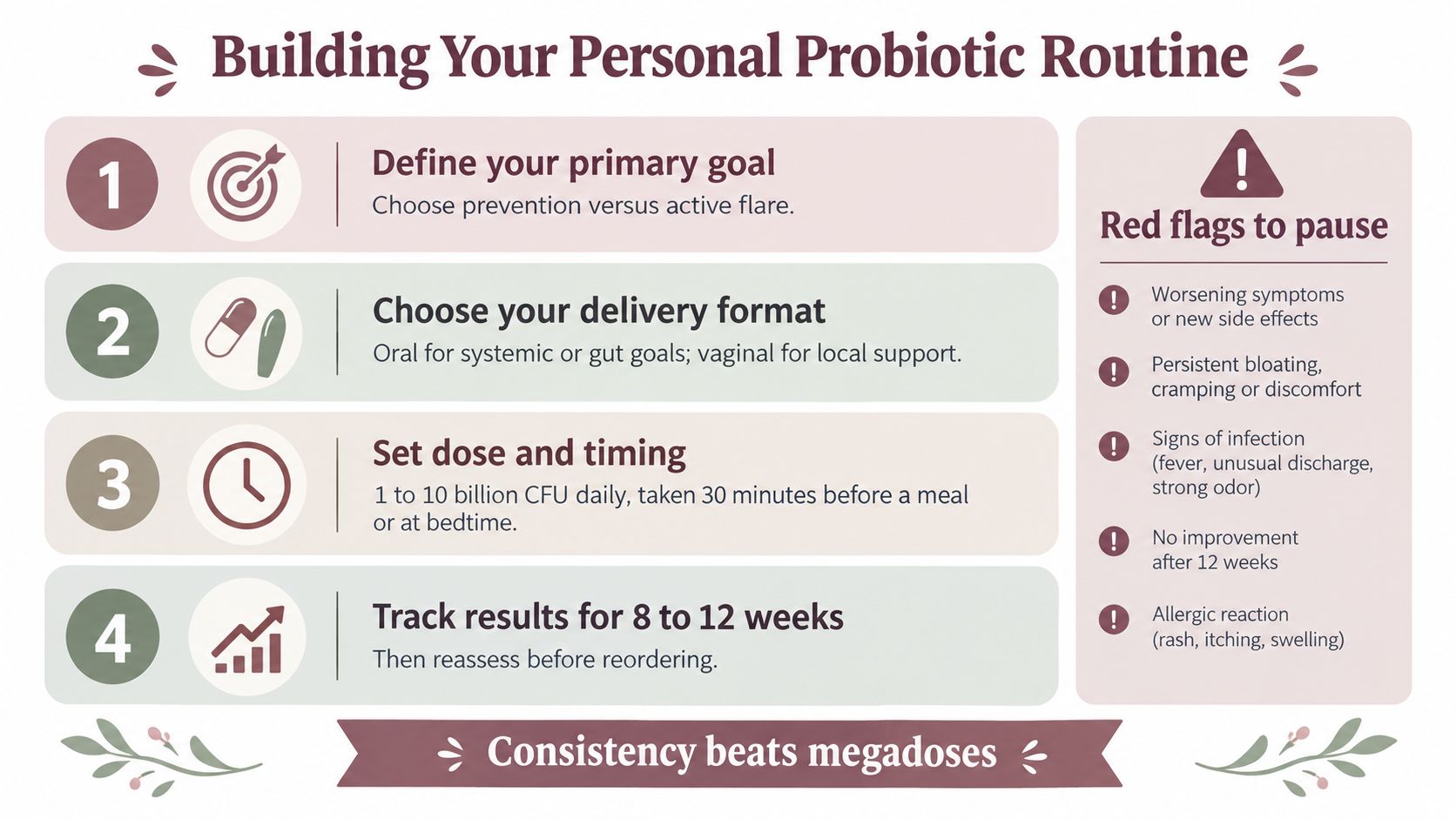
A sensible routine is smaller than most marketing funnels suggest. Pick one primary goal, select the closest evidence-supported route, verify the strain, and give the plan enough time to judge without changing several products at once.
Start with the problem you can define
“Vaginal health” is too broad for a useful selection. Write down whether you're trying to prevent recurrent BV, support recovery after treatment, reduce digestive discomfort, investigate recurrent UTI symptoms, or manage dryness associated with a life stage.
Then separate active symptoms from prevention. A probiotic is not a diagnostic test, and it shouldn't delay care for pain, fever, blood in the urine, pelvic pain, pregnancy-related concerns, unusual discharge, or symptoms that keep returning.
Match the route and label
For a localized vaginal goal, investigate vaginal products only when the exact formulation and strain have relevant evidence. For digestive or gut-adjacent support, an oral product is the more logical format. In either case, look for the complete strain name and the potency guarantee.
Choose one intervention you can follow consistently. A complicated routine creates a practical problem: if symptoms change, you won't know which product, medication, or behavior contributed.
Track tolerance and outcome
Temporary bloating or a change in discharge can occur, but don't assume every new symptom is a normal adjustment. Stop and seek medical advice if you develop significant irritation, an allergic reaction, worsening pain, fever, or persistent symptoms.
For recurrent problems, keep a simple record of dates, symptoms, treatment, sexual activity, menstrual or hormonal changes, and the product used. That record gives a clinician more useful information than a vague impression that a supplement “didn't work.”
The useful endpoint isn't a bigger supplement cabinet. It's a clear answer about whether a named strain and route helped the goal you chose.
Momotaro Apotheca offers plant-based vulvovaginal care products and condition-focused routines for concerns including BV, yeast-related discomfort, urinary tract discomfort, dryness, and irritation. Visit Momotaro Apotheca to review the available products and educational guidance, then discuss any persistent or recurrent symptoms with a qualified clinician.


