


How to Prevent Recurrent BV: An Actionable Guide
You clear BV, the odor fades, the discharge settles, and then a few weeks later it's back again. That loop is exhausting, and it's why how to prevent recurrent BV has to be treated like a long-term plan, not a one-time cleanup.
BV is not a moral failure or a hygiene scorecard. It's a vaginal microbiome disruption problem, and the evidence keeps pointing to the same reality, antibiotics can clear the episode, but they don't reliably stop the next one. The practical fix is to reduce the triggers that destabilize the microbiome, manage sexual re-exposure, and use suppressive treatment when recurrence is established.
Table of Contents
- Why BV Keeps Coming Back
- Everyday Triggers That Disrupt Vaginal Balance
- Sexual Health and Partner Considerations
- A Clinician-Supported Suppression Plan
- What the Evidence Actually Says About Probiotics and Boric Acid
- Real-World Scenarios and Troubleshooting
- Your Prevention Checklist and When to See a Clinician
Why BV Keeps Coming Back
If you have treated BV and then watched it return, you already know the problem is bigger than symptom relief. The World Health Organization describes bacterial vaginosis as a common condition in reproductive-age women, and recurrence after antibiotics is frequent enough that prevention has to be part of the plan, not an afterthought (WHO). The point is simple. Clearing symptoms does not mean the vaginal microbiome has settled.
Short-term cure and long-term control are different problems. One clinical review found that oral metronidazole can clear symptoms in the short term, yet recurrence within a year still remains common, which tells you the same thing patients learn the hard way, symptom relief does not equal stability (WHO). Stop chasing the idea of getting rid of BV forever. Start treating it as relapse prevention.
What recurrent BV actually means
Recurrent BV is commonly defined as 3 or more symptomatic infections in 1 year (Oxford Clinical Infectious Diseases). People who keep having BV episodes may be offered suppressive antibiotic gel for several months to reduce recurrence, because repeated flares usually need a maintenance plan instead of another one-off course of treatment.

Practical rule: if it keeps happening after a standard course of treatment, stop blaming yourself and start treating it like a recurrence pattern that needs a prevention plan.
The core problem is usually a mix of re-exposure and microbiome instability. That means there is rarely one fix that holds on its own. You need to remove the things that keep knocking the vaginal environment off balance, then decide whether you need maintenance therapy to hold the gains.
Understanding vaginal pH and balance helps explain why the same pattern can keep repeating even after treatment.
Everyday Triggers That Disrupt Vaginal Balance
The fastest way to keep BV in the loop is to keep irritating the vagina and vulva with products or habits that don't belong there. Douching is the clearest offender, because it disrupts the normal flora and pH instead of “cleaning” anything. The same logic applies to scented washes, deodorized sprays, and harsh internal products, they can strip away protective bacteria and make it easier for BV-associated organisms to rebound.
Clean externally, leave the inside alone
Use plain water or a mild unscented external soap only on the vulva, not inside the vagina. If you're using perfumed detergents or fabric softeners on underwear, switch to fragrance-free options and see whether irritation settles. The vagina is self-cleaning, and internal cleansing usually makes the problem worse, not better.
Douching is not a reset. It's a disruption.
Moisture matters too. Long periods in sweaty workout clothes, tight leggings, wet swimsuits, or damp underwear keep the area warm and irritated, which is the kind of environment many patients recognize right before a flare. Breathable cotton underwear and prompt clothing changes are boring advice, but boring advice is often the advice that works.
A routine audit that actually helps
Run your habits against this quick check:
- Internal products: no douches, no vaginal deodorants, no “feminine wash” inside the vagina.
- External cleansing: water first, mild unscented soap only on the outside.
- Laundry: fragrance-free detergent if you're sensitive.
- Clothing: change out of wet or sweaty clothes quickly, especially after workouts or swimming.
- Comfort care: if friction, dryness, or irritation is making you miserable, a barrier-supportive product like Soothe & Restore Salve is designed for external vulvovaginal comfort, not for internal treatment.
If you want a deeper breakdown of pH and why these choices matter, this guide on demystifying vaginal pH is worth reading. The point is simple, reduce unnecessary disruption and give the microbiome a chance to settle.
Sexual Health and Partner Considerations
Sex is one of the most under-discussed BV triggers, and the data here are blunt. In a longitudinal study, BV recurrence within 6 months was 28%, and risk was significantly higher with the same pre- and post-treatment sexual partner, with an adjusted hazard ratio of 1.9, and with inconsistent condom use, also 1.9 (Oxford Clinical Infectious Diseases). A separate review reports that recurrence risk increases 3-fold after re-exposure to the same sexual partner following treatment (PMCID review).
What consistent condom use really means
I'm direct about this with patients. If BV keeps coming back after sex, use condoms consistently for at least 3 to 4 months after treatment, especially with a partner you're already sexually active with (PMCID review). That means every act, not “most of the time,” and it means not making exceptions because the night feels low-risk.
Use a water-based, fragrance-free, pH-conscious lubricant if friction is an issue. Friction and mucosal disruption are part of the relapse story, and post-sex irritation can make the vaginal environment less stable. Keep post-sex hygiene simple, urinate if that helps your routine, rinse externally with water if needed, and don't go straight to douching or scented wipes.
Partner treatment, contraception, and the awkward conversation
Partner treatment is not routine BV care right now, even though colonization and re-exposure clearly matter. That's the frustrating part, and it's why many patients feel like they're doing everything right while still getting burned by the same cycle.
There's also a signal that estrogen-containing contraception is protective, with an adjusted hazard ratio of 0.5 in the longitudinal study above (Oxford Clinical Infectious Diseases). That doesn't mean everyone should switch contraception on the basis of BV alone, but it absolutely means BV belongs in the conversation at your next visit.
If you need a practical after-sex checklist, this resource on how to prevent BV after sex gives a good framework. Say it plainly to your partner, “I'm trying to stop the BV cycle, so I need condoms consistently for a while,” and don't apologize for protecting your health.
A Clinician-Supported Suppression Plan
A single antibiotic course usually does not break the recurrent BV cycle. The clearest clinician-backed suppressive approach uses staged treatment, oral nitroimidazole first, then boric acid, then maintenance metronidazole gel, because each phase is doing a different job (CDC). The point is to clear active BV, disrupt the conditions that let it persist, then hold the vaginal environment steady while it recovers.
The three phases and why they exist
Start with oral nitroimidazole, usually metronidazole or tinidazole, 500 mg twice daily for 7 days. That is the active treatment phase, aimed at the overgrowth that is already there. Then use intravaginal boric acid 600 mg daily for 21 days, which is used as a clinician-supervised adjunct to help with biofilm disruption. After that, use suppressive 0.75% metronidazole gel twice weekly for 4 to 6 months, which is meant to keep relapse from taking over while the vaginal ecosystem settles down (CDC).
A similar cohort protocol in 105 women with refractory recurrent BV used oral nitroimidazole plus boric acid 600 mg daily for 30 days, then twice-weekly metronidazole gel for 5 months, with follow-up after 30 to 35 days before maintenance began (CDC). The practical lesson is simple, you do not stop the plan the minute symptoms quiet down.
Don't quit early just because you feel better. The maintenance phase is there for the high-risk window after treatment.
Suppression has trade-offs. It can hold BV down, but it also asks for discipline, repeat visits, and tolerance for a treatment plan that feels longer than people want. That is the price of trying to interrupt a cycle that keeps re-establishing itself.
What to ask before you start suppression
Bring a clean timeline to your clinician. If you use managing medical records online, keep prior BV episodes, test results, and medication dates in one place so you are not trying to reconstruct the whole history from memory during a rushed appointment.
Ask whether your pattern meets recurrent criteria, whether you should be screened for other infections, and what to do if symptoms flare during suppression. If symptoms never fully clear, that is a diagnosis problem, not just a maintenance problem, and the diagnosis should be revisited before you keep pushing the same plan.
For people trying to sort through online advice, a practical review of vaginal probiotics for BV and yeast can help separate marketing from what is supported.
What the Evidence Actually Says About Probiotics and Boric Acid
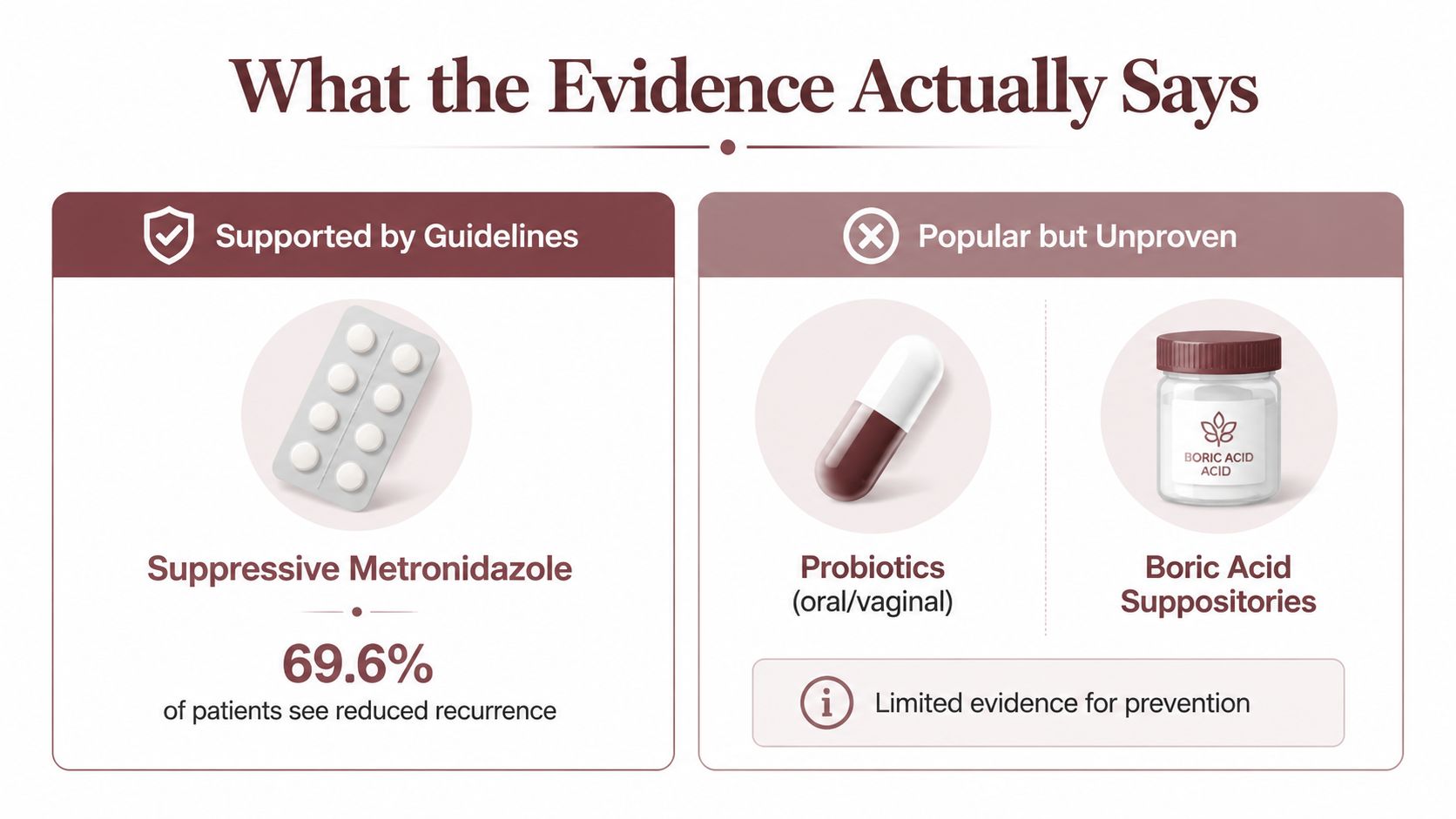
People online like to promise a permanent fix. The evidence does not back that confidence. For recurrent BV, suppressive metronidazole is still the clearest guideline-supported strategy, and one compliant maintenance gel regimen prevented symptomatic recurrence in 69.6% of patients at 6 months in one study (Recurrent bacterial vaginosis review).
Supported versus popular
The split matters. A systematic review found mixed results for oral and vaginal probiotics, and current guidance does not recommend probiotics for recurrence prevention. People reach for them because they sound gentle and microbiome-friendly, but that is not the same thing as proven protection. If you are comparing marketing claims with what the evidence supports, a look at a daily probiotic for vaginal health makes the gap obvious.
Boric acid sits in a different category. In the staged regimen above, it is used as a clinician-supervised adjunct, not as a casual DIY product. That distinction matters because boric acid belongs inside a suppression plan, not as a stand-alone cure. For a practical review of the probiotic claims people keep seeing online, vaginal probiotics and BV is a useful place to separate branding from evidence.
A quick evidence filter you can use
- Guideline-backed: suppressive metronidazole regimens for recurrent BV.
- Sometimes used with supervision: boric acid inside a structured plan.
- Popular but not proven for prevention: probiotics, pH-balancing products, and most home remedies.
Use one question first. Is this product helping relieve symptoms, or is it shown to prevent recurrence? That filter cuts through a lot of noise.
Many people do not need more hype. They need a plan they can follow.
Real-World Scenarios and Troubleshooting
A patient wakes up the morning after unprotected sex and already feels the familiar odor starting. That isn't random bad luck, it's often a re-exposure problem. The right move is to stop the trigger, use condoms consistently going forward, and if this is part of a repeating pattern, talk to a clinician about a recurrence plan instead of waiting for the flare to fully declare itself.
Another patient comes back from a beach weekend with wet swimwear, hot tubs, and tight shorts. The flare isn't mysterious, she's been sitting in moisture, heat, and friction for hours. Dry clothing, a simple external rinse, and cutting out the irritants may settle a minor blip, but if the discharge and odor persist, that's no longer a clothing problem, it's a recurrence that needs treatment.
Stressful month, disrupted sleep, and the “it's probably BV again” feeling
Stress doesn't act alone, but it often sits next to missed routines, less sleep, and more irritation. If symptoms show up during a chaotic month, don't jump straight to self-treatment with random products. Check whether the episode fits your established BV pattern, then decide whether you're dealing with a short-lived disruption or a genuine return that needs clinician input.
Escalate when symptoms don't behave like your usual pattern. Severe pain, unusual discharge that doesn't match prior episodes, or recurrence that keeps arriving soon after treatment deserves a visit.
The key distinction is this, a small flare that responds to trigger avoidance is one thing, but repeated episodes despite consistent prevention are another. At that point, you need the full cycle of diagnosis, treatment, and suppression, not another round of guessing.
Your Prevention Checklist and When to See a Clinician
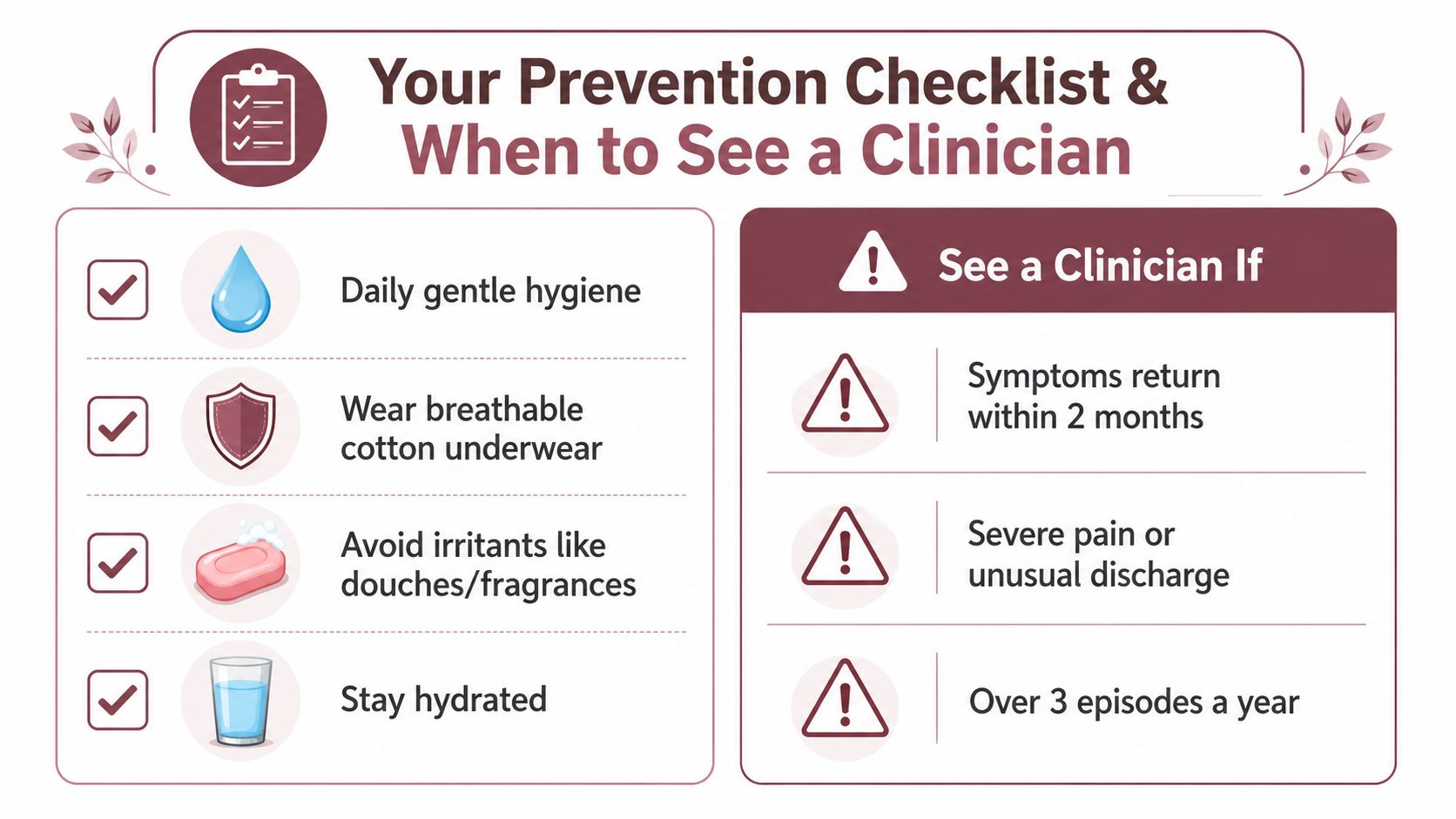
Keep the routine boring and consistent. Use gentle external hygiene, avoid douches and fragrances, change out of wet clothing quickly, and wear breathable cotton underwear. After sex, use barrier protection consistently if BV tends to return, and don't let irritation linger unanswered.
See a clinician if
- Symptoms return within 2 months
- You've had more than 3 episodes in a year
- You have severe pain or unusual discharge
- Symptoms keep recurring despite careful trigger avoidance
- You're not sure it's BV and not another infection
If you keep cycling through symptoms, don't keep guessing at home. Recurrent BV can overlap with other conditions, and persistent symptoms deserve a proper workup, not more product experimentation. The point of prevention is to reduce recurrence, and when that fails, the next step is a clinician-guided plan, not more self-blame.
Momotaro Apotheca makes vulvovaginal care products for people who want gentle, pH-conscious support without adding more irritants to the mix. If you're trying to break the BV cycle, visit Momotaro Apotheca to look at simple external-care options and educational resources that fit into a real prevention routine.


