


Why Do I Keep Getting Yeast Infections
You've probably had the same frustrating loop: the itching settles, the burning calms down, you finish the cream or pill, and then a few weeks later the symptoms creep back in. That pattern can make anyone start scanning their habits for a mistake, but the more useful question is simpler and kinder, is this yeast again, or is something else driving the cycle?
Recurring vulvovaginal candidiasis is common enough that clinicians treat it as a real pattern, not a personal failure. The CDC estimates that about 75% of women will have at least one vulvovaginal candidiasis episode, 40% to 45% will have two or more episodes, and recurrent VVC, usually defined as three or more symptomatic episodes in under one year, affects fewer than 5% of women (IJOGR review). That means the experience is common, but the cause of repeated flares still needs to be understood rather than guessed.
Table of Contents
- The Recurring Yeast Infection Cycle
- How Candida and Vaginal Balance Actually Work
- It Might Not Be Yeast Again
- The Triggers Behind Repeated Yeast Flares
- Why Yeast Keeps Coming Back Despite Good Habits
- How Clinicians Diagnose Recurrent Yeast Infections
- Breaking the Cycle With Prevention and Supportive Care
- When It's Time to See a Clinician and What Comes Next
The Recurring Yeast Infection Cycle
The cycle usually starts with a very ordinary-looking flare. Someone treats the itching, burning, swelling, or discharge, gets relief, and assumes the problem is solved. Then the symptoms return, sometimes after sex, sometimes after a period, sometimes after antibiotics, and sometimes with no obvious trigger at all.
That back-and-forth can feel like your body is betraying you, but it often means the underlying driver never got identified. Recurrent VVC is commonly defined as 4 or more culture-proven episodes, and expert reviews note that many recurrent cases come from a persistent host predisposition rather than a single one-time trigger (NCBI Bookshelf). In other words, the flare is often a symptom of a setup that stays in place after the first treatment ends.
Why the loop keeps repeating
If the organism wasn't confirmed, the treatment may have been aimed at the wrong cause. If the organism was confirmed but the species wasn't identified, the treatment may have worked only partially. If an upstream driver like glucose imbalance, hormone shifts, antibiotics, or immune suppression is still active, the vaginal environment can stay easy for Candida to re-expand in (IJOGR review, PMC review).
Practical rule: a flare that improves and returns is a clue, not proof. Treating symptoms alone can make the pattern feel mysterious when the real issue is still sitting upstream.
For a symptom-by-symptom overview, the recurring pattern described in these recurring yeast infection symptoms often matches what people are living through before they ever get a firm diagnosis.
How Candida and Vaginal Balance Actually Work
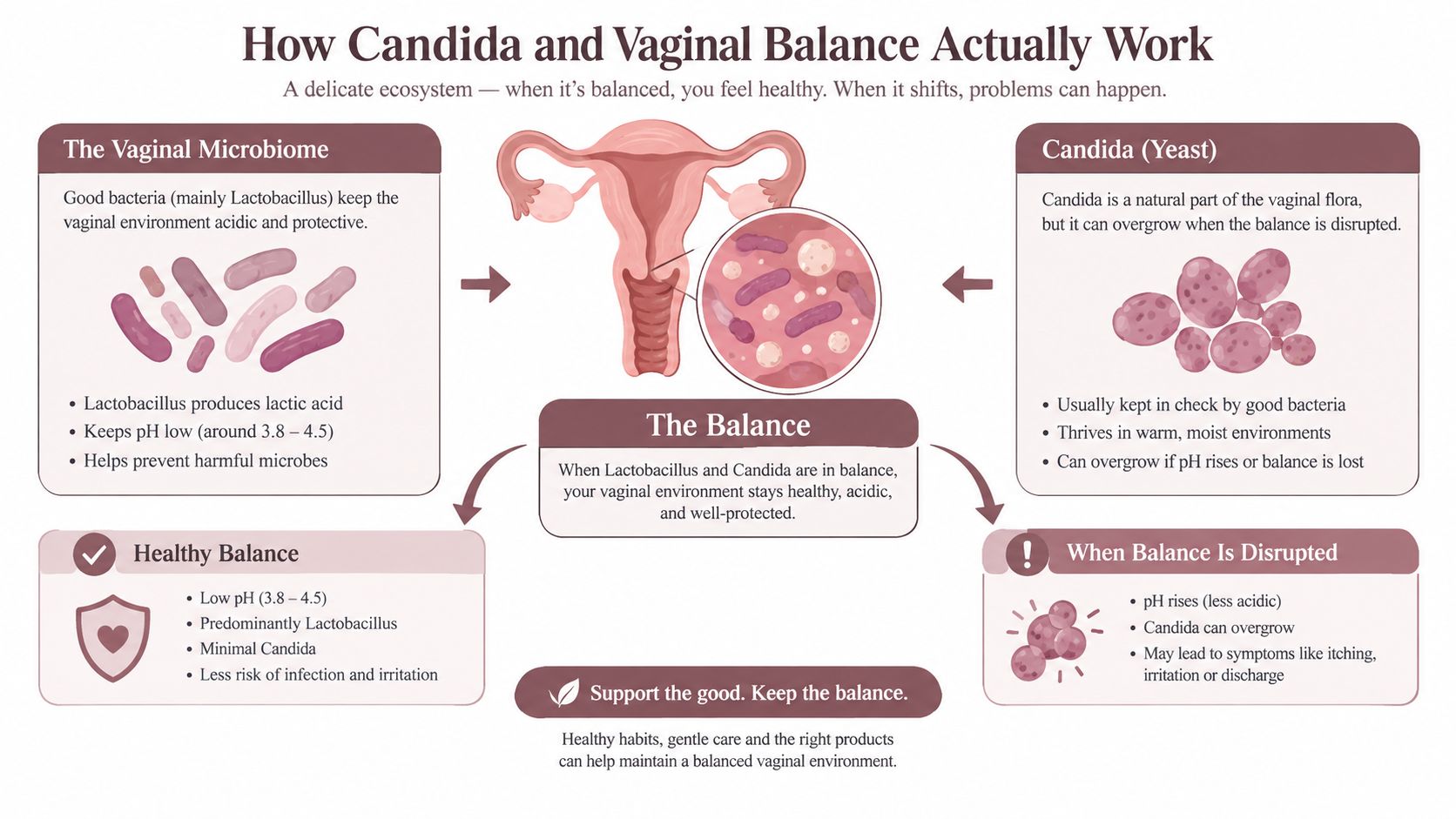
Candida isn't an invader that appears out of nowhere. It's a yeast that can live in the vaginal environment in small amounts, alongside bacteria that help keep the ecosystem steady. The protective bacteria, especially Lactobacillus, help maintain an acidic environment that makes overgrowth harder.
A useful way to picture it is a garden. Lactobacillus are the dense, healthy plants that crowd the soil and keep the space stable. Candida is more like a weed; it can exist in the background, but if the soil changes, the crowding thins out, or the environment shifts, it has room to spread.
What recurrence means at the microbial level
Recurrence can happen in more than one way. Sometimes the same Candida population never fully clears and regrows. Sometimes a new strain is introduced later. Sometimes the vaginal community looks “better” after treatment, but it doesn't fully reset, so the environment stays fragile and can tip again.
That's why the phrase “yeast infection” can oversimplify what's going on. Candida albicans is the most common species, but non-albicans species behave differently and don't always respond the same way to standard treatment. If the species is different, the symptoms, response, and best next step can be different too.
For a broader view of how the ecosystem supports balance, this guide to a healthy vaginal microbiome is a useful companion.
The key idea is simple. The vagina is an ecosystem, not a blank slate. Repeated symptoms often reflect a system that never fully returned to balance.
It Might Not Be Yeast Again
A lot of people search “why do I keep getting yeast infections” when the deeper question is, “why do the symptoms keep coming back after treatment?” That matters because recurrent itching, burning, and discharge don't always mean Candida.
Self-diagnosis is especially shaky here. One source reports that only 11% of women accurately identified a yeast infection, and even women who had been diagnosed before were correct only 35% of the time (HealthyWomen). That gap is big enough to explain why so many people keep using antifungals on symptoms that were never yeast in the first place.
Common look-alikes
- Yeast: often associated with thick, white, cottage-cheese-like discharge and intense itching.
- BV: more likely to cause thin, gray discharge with a fishy odor.
- Trichomoniasis: can produce frothy, yellow-green discharge and spotting.
- Contact dermatitis: often brings burning or itching after soaps, wipes, pads, lubricants, or other irritants.
A clinician-collected swab can help sort out the difference, especially when symptoms return quickly after treatment or never fully resolve. That matters because the wrong diagnosis creates a loop, the person treats yeast, the underlying issue remains, and the symptoms keep reappearing.
| Condition | Discharge | Odor | pH Range |
|---|---|---|---|
| Yeast | Thick, white, clumpy | Usually none or mild | Often normal |
| BV | Thin, gray, watery | Fishy | Higher than normal |
| Trichomoniasis | Frothy, yellow-green | Can be unpleasant | Higher than normal |
A separate clue can show up outside gynecology. If someone is also dealing with appetite loss, frailty, or urinary symptoms, a broader medical issue may be in play, which is why a primary-care resource like reduced eating and UTI in elderly can be useful when the pattern isn't cleanly vaginal.
Latex, lubrication, and irritation can muddy the picture too. If symptoms feel tied to products, friction, or timing rather than classic yeast patterns, a swab is more useful than another round of guessing.

The Triggers Behind Repeated Yeast Flares
Repeated flares usually come from more than one layer of vulnerability. Some drivers sit upstream in the body. Others come from exposures that disturb the vaginal environment. A third layer is the host itself, meaning the person's immune response, genetics, and local tissue behavior.
Upstream conditions
Diabetes and poor glucose control matter because higher glucose can support Candida growth. Pregnancy and other estrogenized states can also make the vaginal environment more favorable for overgrowth, and recent expert reviews continue to list diabetes, pregnancy, antibiotics, hormonal contraception, and postmenopausal estrogen loss as risk factors for recurrence (PMC review, Springer review).
That's why a flare that tracks with cycle changes, gestational changes, or blood sugar issues deserves more than symptom suppression. The body may be signaling a setting that keeps favoring Candida.
Exposures that disrupt balance
Repeated antibiotics can lower protective bacteria, which gives Candida more room. Douching does the same kind of damage by washing away the organisms that help keep the ecosystem steady. Moisture, friction, and occlusive clothing can also make the area less stable, especially if symptoms often show up after workouts or long stretches in damp clothes (PMC review).
Good habit, wrong outcome: a person can be clean, careful, and still keep getting symptoms if the vaginal environment keeps getting pushed off balance.
Host factors
Some people flare repeatedly while others in the same environment don't. That points to genetic susceptibility, immune variation, and microbiome disruption rather than hygiene alone (NCBI Bookshelf). Stress can also matter indirectly by affecting immune tone and sleep, which can make an already vulnerable system less resilient.
If symptoms keep returning after careful self-care, the more honest explanation is often biology, not failure.
Why Yeast Keeps Coming Back Despite Good Habits
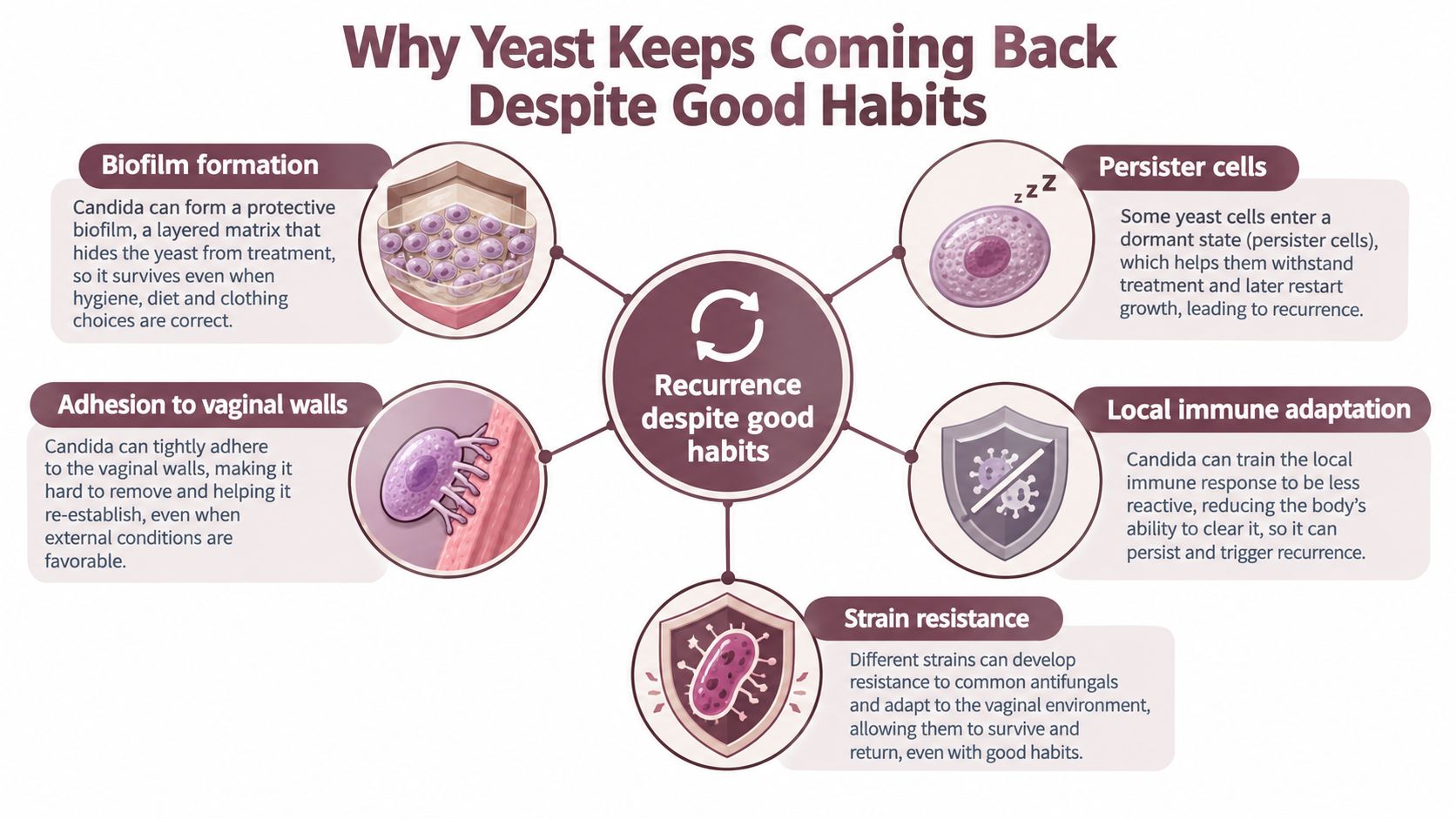
Good hygiene doesn't stop every flare, because some of the most stubborn drivers are invisible. Candida can form a biofilm, a self-made protective matrix that helps it cling to vaginal tissue and makes it harder for antifungals and immune cells to reach it. That means a person can do everything “right” and still not fully clear the organism.
Non-albicans species change the picture
Not all Candida behaves the same way. Candida glabrata and Candida krusei are important because they can respond poorly to fluconazole and may present with less classic symptoms. Their role in recurrence is one reason persistent symptoms shouldn't be assumed to be ordinary albicans yeast.
The same issue shows up with resistance. Short courses of over-the-counter azoles can temporarily reduce symptoms without fully eliminating the problem, especially if the species is resistant or the dosing wasn't enough for the organism involved. That's how the cycle gets harder to break over time.
Why symptom relief can be misleading
A person may feel better because inflammation settles, not because the vaginal ecosystem has fully recovered. The lactobacilli recovery gap matters here, since symptom resolution doesn't always mean the protective bacteria have re-established a stable environment. If the vaginal community is still fragile, another flare can start with relatively little provocation.
If symptoms keep returning after standard treatment, the next question isn't “What product did I miss?” It's “What biology is still active here?”
A growing share of recurrent cases may involve these less visible drivers, which is why a one-size-fits-all approach keeps falling short in real life.
How Clinicians Diagnose Recurrent Yeast Infections
Diagnosis starts with counting episodes carefully. Four or more symptomatic episodes in twelve months is a common threshold for recurrent disease, and that number matters because it changes the level of evaluation. A clinician usually wants to know not just how often symptoms happen, but whether each episode looked the same.
A typical visit starts with a history and pelvic exam, then moves into vaginal pH testing, saline and KOH wet mount microscopy, and, when recurrence is suspected, culture with species identification. Microscopy is useful, but it can miss non-albicans species and doesn't always explain why symptoms keep returning.
Tests that help sort the cause
| Test | What It Detects | Best Used When |
|---|---|---|
| Vaginal pH | Acidity changes | Symptoms may be from BV or trichomoniasis |
| Wet mount microscopy | Yeast forms, clue cells, motile organisms | Initial in-office evaluation |
| Vaginal culture | Candida growth | Symptoms recur or don't match classic yeast |
| Species identification | Albicans vs non-albicans Candida | Treatment keeps failing or resistance is suspected |
| Glucose testing | Diabetes or poor glycemic control | Recurrence is frequent or symptoms are stubborn |
| STI testing | Trichomoniasis and other mimics | Discharge, odor, or risk history suggests overlap |
A clinician may also review fasting glucose, HbA1c, medications, hormone exposure, and STI risk to look for drivers outside the vagina itself. A written episode log helps too, especially if it includes dates, cycle timing, products used, and whether the treatment truly worked.
For a practical treatment overview after diagnosis, how to treat recurrent yeast infections gives helpful context on the kinds of next steps clinicians use.
Breaking the Cycle With Prevention and Supportive Care
Prevention works best when it targets the upstream drivers first. If blood sugar is a factor, managing glucose is more important than rotating through more creams. If antibiotics or steroids keep showing up on the medication list, that needs to be reviewed with the prescriber instead of ignored.
Daily habits that actually change the environment
- Keep the area dry: change out of wet clothes quickly and choose breathable cotton underwear.
- Avoid irritants: skip douching, scented washes, sprays, and fragranced wipes.
- Use simple cleansing: plain water or a mild unscented cleanser is usually enough for the vulva.
- Watch medication timing: repeated antibiotics and corticosteroids can shift the balance, so ask whether alternatives exist.
- Track patterns: note cycle timing, sex, workouts, new products, and treatment response.
Adjuncts can make sense for confirmed recurrent vulvovaginal candidiasis, especially when clinicians are already involved. The evidence-aware probiotic strains most often discussed in this context include Lactobacillus rhamnosus GR-1 and L. reuteri RC-14, and boric acid may be used as a complementary option for certain recurrent or non-albicans cases under medical guidance.
Topical botanicals can fit as comfort support, not as a substitute for antifungal treatment when an active infection is present. A product like Complete Infection Defense Kit is positioned as internal and external support for BV, yeast infections, and pH imbalance, with a salve, tonic, probiotic, urinary support supplement, and suppository in one routine.
The important part is realism. Prevention can reduce frequency and make flares less disruptive, but it doesn't guarantee zero recurrences. If the pattern is biologic, the goal is to lower the odds and catch the trigger sooner.
When It's Time to See a Clinician and What Comes Next
Get evaluated if you've had four or more symptomatic episodes in a year, if symptoms don't clear after a full OTC antifungal course, or if the pattern keeps coming back fast after treatment. Fever, severe or rapidly worsening pain, foul-smelling discharge, post-coital bleeding, and first-time symptoms during pregnancy all deserve prompt medical attention.
At the visit, the clinician usually starts with a focused history, speculum exam, vaginal pH, and microscopy. If recurrence is suspected, culture and species identification help determine whether this is ordinary Candida albicans, a non-albicans species, or something overlapping with another vaginitis pattern.
Maintenance therapy can be appropriate for confirmed recurrent vulvovaginal candidiasis, and some cases use a step-down plan after the initial flare is controlled. Non-albicans species may need different approaches, including boric acid or topical nystatin, because the usual OTC path doesn't always match the biology.
The biggest shift is mental, not just medical. Recurrent symptoms are a pattern to investigate, not a verdict on your hygiene or discipline. Bring your notes, name the triggers you've noticed, and ask for species-level testing if the cycle hasn't broken.
Momotaro Apotheca makes plant-based vulvovaginal care products and routines for irritation, dryness, recurrent yeast discomfort, and urinary support. If you want to explore supportive care alongside clinician-guided treatment, visit Momotaro Apotheca and look through the educational resources and product routines that fit your symptoms and stage of care.


